Stillness and silence are not the same. In the still dark of the chapel, I could hear for the first time the gentle susurration of breath from the singers next to me in the stalls. Compline had been said—or rather, sung; our duty was discharged. The warmth of the graduate common room and the sweetness of mugs of hot chocolate and glasses of port awaited us, our weekly reward for singing the service. All we had to do was stand, file out from the stalls in any order we liked, and cross the court that divided the chapel from the common room. Yet, for a span of time I could not measure, then or now, we waited, dwelt in that still darkness, vividly aware of one another, just as we had been while singing.
We had made no explicit agreement to stay, to wait a while. After other services, in other weeks, at least one of us had left almost at once, the rest of us soon following behind. Was it something in the music that week that called us to wait, something of surpassing beauty calling for further attention? Was it simply the exquisite darkness of the chapel after all the candles were extinguished that brought us to stillness? Whatever it was seemed to lie beyond my capacity for thought and expression. All I experienced was a quiet awareness that seemed both empty and full—above all, still.
When, a few years later, I was asked by a friend whether I had ever had anything I could call a religious experience, I immediately said no—but then I paused and described this moment as a graduate student at St. John’s College, Cambridge. I added that I wasn’t sure.
My friend had asked because I was describing to him an absence in my life that I did not know how to name. I knew he was a practicing Christian, an Anglican who attended an Episcopal church in Chicago. I also knew he had written a master’s thesis on the nature of religious belief and that we could, for that reason, have a conversation that was at once abstract—we were both doctoral students in philosophy—and personal. I think he realized that the felt absence in my life was God and that God was working in my life all the same. But at the time, the only language I had for any of these experiences was music. Later I learned another language, but the first remains with me as a kind of mother tongue.
I didn’t have a clear sense of how many of my fellow singers in Cambridge were themselves believers, professing Christians. I had gotten my start with choral singing the previous academic year at Balliol College, Oxford, where joining the chapel choir was a widely recognized act of considered amateurism. One joined the choir in much the same way that one might join the college rowing team without any prior experience. It was, in an uncomplicated way, just the sort of thing one did when one “went up to” Oxford.
The chapel choir at Balliol was also my first sustained exposure to liturgical Christianity, and, as with so much else at Oxford, I found myself regularly engaged in a type of anthropological observation, albeit in a participatory mode. I noticed, on the rare occasion of a Communion service in the chapel, that very few of those in the choir, who typically outnumbered the congregation, went up to receive. But we all said all the prayers, including the Creed, by custom.
At Cambridge, in the Compline choir, we took turns serving as the cantor. I relished the role, which immersed me in the rhythmic beauty of the liturgy’s Elizabethan language and the austere power of the ancient chants. I always found myself moved when chanting these words: “Into thy hands, O Lord, I commend my spirit; for thou hast redeemed me, O God of Truth.”
At the same time, I wondered whether it was appropriate for someone without any professed religious beliefs, let alone a non-Christian, to say these words, to sing unto the Lord, the God of Truth. The chapel, we were told, was a space for all members of the college, regardless of their religious affiliation—but it was also a consecrated house of Christian worship. More generally, I found that secular and sacred were blurred together in Cambridge. I had been delighted to be named a Benefactors’ Scholar, but I was bemused to learn, when I arrived, that this status would be conferred in a formal ceremony in the chapel and came with the duty of saying the Latin grace at formal dinners in the hall for a week during the academic year. Still, despite the strangeness of these experiences, I never felt any pressure to say or do anything foreign to my own sensibilities and beliefs.
The truth I learned through these experiences is that the sacred and the secular are, in fact, always blurred together—or rather, intertwined. Certainly, if you believe that the world is God’s creation, that he has deemed it good and provided for its redemption and our salvation, then the polite boundaries we observe between houses of worship and the rest of our public lives will come to seem arbitrary. My experience has shown me that sacred music, in particular, tends to burst past these boundaries, not because of deliberate efforts at proselytism but by its very nature.
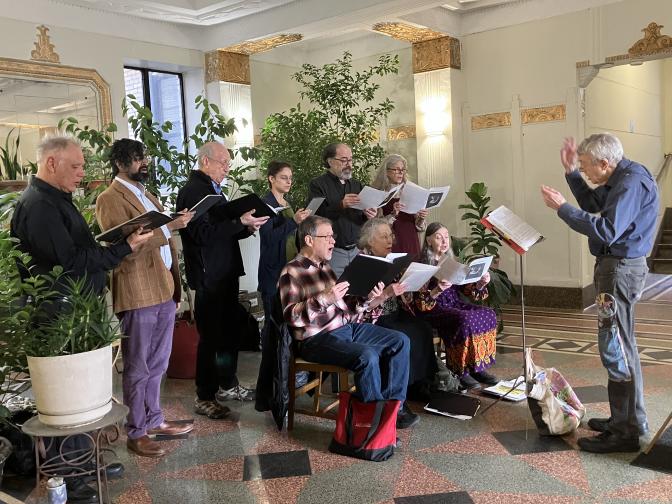
Twice a month, I witness this transgressive tendency of sacred music on the sidewalks and in the subway stations of New York City. I am a member of the Renaissance Street Singers, founded by John Hetland in 1973 and still directed by him. The group is not a religious one, but almost all of the music we sing—Renaissance polyphonic compositions of the fifteenth and sixteenth centuries—was written for use in Christian liturgies: anthems, motets, antiphons, and settings of the ordinary of the Mass. The texts—typically in Latin, though we occasionally sing music in English, German, Italian, and other vernacular languages, as well as in Hebrew—are usually Biblical or appointed for a specific liturgical purpose.
John chooses this music because he regards it as the composers’ best work. (An abundance of secular music—love songs, drinking songs, even music for the theater—also survives from this period, some of it written by the same composers.) We also simply like to sing it. Other groups of early-music enthusiasts might well choose a different repertoire—secular madrigals, say, or chansons. John makes sure to tell our audiences, those who pass by our street concerts and pause for long enough to hear him say something about the music, that we sing the music we love because we love to share it. The implication, of course, is that we are not a church group or in any other way representatives of institutional Christianity. A number of our members are Jewish, while others profess no particular faith. Our stated goal is simply to share the beauty of this music.
Even taken only on these terms, the music we sing is extraordinary, in the literal sense of being unfamiliar and out of place. Later music from the baroque, classical, and Romantic eras dominates the airwaves of classical-music radio stations and their streaming counterparts. Bach, Vivaldi, and Mozart are often played in public spaces to suggest an exclusive or elegant atmosphere—or simply for the sake of promoting calm, as at airports or dentists’ offices. But one seldom hears in public the music of Josquin des Prez or Giovanni Pierluigi da Palestrina or Thomas Tallis, who were each among the undisputed masters of their time.
What makes this Renaissance music so distinctive is its polyphonic (“many-voiced”) character: each voice has its own melodic line, which is interwoven with the others to create a dense and complex aural texture, a tapestry of voice. While this style left a mark on later work, most notably on the counterpoint of Bach, among its closest musical relatives is traditional Georgian music—that is, music from the Republic of Georgia in the Caucasus region. Georgian polyphonic music is mostly choral and includes both secular music and music appointed for the Georgian Orthodox liturgy.
Of course, one can still hear Renaissance polyphonic music in concert halls and even in a handful of churches, but hearing it on the streets layered above the din of city life is remarkable. I know this not only from the occasions when I’ve arrived late to our concerts and approached the assembled group first as an audience member, but also from my first encounter with John and the Street Singers, when I walked by a concert on College Walk in the heart of Columbia University’s main campus. That was in September 2018, in those startlingly distant days before the university’s gates were locked because of protests against the war in Gaza. Like most of our audience members, I didn’t stay long at the concert, but I did let myself be absorbed by the music for a few minutes, even though I was running late for an appointment. I was struck by the sheer boldness of the enterprise of singing this otherworldly, often-delicate music in a crowded public thoroughfare, but even more by the fact that the concert somehow managed to transform the space around it, out to the limit where the music could only dimly be heard. We were not in a church or a concert hall, yet we—the audience, the singers, John, others simply walking by with only a half-glance—seemed to be in a place set apart.
That is part of what it is for something to be sacred: to be set apart. But there is a further condition: sacred things are such that we are ordered to them and not they to us. That is why the fitting attitude toward such things is reverence or awe. It is a mark of secularization that fewer things are held to be worthy of reverence in the broader culture, but art is a stubborn exception. One can see public displays of largely untutored reverence in places as different as a sedate art gallery and a rowdy concert hall, evidence of the hold that beauty in its varied guises can have on us. Sacred music as a type of sacred art seems, therefore, to present a puzzle: Is its hold on us a product of its artistic merit or rather its sacred function?
To untie this knot, we must reject a natural assumption—namely, that sacred music is itself sacred in the primary sense. Rather, sacred music is an instrument with which we hallow—that is, make sacred—a given space and period of time in such a way that our attention may come to rest on what is sacred in the primary sense: the divine. Performing sacred music, of course, may also be an act of worship for the performers—and, in a diffuse way, for all others who are present and thereby share in the performers’ action of giving God his due.
My experiences in Cambridge and with the Street Singers have led me to realize that, whatever the professed beliefs of the performers and even outside a liturgical context, sacred music retains its essential capacity to hallow time and space and to redirect our attention to the transcendent and, ultimately, to the divine.
That is why we should be careful with statements such as the claim made by Pope Pius X in a 1903 motu proprio that sacred music should “be holy, and therefore avoid everything that is secular.” The claim is correct, but this avoidance must be understood in terms of what is ordered to what, not because sacred music must itself be kept cloistered from a world that would profane it. Admittedly, not everything with worldly origins can be absorbed into sacred art (though even the polyphonic music of the Renaissance was originally inspired partly by secular musical practices). That is why, for centuries, the Church has commended certain traditional forms as best suited for liturgical use. But sacred music need not be seen as an artistic treasure accessible only to the faithful.
I have emphasized attention over belief in my claim for the power of sacred music. Of course, there is a relation between attention and belief. Genuine belief depends on attention: for our beliefs to make contact with their objects and continue to do so over time, these objects must first be objects of our attention and awareness. We can find ourselves professing beliefs that are no longer genuinely ours when our awareness of the objects of those beliefs slips away.
Attention comes first in another way: it is primordial and prelinguistic. Sacred art and sacred music, in particular, are able to reorient our attention in ways that language and communication draw on but are not always able to reach on their own. Years of singing sacred music began to work a set of effects on me. Some of these were within reach of my reflective thought. For instance, I became curious about the liturgical practices and prayers that sacred music accompanied, as part of trying to understand the music itself better. But some of the effects were wholly unbidden and largely unnoticed. At times when I was not regularly part of a choral group, I found myself feeling restless. While I enjoyed singing in community groups of various kinds, it was in church choirs that I found particular solace.
And that, of course, meant going to church, where I witnessed the place of the music in the liturgy and experienced being part of the broader community to which a church choir belongs. I began attending Episcopal churches, since Anglican liturgies seemed the most familiar. I even started going to church when I wasn’t already part of a church choir, as when I first moved somewhere new or while traveling. At churches with volunteer choirs, a strong voice in the pews—especially a baritone or tenor voice like mine—tends to lead to recruitment. But before long, I realized I wasn’t there just for the music.
I tried explaining to people that, while I still considered myself a nonbeliever, it felt important to go to church. I tried pointing to various things churchgoing afforded beyond membership in the choir: a connection to a wider community—especially important for those like me who were prone to being trapped in a university bubble—an opportunity for service to others, time set apart for nonproductive activity. But in reality, I couldn’t fully explain it to myself. I felt closer to understanding why when I was singing with others.
The truth is that I had become quietly discontent with the pieties of the academic life I had been leading, where religious belief tends to be openly dismissed as superstition. Such a worldview was failing to make sense to me, even as I seemed to lack an alternative that felt worthy of commitment. It took some time for me to realize that I was already pursuing that alternative in the Christian communities I was a part of and that I was in fact already committed to it.
My particular hindrance, perhaps a consequence of my study of philosophy, was an excessively rationalistic conception of what belief meant in this context and what kind of commitment it presupposed. Philosophers going back to the ancient Greeks have been fond of using affirmations of bland factual claims—“it is raining” (the favorite example of twentieth-century analytic philosophers) or “it is daytime” (the ancient Stoic counterpart)—as their basic model of what beliefs are. But some of our beliefs concern matters that are not readily assessed purely in terms of facts and evidence.
Consider my belief that you are my friend. To some extent, this belief can be assessed in terms of what I know about your attitudes toward me, the history of our interactions, and so on. But part of this belief is also simply a matter of commitment: whether I am inclined to treat you as my friend. These dimensions of belief interact with one another. Our interactions will be influenced if I profess, openly to you or simply inwardly to myself, my view that you are my friend. Of course, no such profession is necessary for friendship, and any profession of friendship may simply be the recognition of something that had long ago become fact.
When I came to see that wholehearted actions can express our commitments as much as—or even more than—explicit avowals, I was able to see my own actions as expressing beliefs I was not ready to avow, out of fear of looking foolish or strange or claiming something that did not seem like it belonged to me. In time, the language that my life in the Church gave me for my own commitments eventually became language I could avow, and at that point I sought formal membership through the sacrament of baptism.
But another consequence of this reorientation of my thinking about belief was seeing that my awareness of (and belief in) God in Christ working in the world was present in an inchoate way from the start of my encounter with the sacred music of the Church. Choral singing, like corporate prayer, makes your voice part of a communal act. When I was chanting the Compline prayers on behalf of those present in the chapel at St John’s College, my voice was not wholly my own, but made an instrument of corporate worship. The form of the prescribed liturgy, and especially the community of worship in the chapel, carried the weight of this act for me, which I was not yet ready to bear on my own. But my wholeheartedness in chanting the prayers and in singing the polyphonic anthems and hymns with which we supplemented the service also made those acts of worship my own.
My transformative encounter with sacred music has helped me see the importance of the ancient traditions of the Church in making worship beautiful. For others, the architecture of a cathedral, the beauty of stained glass, or the significance of a religious poem may afford the same path of transformation. But just as public worship is central to the Christian vocation, even against the background of a pluralistic culture, so, too, is the celebration of sacred music as an offering and invitation to the world.
This offering, this invitation, need not take the form of explicit proselytism. People are naturally drawn to what is both beautiful and holy. In our specific cultural context, they are drawn to what is holy in part because it is beyond price, beyond the efforts of our market society to calculate value purely in terms of consumption, which the human spirit naturally resists.
Sacred music, whether classical or contemporary, cannot plausibly be cool or trendy. There are no surfaces here in which to dwell—one always encounters the very thing itself. There is no guarantee, of course, that sacred music is beautiful, but the surpassingly beautiful works that the Renaissance Street Singers perform seem to break past the barriers that the elite-coded world of classical music throws up elsewhere. When, for instance, we sing a work like William Byrd’s “Ne irascaris, Domine,” I have seen children, pets, people busily striding to their next appointment, and others lazily strolling on a sunny day all come to a halt in wonder. One does not need to know Latin to sense the earnestness of Byrd’s (and Isaiah’s) plea for the restoration of Jerusalem.
As I am often reminded, we live in a broken city, a desolation for too many of our fellow citizens, in a broken world. All of us, especially those of us who live the most comfortable lives, ought to ask God’s forgiveness every day for the evils we do and the evils done in our name. But in Byrd’s hands, Isaiah’s plea is not only urgent, a quiet and insistent prayer, but also a vessel of the hope we need in order to cooperate with God in bringing about his kingdom and his restoration. Each time we sing “Ne irascaris”—and other compositions like it—on the streets, a little of New York City is made beautiful, even sacred, by the joint attention of those who are present. From time to time, I think, we might also make the lives of one or two of those who listen different.