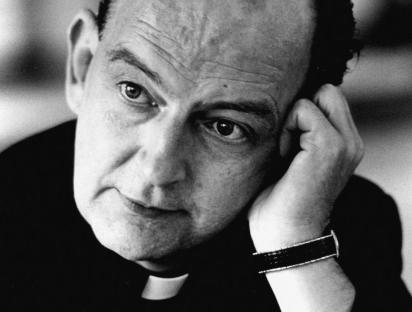
“Apologetics, Christian or other, is always a risky enterprise,” the late Stanley L. Jaki once wrote. “Once caught in apologetic zeal, one can, especially if one is a historian, easily overshoot the target.” It was a characteristically shrewd insight, and one that might be applied to certain aspects of Jaki’s own remarkable career.
Born in Hungary in 1924, Jaki left for the United States at a very young age—newly ordained as a priest of the Benedictine order—and began teaching undergraduate French at St. Vincent Seminary in Latrobe, Pennsylvania. An insatiable curiosity led him to continue his studies after earning a theology degree, and in 1954, he obtained a bachelor’s degree in physics. In his words, “I wanted to learn for a higher purpose. It was to understand, propagate, and defend my Roman Catholic religion, which on the intellectual level, is a set of propositions with enormously wide ramifications.” And learn he did. When he was twenty-nine, complications from a tonsillectomy deprived Jaki of his voice. While he could no longer teach, he put the time to good use, beginning graduate studies in physics at Fordham University with Victor Franz Hess, who won a Nobel Prize for codiscovering cosmic rays. Jaki distinguished himself with a close study of ground-based radon and thoron (potential cancer-causing radioactive gases that every new homebuyer has to test for). The paper, which earned him his PhD in 1957, continues to be cited by environmental scientists to this day.
Perhaps with some encouragement from Hess, a fellow Catholic, Jaki immersed himself in the study of history and science. He began preaching a truly novel kind of apologetics, according to which science as we know it was birthed by the very religion it often seems to challenge. Jaki’s first book, The Relevance of Physics (1966), examined the historical development of mechanics from the ancient Greeks to Einstein and the first generation of quantum physicists. The book was well received for its critical analysis of the often unstated philosophical presuppositions scientists made in their theories and experiments.
Jaki drew critical attention to numerous bold assertions from physicists about the inevitability of finding a Final Theory, a comprehensive account of the workings of the physical universe. “Cocksure optimism no longer seems to square with the facts of physics,” Jaki wrote in his concluding chapter. “On the contrary, the course of scientific history has brought out forcefully to what a surprising degree finality is absent in physical research. Physics in all of its main types—organismic, mechanistic, mathematical—has failed to find the definitive key to the complete intelligibility of the physical world.”
After taking a position as a professor at Seton Hall, a post he retained for the rest of his life, Jaki began a prolific career of carefully articulating the limits of science in dozens of books. Brain, Mind and Computers won the Lecomte du Noüy Prize in 1970. Science and Creation, a more ambitious work published in 1974, tackled the history of what Jaki called the many “stillbirths” of science in the ancient civilizations that preceded Christianity.
In Jaki’s view, science was stillborn in Egypt, Greece, and China because each of those civilizations assumed that time was cyclical and that the universe had no beginning or ending. Indeed, the very concept of “universe” as we understand it, Jaki claimed, would have been incomprehensible to the ancients. In such a climate, no mathematically robust system of mechanics could ever get off the ground, let alone sustain itself long enough for fruitful application.
In the mid-1970s, Jaki was invited to present the prestigious Gifford Lectures at the University of Edinburgh. Lord Gifford had instituted the public lectures in 1887 to encourage the discussion of science as it relates to natural theology. Past lecturers have included Hannah Arendt, Stephen Toulmin, Roger Scruton, Patricia Churchland, and one of Jaki’s intellectual heroes, the Thomist philosopher Étienne Gilson.
Science as it related to natural theology, Jaki worried, could be a tricky subject. “But I was most careful,” he wrote in his autobiography,
not to give the impression that science demonstrated the existence of God; in fact I deplored time and again the expectation that science could perform that service, let alone that holes in scientific knowledge were to be filled with a reference to God. It was possible, however, to claim, which I did emphatically, that a careful study of science could help expose the inanity of some “scientific” objections to natural theology.
Jaki’s lectures were later published in 1978 as the Road of Science and the Ways to God. From then on, he felt emboldened to vigorously promote his argument that science, as a self-sustaining activity, survived and succeeded in only one civilization, Christian Europe. Ancient civilizations had proven unable to formulate reliable laws of mechanics. It was only when certain Christian principles became foundational among the elite natural philosophers of the High Middle Ages, Jaki argued, that it became possible to think of motion in an entirely new way. “The novelty was rooted in the autonomy which only a truly transcendental Creator could impart to a created entity without diminishing the latter’s dependence on the former.” What Christianity provided, Jaki said, was something entirely lacking in other civilizations: a belief that there was an absolute beginning to the world, and an absolute beginning to physical processes.
The key, for Jaki, was Newton’s law of inertia. As Newton stated in his famous Principia, an object will remain at rest or travel in a uniform rectilinear motion unless acted on by another force. This formed the basis of modern mechanics, and in Jaki’s view, it could be traced directly back to the work of Jean Buridan, who formulated an “impetus” theory of motion while teaching at the University of Paris in the mid-fourteenth century.
Much of what Jaki learned about medieval science came from the pioneering detective work of French physicist Pierre Duhem, whose discovery and translation of fourteenth-century manuscripts from the University of Paris formed the basis of his comprehensive ten-volume Le système du monde. Jaki wrote an admiring but not uncritical biography of Duhem in 1987 in which he agreed with Duhem that the work of medieval philosophers such as Buridan and Nicolas Oresme had set the stage for Copernicus, Galileo, Descartes, and Newton.
Jaki went further than Duhem: he argued that Buridan’s purely theological objections to Aristotle’s theory of motion cleared the way for Newton’s laws of motion more than three centuries later. In Jaki’s view, Buridan’s genius was to cite theological doctrine, specifically the doctrine of creation, to argue that celestial bodies like the planets continued to move through the heavens with the original impetus imparted to them by God at the very beginning of time. And such an impetus would also hold for projectiles on earth, if they did not succumb to friction from the atmosphere. (Aristotle had taught that projectiles needed constant application of force from the air around them to keep momentum, a notion that philosophers already questioned centuries before Buridan.)
It’s a tantalizing idea, but is it true? Since Jaki was trained exclusively in physics, it’s not surprising that his conception of science was quite narrow; he saw it almost exclusively in terms of mechanics—the quantitative study of motion. On that basis, he believed he could draw a direct line of progress from the natural philosophers of the High Middle Ages to Isaac Newton, the leading figure of the Scientific Revolution.
With regard to the ancients, such a narrow definition of science leaves out the numerous technical and mathematical developments of the Babylonians, Egyptians, and most particularly the Greeks, who, as Jaki himself admitted, raised geometry to the standard of a science.
As for modern science’s medieval forebears, most scholars agree that Duhem overstated his case when he claimed Buridan as a forerunner of Galileo. In his book The Invention of Science, David Wootton writes that the medieval theory of impetus, as stated by Buridan, produced no transition away from Aristotle’s physics toward a more quantitative understanding of motion:
Aristotle continued to be the textbook, and although the theory of impetus was used to patch and mend problems within Aristotle’s theory, there were no separate treatises devoted to impetus theory. Impetus theory was used to handle some anomalies, not to bring about a revolution; indeed, medieval natural philosophers were incapable of imagining a revolution that would supplant Aristotle. Because they were not conducting normal science, they never finally resolved the problems that puzzled them.
Reviewing Jaki’s book The Savior of Science, the late David C. Lindberg of the University of Wisconsin–Madison bluntly concluded that Jaki’s analysis “does serious violence to the historical record that Jaki claims to revere. Jaki pays no attention to the ample evidence for Greek belief in the rationality of the universe. He neither defends the claim that impetus and inertia amount to the same thing nor informs his reader that almost no active historian of science accepts the identification.”
Such reactions were perhaps unavoidable given Jaki’s predilection for working in isolation. He did not correspond much with historians of science or attend conferences to share his ideas. And when he did engage with peers, he was often confrontational. (The late Harvard University astronomer and historian of science Owen Gingerich once told me, “Jaki’s over the top.”)
Preoccupied with physics, Jaki never properly appreciated the achievements of Darwin, whom he was content to attack on theological grounds. “Darwinism,” he quipped, “is among all major scientific theories the one that claims the most on the basis of relatively the least.” While quick to distance himself from both Biblical creationists and intelligent-design proponents, he often repeated their talking points against Darwinian theory without seriously studying the science behind it. (This was painfully evident in one of his last talks at a 2008 Vatican symposium on evolution.)
What was perhaps more surprising, given his eloquent appreciation of Einstein’s theory of relativity and its importance for modern cosmology, is that he never fully understood quantum mechanics. Like Einstein, Jaki believed that quantum physics was incomplete and would be surpassed by a more classical deterministic model of the subatomic world.
Still, Jaki’s work, however idiosyncratic and constricted by its apologetical purposes, has lasting value for Christians interested in debates about science and religion. The extensive notes and bibliographies he compiled still raise questions and themes worth exploring. (My own book on medieval technology was in no small part inspired by his essays.) In 1987, Jaki was awarded the Templeton Prize for documenting the debt that scientific progress owes to religious presuppositions.
Rereading his work now can be challenging. The tone is too often scolding, and over the course of his many essay collections, the repetition of the same themes, examples, and anecdotes can wear thin. Like one of his heroes, Gilson, Jaki could shrewdly assess the philosophical errors of scientists going back to Descartes. But having a flawed metaphysics (or no metaphysics) hardly prevented Darwin, Einstein, Hubble, or Dirac from making great scientific discoveries.
Politically, Jaki was refreshingly unconventional. His conservatism was almost entirely at the level of the individual. Like Pope John Paul II, he was no champion of the free market. He was out front in support of the science of global warming long before it was fashionable and eloquently deplored the unregulated exploitation of natural resources purely for profit.
In the end, Jaki wanted to defend the Catholic faith and to insist on its relevance to science. To the extent that Christianity makes a claim about the ultimate nature and destiny of humanity, this seems reasonable. But Jaki’s constricted, physics-based understanding of science ended up limiting his appreciation of science’s wide scope. The late Irish historian of science Fr. Ernan McMullin recognized this problem. In one of his essays, “Science and the Catholic Tradition,” he argued that natural science more broadly is a searching-out of the intelligible imprint that the Creator has impressed throughout his work:
It is true that some have held that science tells us nothing of real structure; it is to be regarded, they say, simply as a convenient way of cataloguing phenomena. This was Bellarmine’s contention against Galileo, and it echoed a distrust of the “mathematicians” which was common at that day among philosophers and theologians. It is the view of modern positivism, too—a view which, partly through the influence of Duhem, has tinged the whole of contemporary Catholic thinking on the nature of science. Though possessing a certain plausibility in the context of descriptive theories of motion, this view is utterly and demonstrably inadequate as an account of what science in general is doing. It makes the scientist either a collector of curiosities or a technologist.
To his credit, Jaki might have agreed with some of this. After all, he, too, recognized Duhem’s shortsightedness when it came to Aquinas and Einstein, both of whom, like Jaki, were committed to a healthy realism about the natural world. The world, they believed, was both orderly and intelligible. “The Lord God is subtle,” as Einstein famously wrote, “but not malicious.”