“No one steps into the same river twice.” This aphorism, from the ancient Greek philosopher Heraclitus, has been debated for millennia. For philosophers, it traces a path not taken in Western philosophy—one where change and flow, rather than essence and identity, are the fundamental nature of reality. Heraclitus is also quoted in lecture halls far from the philosophy department, in courses on hydrology and engineering, where his aphorism is treated not as metaphor but as a statement of fact. You actually can’t step into the same river twice because rivers are constantly changing systems. What’s more, even so minor an intervention as placing a foot in the current alters it. Eddies form, flows shift, silt and gravel tumble, and, just like that, we’ve changed a river in ways more complex than we can imagine. Hominids have been walking in rivers for millions of years. Homo sapiens’ impact has gone far beyond footfalls. The rivers we see today, even those we consider “wild,” are artifacts. Our cutting, plowing, and paving have speeded their flow, deepened their channels, and clouded them with sediment.
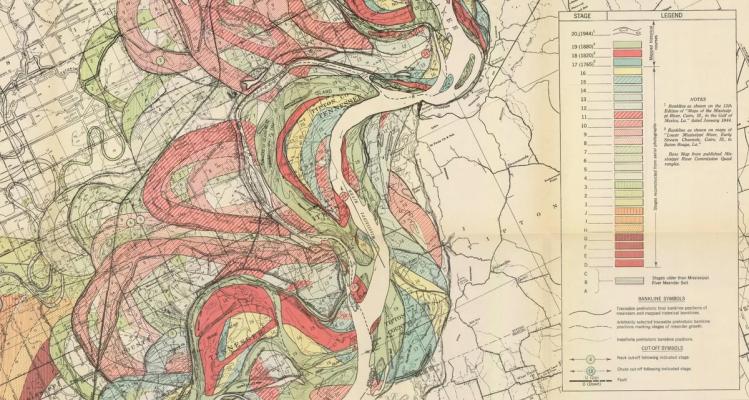
Look out the window during a flight over the Mississippi and you can glimpse the river’s dynamism. It snakes back and forth through the land like a sine wave. In a sense it is: one that vibrates on a millennial scale, sounding a bass note below our imagining. In the 1940s, the geologist Harold Fisk created a stunningly beautiful set of “meander maps” that plotted the deep time of the Mississippi’s movement. In the maps’ twenty-eight colored layers, Robert Macfarlane sees the Mississippi come to life “twisting like mating snakes, writhing with river ghosts…an itinerant, wandering being.” James C. Scott is likewise mesmerized by Fisk’s portrayal of movement in “river time,” which puts the lie to the simplistic “delineation of water from land” etched in our maps and our imagination. Fisk is a provocative example. He created these maps of motion for the Army Corps of Engineers, who undertake gargantuan labors to still the mighty movement of rivers.
Scott’s In Praise of Floods aims to “think with” rivers in order to consider both what they reveal about reality and the impact of our constrained imaginations on them. These form two sides of a coin. By describing the geophysical and ecological complexity of riverine “assemblages,” Scott illuminates the destructiveness of our simplifying, anthropocentric imagination. This imagination has remade the world’s rivers over the course of humankind’s accelerating stumble into the Anthropocene.
Scott, who died last year, was an anthropologist of Southeast Asian cultures who made major contributions to political science on the limits of state power—Seeing Like a State (1998), Against the Grain: A Deep History of the Earliest States (2017)—and the possibilities of resistance against it—The Art of Not Being Governed (2009), Two Cheers for Anarchism (2012). In what was generally accounted as backwardness—a lack of writing and settled agriculture—Scott found intentional, anarchist strategies of resistance as well as ancient insights into human flourishing.
In Praise of Floods began with Scott’s use of the Ayeyarwady River as a cover story for political research in Burma. The deception “became a preoccupation” and developed into an undergraduate course. The posthumously published book bears the marks of a course outline: sections on river science, the history of rivers’ domestication and exploitation, an ethnography of Burman river spirits, a chapter of parliamentary-style speeches from the nonhuman denizens of the Ayeyarwady, and a final chapter that situates the project within Scott’s concerns about state power.
Scott writes against the “line on the map” conception of rivers, which is focused on their main channels. To conceive of rivers in this way is like defining a tree by its trunk, ignoring its roots and leaves. Rivers are channels, yes—but they are also their floodplains, the valleys they have carved, and their entire watersheds. These vast assemblages begin not at some arbitrary headwater but with dew falling on soil anywhere in their watersheds. By gathering and transmitting water, nutrients, and sediments, rivers transform geologies and give birth to whole ecologies.
The “line on the map” does more than misunderstand rivers’ true extent. It provides the rationale for our projects to still their many motions. Key among these motions is the flood cycle: a physical and ecological action as fundamental to rivers as their linear flow. During floods, rivers expand by orders of magnitude: parts of the Amazon can be forty times wider and fifteen meters higher in the spring than in the fall. As rivers “exhale” into their floodplains, fish and other channel dwellers gain access to a broad landscape. Some fish species consume as much as 80 percent of their annual nutrition during floods. Many depend on the still, shallow floodwaters to reproduce. After fifty years of declining harvests, the great Mississippi flood of 1993 ushered in a record fish catch. The rich soils of river valleys, where agriculture and civilization began, were nursed in these annual inundations, yet humans account floods as “natural disasters.”
Scott was a theorist of the longue durée who studied political dynamisms dating back to the Neolithic Period. He brings this perspective to human interventions in river systems, describing a “thin Anthropocene” underway for ten millennia. The earliest of these interventions—such as grain farming in silt exposed after annual floods withdrew—were still engaged with the natural cycles of hunter-gatherer cultures. This echoes Laudato si’s discussion of early forms of technology “in tune with and respecting the possibilities offered by the things themselves…receiving what nature itself allowed, as if from its own hand.” Later, with small-scale weir construction and the fire-clearing of arable land, humans traded mobility for modification. Scott sees in such small-scale interventions, often characterized as Indigenous ecological practices, the beginning of our ongoing effort to engineer ecosystems to suit human needs.
China’s Yellow River illuminates the cumulative scale of these early interventions. Ancient deforestation for lumber, firewood, and agriculture increased the river’s velocity and sediment load of loess clay (the source of the river’s name). When the channel clogged with sediment, it would “leap” and cut a new channel, often through towns and cultivated fields. Its exit to the sea shifted north and south as far as five hundred miles. Imagine the Mississippi Delta shifting to Dallas or Tallahassee. The channel has shifted twenty-six times in the past 2,500 years, most of them before the river known as “China’s Sorrow” was (somewhat) stilled in the Ming Dynasty.
Modern science and technology accelerated into our current era, which Scott calls the “thick Anthropocene,” as “dynamite, earth-moving machinery and reinforced-concrete” enabled massive engineering of river channels. Upstream, wetlands were drained and fields tiled over in the final battles of a millennial “war to exterminate mud,” which enforced strict boundaries between water and land. All this combined to create the (supposedly) unmoving lines on our maps. Scott documents the almost complete commodification of the Ayeyarwady into a water source, fish stock, waste sink, and transportation route. In an “ultimate act of dismantling,” the riverbed itself has been mined for gravel and sand.
The book concludes with a return to the defining themes of Scott’s career: the narrow logic of accumulation and control that characterizes state systems. Human dependence on rivers and our shortsighted attempts to control them illuminate the trap of state forms of power: brittle systems building ever-higher dikes. Gesturing at a solution, Scott notes how some societies that were once committed to “hard-path” engineering, such as the Dutch and their nation-constituting system of dikes, have learned the need for “soft-path” solutions that better respect water’s dynamics.
Robert Macfarlane’s Is a River Alive? is a beautifully written riverine tangle. It includes encounters with three rivers and their ecological communities, grief- and wisdom-filled dialogues with human guides, and—flowing through the whole book—conceptual currents of nonhuman animacy and legal movements to recognize the “rights of nature.”
Macfarlane swims in the headwaters of the Río Los Cedros in Ecuador with justices from the Ecuadorian Constitutional Court who saved the river from a mining project that would have filled it with silt, cyanide, and mercury. Their landmark 2021 ruling recognized the right of the Río Los Cedros to “maintain its cycles, structure, functions and evolutionary processes.” Macfarlane’s companions on this expedition—among them the musician Cosmo Sheldrake—composed “Song of the Cedars” with the sounds of the forest. They have petitioned Ecuador’s copyright office to recognize the Los Cedros cloud forest as coauthor of the song.
In the intertwining estuaries of the Kosasthalaiyar, Cooum, and Adyar Rivers at Chennai in southeast India, Macfarlane finds rivers so polluted as to raise the negative question: “Can you murder a river?” Human disregard is starkly illustrated in a “fraud map” that avoids environmental regulation by simply deleting an inconvenient river from the official record. Suppressed and forgotten by humans, the rivers nonetheless “remember,” returning to and reclaiming their former “homes” during floods. Amid this loss, Macfarlane finds people who ally themselves with the various creatures who depend on the rivers. A “turtle patrol” spends nights rescuing egg broods of Olive Ridley sea turtles. One member, who becomes nocturnal himself during nesting season, reacts with puzzlement when asked why he does it. His reply is simple: “For life.”
Macfarlane is inspired by Robin Wall Kimmerer’s proposal for a “grammar of animacy.” Kimmerer draws from her ancestral, verb-centered Potawatomi language to recognize the aliveness not just of animals, plants, and fungi, but also of earth, water, and air. English reduces all of these to the objectifying pronoun it. Macfarlane observes: “In English, there is no verb ‘to river.’ But what could be more of a verb than a river?” He invokes the Middle English “gramarye”—a book of spells—to describe his own efforts to “re-enchant existence.” Macfarlane’s “Counter-Desecration Phrasebook,” Landmarks (2015), compiles a “word hoard” of vernacular terms for the natural world from the Anglo-Celtic isles. My favorite: “smeuse”—Sussex dialect for a “gap in the base of a hedge made by the regular passage of a small animal.” The word leaps off the page into memory and sight. In The Lost Words: A Spell Book (2017), Macfarlane collaborated with illustrator Jackie Morris to “conjure back” twenty-nine words concerning nature (e.g., “acorn,” “fern,” “newt”) that had been deleted from the 2007 Oxford Junior Dictionary to make room for terms such as “blog” and “broadband.”
Macfarlane finds a practical “grammar of animacy” in the movement to recognize the legal rights of nature. He charts its sources in both law journals and Indigenous cosmopolitics: Christopher Stone’s landmark 1972 paper “Should Trees have Standing?”; the Kichwa notion of Sumak kawsay, enshrined in the 2008 Ecuadoran Constitution; New Zealand’s 2017 legal recognition of Maori defense of the Whanganui River. The movement has spread around the world, expanding to embrace rivers, lakes, manoomin (wild rice), and Tsuladxw (salmon). “Geographies of natural rights are beginning to match up,” Macfarlane writes. “[P]ieces of jigsaws are being pushed together, their edges meeting, forming continuous areas of resistance to one-dimensional definitions of rivers.”
Escaping anthropocentrism is not easy, however:
As for speaking to or for a river, or comprehending what a river wants—well, where would you even start with that process? Surely all our attempts to bend the law round so that it recognizes the rights of rivers or forests will only end up with human proxies, jockeying for their own positions and speaking in incorrigibly human voices—ventriloquizing “river” and “forest” in a kind of cos-play animism.
But Macfarlane insists that to describe a river as “alive” is not to equate it with human life, but “to deepen and widen the category of ‘life.’” Yuvan Aves, his guide in Chennai, reflects: “[A] small ‘self’ suffers and causes suffering…a love of the living world lets single identities and selfhoods expand and encompass other beings, entities and whole landscapes, such that the self becomes a spacious thing.”
Macfarlane brings his substantial powers as a writer to this challenge: trying to find an appropriate “grammar of animacy” for each river and approximating its speech in human language. This results in some stunning passages, each of them worthy of sustained reflection. Taken together, they display the struggle of a person of letters to enter the flow of something fundamentally different. Literature is “littered with the debris” of attempts to articulate water. “Faced with a river, as with a god, apprehension splinters into apophasis; deixis is dismantled. The alien will not be articulated.”
Macfarlane faces this challenge most deeply in the book’s final encounter: with the Mutehekau Shipu River in Ekuanitshit—otherwise known as Quebec. The river is still largely wild, but it is threatened with the hydroelectric dams that have reduced other rivers in its watershed to “ghost sisters,” flooding their ecological communities and driving the Ekuanitshit Innu from their ancestral life-worlds. Innu activist and poet Rita Mestokosho advises Macfarlane to leave his notebook behind. “Rather than you speaking of the river, it is the river who will speak to you.” This section is much more personal, indeed visceral, than the rest of the book. Macfarlane recounts the Mutehekau Shipu’s physical effect on him as he is drawn into its current, buffeted and “broken down” by its rapids, “being thought by it” beyond the “delusion of perception…beyond the river’s flow.” He arrives at an insight that would please both Scott and Heraclitus: the current “doesn’t stop at the river’s banks, but overfloods them…. We are always launched upon the river, already afloat on the flow.”
Scott powerfully illuminates the short-sightedness of humankind’s brittle reengineering of riverine assemblages. Transformation, however, requires more than knowledge. Macfarlane contends with anthropocentrism by drawing us into the struggle to engage with and attend to these elemental, world-making beings.
Macfarlane’s wrestling with the otherness of rivers expresses what Rudolf Otto would call the mysterium fascinans: experiencing the other in terms of attraction and desire for union. But, in view of the deadly power of rivers, there is surprisingly little in this book of the mysterium tremendum, in which awe shades into fear and terror. One exception is Macfarlane’s discussion of Algernon Blackwood’s novella The Willows (1907), which evokes the animacy of the Danube in the register of horror. More recently, Laura Jean McKay’s novel The Animals in That Country (2020) features a plot in which human communication with different species is saturated with howls of pain and threats of vengeance. The words “death” and “kill” appear often in MacFarlane’s book, but it’s almost always rivers and ecological communities who are dying or being killed—even in the sections where Macfarlane’s own life is threatened by the Mutehekau Shipu. That may be the lesson of both books: in the face of the awesome and lifegiving power of rivers, we are the terror.
In Praise of Floods
The Untamed River and the Life It Brings
James C. Scott
Yale University Press
$28 | 248 pp.
Is a River Alive?
Robert Macfarlane
W. W. Norton & Company
$31.99 | 384 pp.