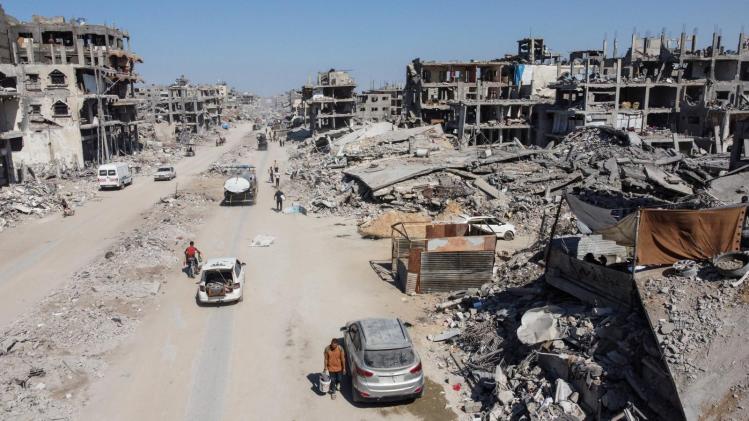
In his address to Israel’s parliament on October 13, Donald Trump declared the end of a long and difficult war in the Middle East. “Some people say three thousand years. Some people say five hundred. Whatever it is,” Trump said, “it’s the granddaddy of them all.” Having just announced an agreement between Israel and Hamas to end the war in Gaza—a war that has claimed the lives of more than sixty-seven thousand Palestinians and displaced approximately 90 percent of Gaza’s population—Trump could be forgiven for his usual hyperbole. If there was ever an occasion that warranted rhetorical overstatement, this might be it.
After two years of relentless bombing, mass starvation, and unspeakable destruction, Trump and his envoys—billionaire real-estate developer Steve Witkoff and the president’s son-in-law Jared Kushner—had finally persuaded Israel to stop its assault on Gaza and to allow the delivery of humanitarian aid. In exchange, Hamas had agreed to return the twenty living hostages still held by the group, all but one of whom was abducted during Hamas’s deadly October 7, 2023, attack on southern Israel. Heralding his twenty-point peace plan, Trump boasted, “today the skies are calm, the guns are silent, the sirens are still, and the sun rises on a Holy Land that is finally at peace.”
But his promise of a “historic dawn” for a new Middle East has already proved short-lived. Even before Israel launched a wave of airstrikes on Rafah on October 19, the Israel Defense Forces (IDF) was carrying out attacks throughout Gaza after the ceasefire took effect. According to officials there, the IDF has killed 97 Palestinians and injured 230 others in 80 violations of the agreement since October 10. Twenty-one of those violations occurred during Israel’s assault on Rafah, which killed forty Palestinians, following an explosion reportedly caused by an Israeli settler bulldozing over undetonated ordinance. (Two Israeli soldiers were killed in the ensuing skirmish, according to the Israeli military, which initially blamed Hamas for the explosion.)
Despite these repeated attacks, Israel insists the ceasefire remains officially in effect as of this writing, and Hamas continues to work with officials from Qatar, Egypt, and other mediating states to negotiate the second phase of the agreement. Still, recent events cast serious doubt on the viability of a deal many have been skeptical about since it was announced.
Conspicuously short on details, Trump’s plan for a postwar Gaza and new Middle East puts “economic integration” and security guarantees ahead of any moral obligations to the people of Gaza; it does not acknowledge, much less advance, their right to self-determination. Instead, Gaza will be managed by a transitional authority made up of international experts and “qualified” Palestinians—a “technocratic, apolitical” committee led by former British prime minister Tony Blair. He and Kushner have spent the better part of a year drawing up plans for the future of Gaza. Kushner was the architect of the 2020 Abraham Accords, which intentionally set aside the Israeli-Palestinian conflict, and the failed “Peace to Prosperity” plan from 2019, which Trump called “the deal of the century.” Most foreign-policy experts dismissed that plan, which touted foreign investment and trade agreements as magic solutions to the region’s most vexing problems. Writing for The Atlantic, Kori Schake described it as a display of the “basest instincts of mercantilist and illiberal politics.”
The current peace agreement features many of the same warmed-over ideas. Representatives from the governments of Egypt, Qatar, the United Arab Emirates, Saudi Arabia, and Turkey will determine who gets to serve on the transitional authority; they will also help establish a special economic zone with preferred tariff and access rates for participating countries. A so-called Board of Peace, chaired by Trump, will supervise the transitional authority. This means Gaza will effectively be run by the United States and other international actors during its redevelopment and reconstruction, which, according to the United Nations, could take up to twenty years and cost $70 billion. Palestinians themselves would have little input.
Diana Buttu, a former adviser to the Palestine Liberation Organization, told The New York Times that the peace agreement is simply papering over the harm caused by decades of occupation. “We’re just going to go back to the way it was before,” she said. And Maryland senator Chris Van Hollen, a member of the Senate Foreign Relations Committee, told the paper that, if the agreement has any chance of working, the administration (and Kushner, in particular) needs to stop approaching it as a real-estate deal and start focusing on human rights.
There are other grounds for concern—that is, apart from the IDF’s violations of the ceasefire. It’s unclear, for instance, if Hamas is really willing to abandon its role in governing Gaza—one of the conditions of the ceasefire agreement. Israel still occupies 58 percent of Gaza, and Israeli prime minister Benjamin Netanyahu has said the war will go on until Hamas disarms, a demand one senior Hamas official said was “out of the question.” Meanwhile, Hamas is clashing with rival factions and shipments of humanitarian aid into Gaza are still being delayed.
According to reports, officials from the Trump administration are increasingly concerned about Netanyahu’s commitment to the peace deal. To keep him on board, Trump has reportedly promised to let him “eradicate” Hamas if it continues its violent crackdown on its rivals. The new Middle East Trump promised just a few weeks ago is already beginning to look like one of his many failed business ventures, a heavily branded fiasco.