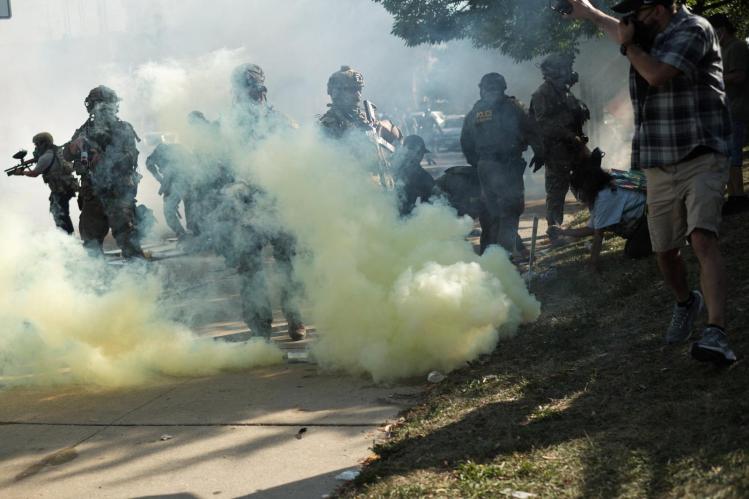
In and around Chicago, ICE has broken down doors, zip-tied and detained residents regardless of their legal status, and trashed their homes without warrants. Federal troops have tear-gassed and pepper-sprayed peaceful protesters, journalists, Chicago police officers, and even a pastor mid-prayer. Detainees include a local TV journalist who was tackled to the ground and thrown into a van, a Chicago alderwoman, and a fifteen-year-old U.S. citizen held for hours without being allowed to contact his family for the crime of throwing eggs at Customs and Border Protection (CBP) agents. And the violence has escalated beyond that: one schoolteacher in her car was shot at five times by ICE agents, and a father of two was killed after attempting to evade arrest at a traffic stop.
These incidents are the result of the Trump administration’s immigration crackdown, “Operation Midway Blitz.” In addition to ICE and CBP, the Department of Defense (now referred to by the administration as the “Department of War”) has federalized thousands of National Guard troops from multiple states. A district court judge in Illinois, April Perry, barred the National Guard deployment in part because she did not find the government’s justification “reliable.” “In addition to demonstrating a potential lack of candor” by the Department of Homeland Security, the request to federalize troops “also calls into question [the administration’s] ability to accurately assess the facts,” explained Perry. She noted discrepancies between the administration’s narratives and the evidence on the ground, including from local law enforcement.
It is unsurprising that the Trump administration’s descriptions of events would be unreliable: their claims are designed for the media, not for a courtroom. The goal is to create feelings first of panic and then of triumph among Trump’s rural and suburban supporters, many of whom may never even visit the liberal cities he’s painted as their enemies. When Trump shares what is purportedly a video of ICE action in Chicago in which the footage is actually from other states, he won’t be fact-checked in real time. Border Patrol initially described the schoolteacher they shot as part of a convoy of vehicles that had boxed in agents, claiming she attempted to run them over and brandished a semiautomatic weapon. By the time the complaint got to court, the weapons charge was conspicuously absent and the ICE vehicle the schoolteacher argues ran into her was driven to Maine, potentially for repairs. But people who get their information about such events from Truth Social or TikTok probably won’t see the court documents. Local judges are stepping in to try to hold ICE accountable, whether by mandating body cameras or forbidding warrantless arrests, but legal rulings alone may not be enough, especially when the highest court in the land seems determined to give Trump most of what he wants.
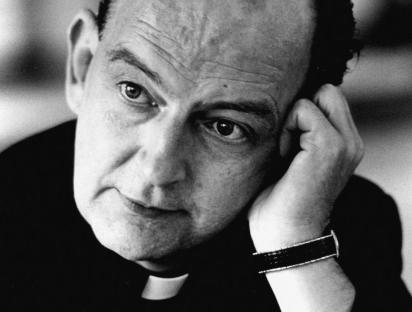
The administration treats migrants as nothing more than scapegoats and political props. But migrants are real people with inviolable dignity. The Church, which has always considered that dignity foundational, has an opportunity and a responsibility to speak on their behalf. It was heartening to hear Chicago archbishop Blase Cupich doing just that on October 21, when he said that the administration’s actions “wound the soul of our city.” He did not mince words: “Let me be clear. The Church stands with migrants.” To undocumented migrants in particular, he provided reassurance. “You have contributed to this nation. You have earned our respect. As the Archbishop of Chicago, I will insist that you be treated with dignity…. You are our brothers and sisters.”
Cardinal Cupich’s words also reflect sentiments expressed by Pope Leo XIV, who was born and raised in Chicago. In early October, the pope met with Latino Catholics and later with Bishop Mark J. Seitz of El Paso. At their meeting, Pope Leo affirmed that “the Church cannot be silent.”
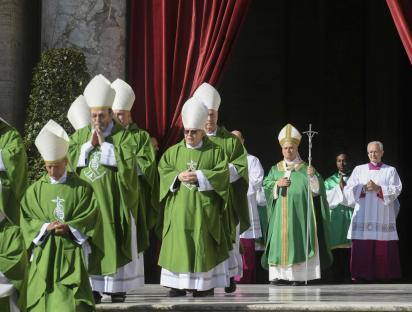
Unfortunately, the United States Conference of Catholic Bishops (USCCB) has been, if not silent, remarkably quiet. Pope Leo expressed his wish that “they were stronger in their own voice.” At their upcoming November Fall Plenary Assembly, the bishops will select a new USCCB president and vice president. The slate of ten nominees ranges from Bishop Robert Barron, a high-profile member of Trump’s Religious Liberty Commission, to Bishop Daniel E. Flores, a bishop in the Rio Grande Valley who has long advocated for migrants. A USCCB president who prioritizes the dignity of migrants at a moment when it is under attack as never before could provide the stronger voice called for by Pope Leo. Migration has rarely been mentioned in press releases and headlines on the USCCB website, despite its prominence in the writings and speeches of recent popes, and it has long been subordinated to issues like abortion in the USCCB’s election-year voting guides. But in light of the Trump administration’s determined effort to undermine migrants’ humanity and safety, that should change.
Trump supporters see stylized montages set to dramatic music, in which camo-clad ICE agents drag “criminals” outside for arrest. They hear descriptions of peaceful protests as riots, residential neighborhoods where tear gas is deployed as hotbeds of “migrant crime,” and citizens who question ICE tactics as insurrectionists. The Catholic Church, which speaks to millions of Americans across the political spectrum, can provide a counternarrative. Even its loudest outcry might not be enough to change policy or sway elections—but then again, it might. At the very least, it would demonstrate that the U.S. Church can still bear prophetic witness to the Gospel’s most basic demands.