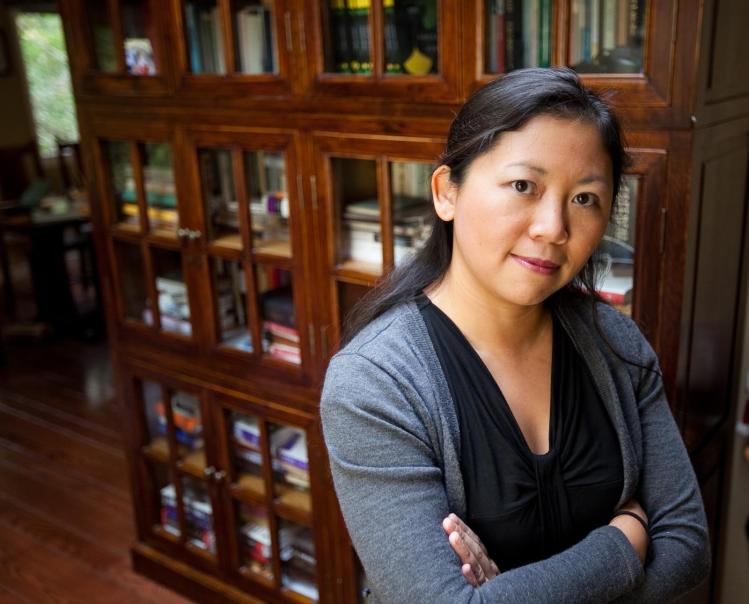
The novelist Yiyun Li has lost two children to suicide in recent years: her son Vincent at the age of sixteen in 2017 and her son James at the age of nineteen in 2024. To write such a sentence is to approach an abyss that, one might assume, neither thought nor language can reach. And yet Li has written two books in which she thinks the unthinkable and says the unsayable. Her recently published memoir Things in Nature Merely Grow (Farrar, Straus and Giroux, $26, 192 pp.) is, as she writes, “the book for James,” whereas her 2019 novel Where Reasons End was “the book for Vincent.” Each acknowledges the inability of language to tame loss even while demonstrating its ability to mark time. Marking time isn’t the same thing as simply passing it. Rather, it’s a way of inhabiting time, of abiding within it. After great loss, we still have the days and hours and minutes and seconds to live in. And so Li gardens and cooks and teaches and writes. “How does one live in an abyss,” she asks in her new book. “By marking time, how else does one live?”
It feels odd, even a category mistake, to call Things in Nature Merely Grow beautiful, though there’s beauty in many of the book’s sentences. It certainly isn’t a manual for “grieving,” a word that Li, committed to precision on aesthetic and ethical grounds, refuses to use. (“Clichés are not merely flabby words used to express unimaginative thoughts,” she writes, “rather, clichés corrode the mind.”) It isn’t an elegy for the brilliant, reserved, and ultimately unknowable James, though his delightful oddness comes through in detail after detail. He was the kind of young child who, when Li went to pick him up from kindergarten one day, was wearing a sign that said, “IM NOt TaLKING Becuase I DON’t WaNT TO!”; the kind of teenager who quietly spent most of his senior year in high school reading “five major works by Wittgenstein.” When Li discovered this, she tried reading the first chapter of Tractatus Logico-Philosophicus, finding it tough sledding: “Oh, he replied with a single word, which could mean, not surprising, or, how could you not understand Wittgenstein, or, I don’t know what I can do to help you, or, simply, read on.”
The list of the many things this book is not could be extended. It’s not a work of consolation. It doesn’t offer “a neat narrative arc,” moving “from suffering to transcendence.” It refuses the languages of therapy or religion. Indeed, we might describe the book as a work of secular apophaticism. It demonstrates how language fails to capture the nature of true sorrow. In doing so, it maps true sorrow’s contours. “And who among the writers I’ve loved has summoned up the abyss in the precise way that I’ve experienced it,” Li asks. “There is no shared abyss; we each dwell alone in our own.” Still, Li, with her disciplined negations, somehow gestures toward the truth.
One early chapter in Things in Nature Merely Grow begins with this detail: “The morning after James’s death, I wrote to my agent Sarah—‘I feel deeply stunned and wounded by life’—then reread it and deleted the adverb deeply, which was an extraneous word.” The refusal of inexactness here is remarkable. To worry over an unnecessary adverb in such a missive and at such a moment might seem a way of deflecting one’s attention from the matter at hand, an attempt to assert control when all is calamitously unmoored. But caring about language is really a way of caring for the world and those who are, or were, in it. Vincent loved language, delighting in its “poetic, musical, and sensual” capacities: “Adjectives and adverbs are my guilty pleasure!” he exclaimed after his mother edited some of them out of a piece of his sixth-grade writing. James loved language, too, taking pleasure in philosophy, reading Camus and Tolstoy. Li’s care with language in general, and her care with language about her sons in particular, is a way of continuing to care for Vincent and James. It’s also a way of approaching a pain that can never be approached directly. Considering herself and her husband, Li writes, “We are parents who can no longer parent. The noun form of the word is forever disconnected from its verb form.” She continues:
Verbs can die, too, when children die. Dead verbs are like bees and ants and butterflies enfolded by the amber of time: to parent, to mother…
The verb that does not die is “to be.” Vincent was and is and will always be Vincent. James was and is and will always be James. We were and are and will always be their parents. There is no now and then, now and later; only now and now and now and now.
That’s the sound of Li writing, staying within time even while she longs to escape from it.
“God, I hate the way there’s always something more to understand, even after you do.” This line, appearing in “Late Aubade,” the first poem from John Koethe’s latest and thirteenth collection, Cemeteries and Galaxies (Farrar, Straus and Giroux, $18, 80 pp.), sounds odd coming from a poet, odder still coming from a poet who’s also a philosopher. (Koethe is Distinguished Professor emeritus of philosophy at the University of Wisconsin–Milwaukee.) After all, isn’t poetry one of the means by which we come to understand things: the world, ourselves, ourselves-in-the-world? And isn’t the philosopher supposed to be a lover of wisdom? “Why can’t the world be simply there for you to see,” Koethe grumbles, “with no questions asked / And nothing else about it you can say?” Well, if the world were simply there for us to see, if we could face the world without asking questions of it or feeling compelled to speak about what we’ve seen, Koethe would be out of two jobs.
In this poem, and in much of Cemeteries and Galaxies, Koethe charmingly performs lateness, an intellectual and even stylistic exhaustion. As a poet, he feels as if he’s come late in the day, long after heroes like T. S. Eliot (“I realize / That I’m repeating myself,” he writes at one point, echoing Eliot’s “East Coker”) and shortly after other lodestars like John Ashbery. (In an earlier collection, Koethe describes the friendship that grew from the younger poet’s rather direct opening line: “Mr. Ashbery, I’m your biggest campus fan.”) Seventy-nine and emeritus, Koethe also knows that he’s late in life. Cemeteries and Galaxies is filled with memories: John Rawls pinch hitting for an absent faculty member at Koethe’s doctoral defense (“C’mon, Burt—it’s not for publication,” Rawls chided another professor who, Koethe remembers, “wanted to make me take out something / I’d said about Quine”); dinners with Jasper Johns and John Ashbery in the 1980s; drives through the Midwestern countryside. And it’s filled with ruminations: on movies, on the nature of privacy, on the impossibilities of naturalism (“If everything’s a part of nature, and if nature includes me too, / And if I’m the one who has to settle what to say, what’s even left / For me to think of as unreal?”), above all on thinking. Koethe realizes he’s working the same mental territory over and over again: “I know I keep on talking about the same ideas and people, e.g., Wittgenstein.” (Koethe has written a book on the Austrian philosopher; I bet Yiyun Li’s son James would find it worth reading.) And yet he continues reflecting, tired of his own mind until it interests him again until it tires him out once more.
Koethe’s poetic line is long and loose, digressive and self-qualifying, more prosey than lyric. And yet it does the thing that lyric does: gives us access not just to a sensibility but the rhythms and music of that sensibility. “The sense I have of life is of a long ‘and yet,’” he writes in one poem. “My favorite conjunction / Is ‘and yet,’” he asserts in another. A second favorite conjunction might be “although,” a third “even if.” To borrow from one of Koethe’s poem titles, all three suggest “Ambivalence as a Way of Being.” Sometimes, the language sags. Often, the ideas meander, loping this way and that. It can be hard to see what this is all pointing toward other than a rendering of the mind at work and at play, not so much worrying things over as entertaining one thought before moving on to the next.
“I say these things,” Koethe writes, “To entertain their opposites, as though those second thoughts might finally / Add up to something real I’ve made that doesn’t stand for anything.” In entertaining opposite thoughts, in moving through the world with emotional and intellectual ambivalence, Koethe entertains and moves the reader, though it’s a quiet and unshowy kind of entertainment. As long as we’re alive, the mind’s music continues. In Things in Nature Merely Grow, Yiyun Li writes, “In this strange life I can still think—think about things and then scrutinize those thoughts; think through things and then start all over, accepting that, short of one’s death, all finalities in life are provisional.” Thinking is, after all, another way of marking time.