On a cold, dark morning in the middle of March, at about 3 a.m., around a hundred people gathered in Santiago Xalitzintla, a tiny Indigenous pueblo in the state of Puebla. They were waiting to start the pilgrimage to Popocatépetl, an active volcano in central Mexico. This pilgrimage, like many others in Mexico, has its origin in pre-Hispanic times but now includes Catholic symbols and beliefs. “It is a link between [our] pre-Hispanic heritage, the colonial, and the Catholic,” said Jorge Arturo Tepo Coria, who has made the pilgrimage four times.
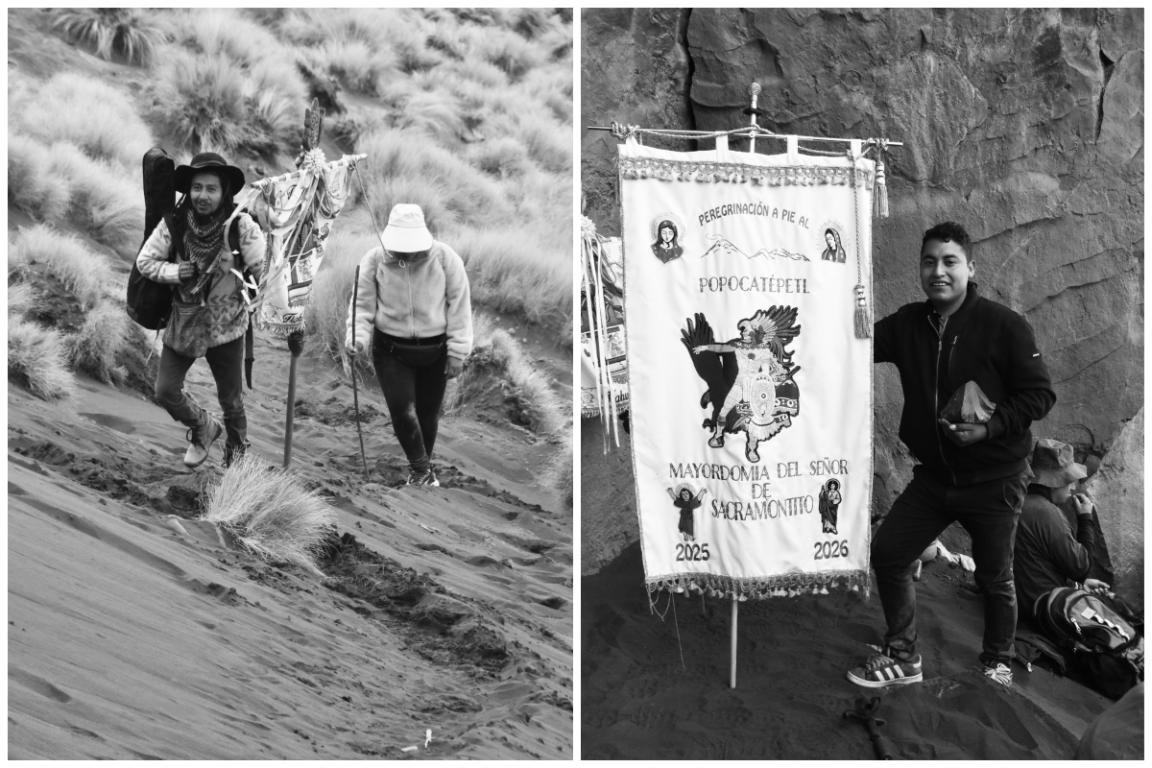
Above, left: One pilgrim carries a personal banner featuring the Nahuatl name Tlahuizcalli, “the glow of the dawn.” It’s derived from the Aztec god Tlāhuizcalpantecuhtli, translated as “Lord of the first star of dawn.” The god is linked to Quetzalcóatl, one of the most powerful Indigenous gods, and Venus, the morning star.
Above, right: This young man is the mayordomo, a lay religious leader who performs various functions to support the Church—in this case, organizing the pilgrimage and paying for the food. Mayordomos typically serve for a year, but in some pueblos, it may only be six months. People wait years to occupy the position, which garners respect but also requires a substantial commitment of time and money.
People from Xalitzintla and other Indigenous pueblos surrounding Popocatépetl make the pilgrimage on March 12 to celebrate the volcano’s birthday. They revere it as a god and make offerings on that day to ask for rain and good harvests. March 12 is also one of the feast days of San Gregorio Magno (St. Gregory the Great). After the Spanish arrived, the pilgrimage to Popocatépetl became a Catholic event to honor that day.
Just after 4 a.m.—after breakfasting on coffee, tamales, and sweet rolls—pilgrims climbed into the backs of dump trucks that would take them part of the way up the volcano. The hard-packed dirt road was full of rocks, making for a bone-jarring ride.
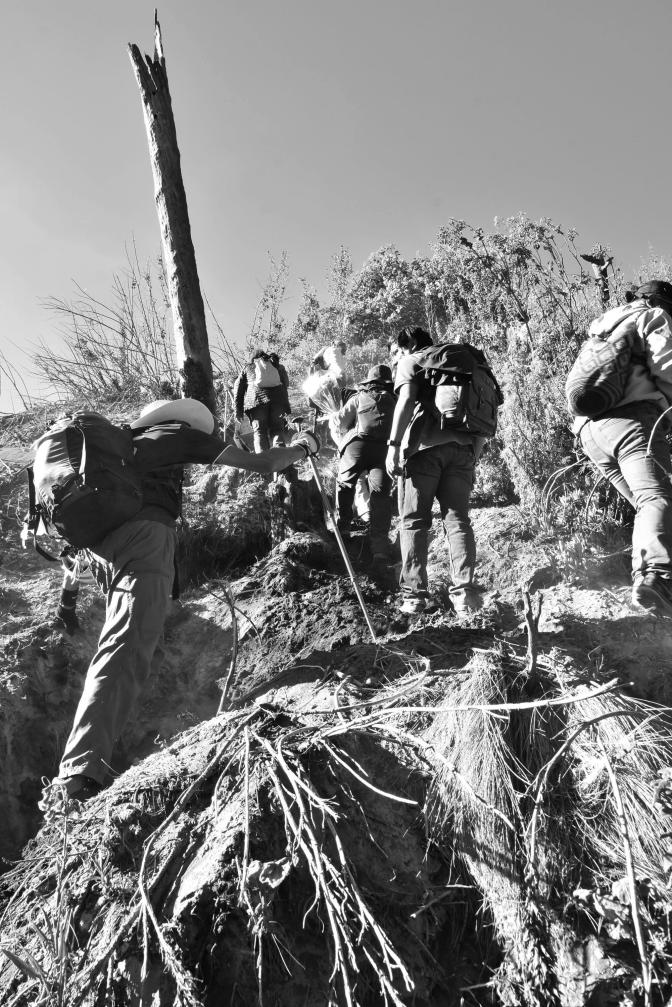
Right: During this particularly difficult stretch, the incline and the ash make it difficult to get any traction. People use hiking sticks, climb up on all fours, or grab onto whatever vegetation they can to help pull them up.
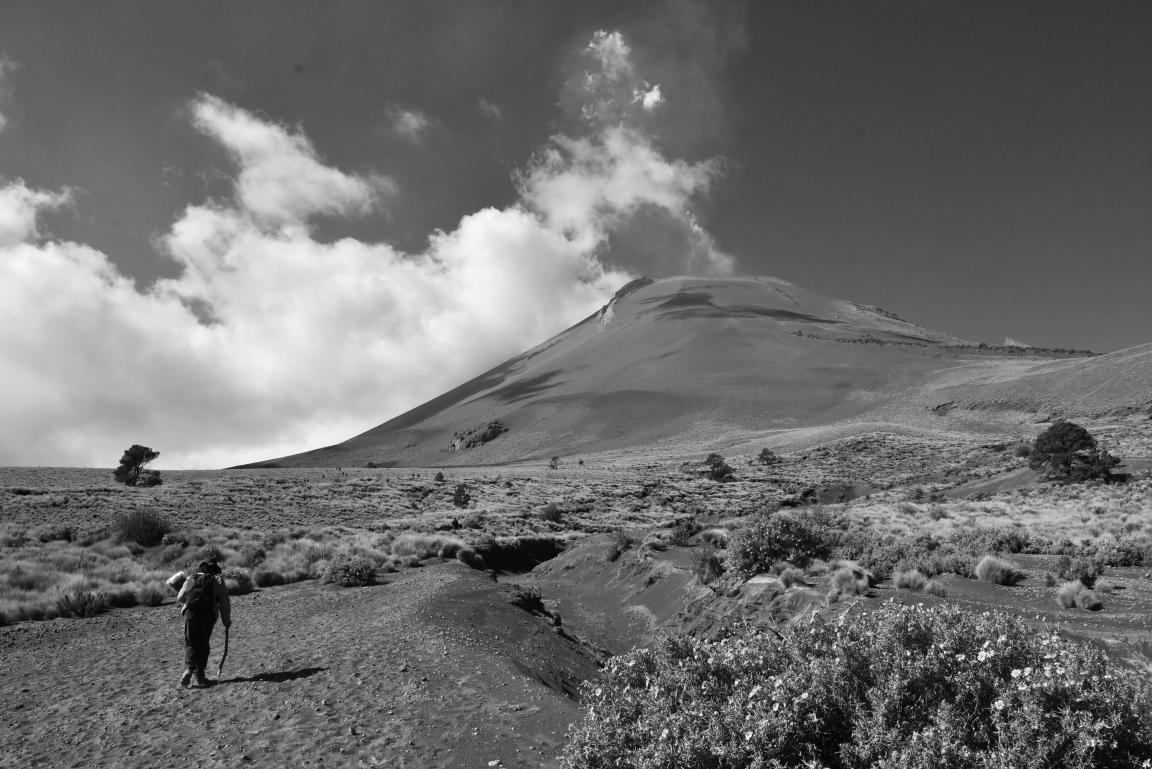
The first part of the hike is flat, followed by an often steep ascent. There were no guides, and for orientation, there was only the volcano itself looming in the distance. Although the pilgrims set out in a single large group, big gaps soon opened up between them, with some people walking alone and others in smaller groups of two or three. The weather soon warmed as the sun came out, and there were few trees to provide shade. The footing was treacherous; the ground was covered with slippery volcanic ash. A pilgrim named José David Quechol Deolarte told me, “When I was climbing and felt fatigued—that’s when I connected with the spiritual.”
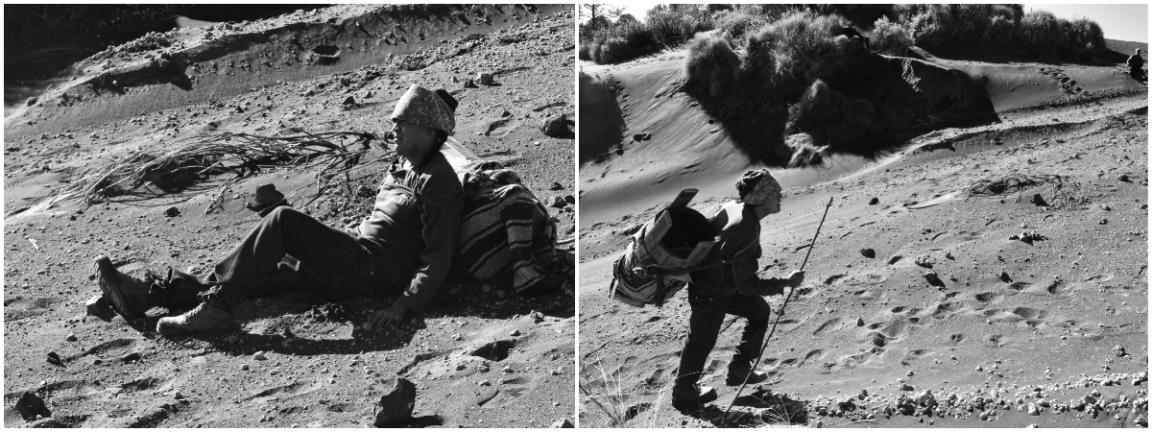
Above: One pilgrim, who carries the traditional drum for the ceremony at the ombligo, stops for a break as the hike takes its toll. On the right, as he begins to climb again, his footprints in the ash give an idea of the terrain he has crossed.
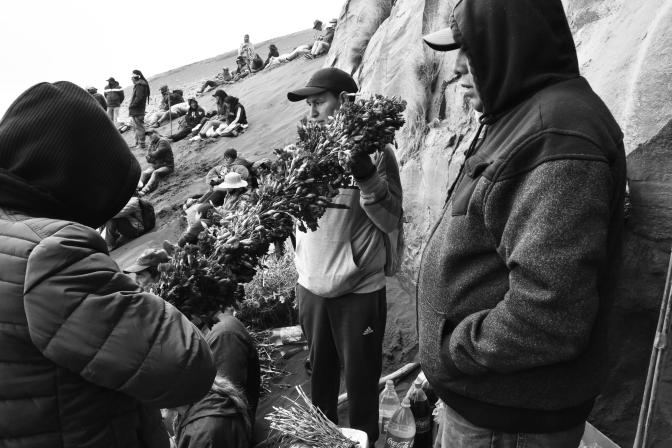
Right: These flowers will decorate crosses, a common practice in Indigenous ceremonies. They are part of the pilgrims’ offerings to honor the gods.
The pilgrimage ends in the ombligo (navel), a tall depression about two miles from the summit. Reaching the destination after a four-hour hike was emotional for Martha Cabrera Figueroa. “When I finally arrived, I wanted to cry, it was so beautiful,” she said. “I was physically tired but spiritually very well.” Crosses—which are both Catholic and Indigenous symbols—were decorated with flowers and purified with copal, a pungent incense. A conch was played, announcing the beginning of a ceremony. Catholic and Indigenous songs were sung, and offerings were placed on the ground. There seemed to be no conflict between the two very different religious traditions represented by the pilgrims. “To be Catholic in these [pueblos] is distinct,” said Quechol Deolarte. “It is different from what it is in…the capital of Mexico. Here, to be Catholic links us to our pre-Hispanic past. It is not pure Western Catholicism, rather it is one with Indigenous roots, one that encapsulates older knowledge and practices.”
Just a few hours after arriving at the ombligo, people began the long, slow trek back down the volcano.
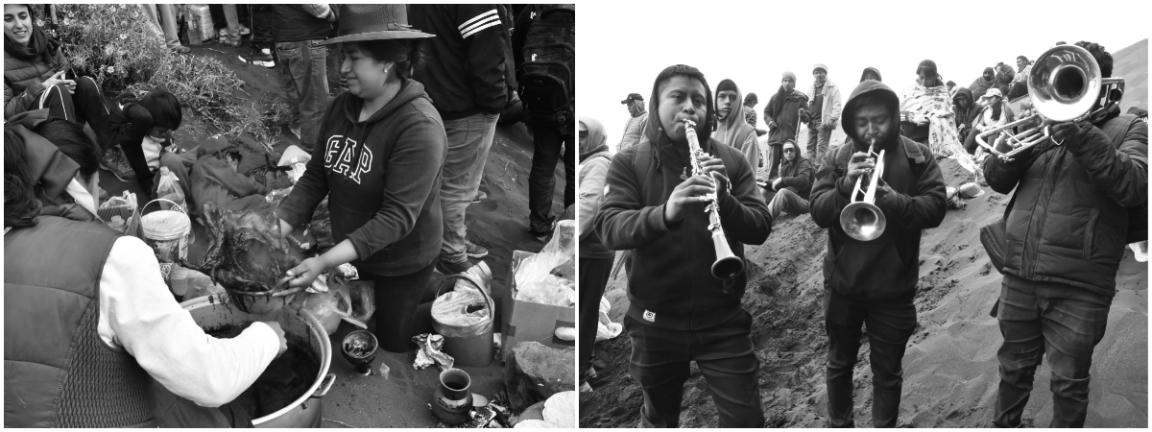
Above, left: Women (and it is all women) cook and serve the food on the pilgrimage, including meat and tortillas. But this turkey is an offering. Instead of being eaten, it will be placed at the base of the cross. Everything needed for the meals—large pots, food—is carried up to the volcano.
Above, right: Virtually all ceremonies and fiestas in Mexico feature music, usually from a live band. These young men hiked up the volcano with their instruments to play music known as banda. Unlike the music of many religious ceremonies in the United States, this music is neither classical nor solemn—instead, banda is loud, upbeat, and joyful.
Below: Three hours into the hike, people have split into very small groups or walk alone through the barren beauty of the volcano. Its bushes and grasses provide almost no shade. Popocatépetl smokes in the distance.