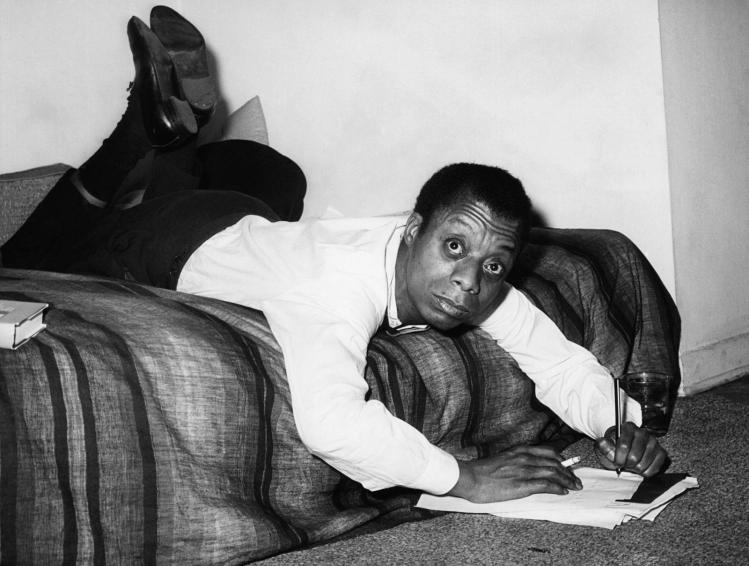
“Whose little boy are you?” That was the question a Pentecostal preacher asked the young James Baldwin as he was about to embark on his career as a child preacher. It was also, Baldwin recalled, the question “pimps and racketeers” asked him on the Harlem street corner, beckoning him into their world. As he would memorably write in The Fire Next Time, Baldwin felt like Elijah Muhammad was asking him “Whose little boy are you?” when the writer, now grown and distinguished, visited the Nation of Islam leader at his home.
Baldwin represents his life as structured around solicitations to kinship and love. For a boy whose own relationship with his domineering father was painfully strained—and who would discover that the man he thought was his father was actually his stepfather—the world was full of promising and threatening substitutes. Would a preacher or pimp offer him the love his father would not? Would God?
In unforgettable essays such as “Notes of a Native Son” and “Many Thousands Gone,” Baldwin explores the link between his quests for a personal and a political father figure. Can a white-dominated nation be the fatherland of Black Americans? What does it mean for politics to be animated by the quest for a loving fatherland, knowing that this quest is almost certain to end in disappointment for a nation’s “native sons”? These are not the sorts of political questions that are tied to a certain political party or project. They pull political practice toward subtle moral inquiry, which Baldwin modeled in his prose and sometimes in his life.
In a new biography, Nicholas Boggs takes James Baldwin’s life to be structured by the work of love. The search for love, and its complications, fuels Baldwin’s writing and engagement with the world, propelling him from Harlem poverty to international celebrity.
The standard account of Baldwin’s life is presented chronologically or geographically: He spends his childhood in Harlem, where, with the support of Black and white mentors and peers, he begins to cultivate his talent for writing. He moves to Greenwich Village, where he is immersed in the interracial avant-garde. Then he is off to Paris to write his first novel, Go Tell It on the Mountain, which will bring him recognition as a leading Black author. As he turns toward explorations of sexuality in his next two books, Giovanni’s Room and Another Country, Baldwin is drawn to the developing civil-rights movement in the U.S. South, where he finds in the young preacher Martin Luther King Jr. insights about the power of love that complement his own convictions. But Baldwin never feels at home in the United States, and he spends most of his mature years overseas, in Turkey and then in the south of France, where he continues commenting on U.S. politics and writing mostly forgotten novels.
Boggs, by contrast, divides Baldwin’s life into four parts, each related to a man Baldwin loved. First is a father figure: the painter Beauford Delaney. Baldwin met Delaney in Greenwich Village, and the older man introduced him to the richness of Black art, music, and theater. Delaney looked at and painted Baldwin in a way that made the awkward adolescent feel seen—and beautiful. Delaney also modeled Black queer life for Baldwin, although the two were never physically intimate. The Delaney section in Boggs’s biography ends in 1948 when Baldwin leaves for France with Delaney’s encouragement (they had applied for the same fellowship and hoped to travel together; only Baldwin was successful), but Delaney reappears in each chapter. He eventually moves to Paris, and by the end of his life, in a role reversal, Baldwin is caring for the older man.
Boggs’s book shows how love, for Baldwin, did not fit into stable categories. The love he sought from father figures in his youth was entangled with erotic love in his relationship with Delaney. In Baldwin’s relationship with the Swiss painter Lucien Happersberger, eight years Baldwin’s junior, he found erotic love, but again with deep complications. At Happersberger’s family cabin in the Swiss Alps, Baldwin was able to complete his first novel. Like each of the primary love interests in Baldwin’s life, Happersberger did not identify as homosexual. In the Alps, Happersberger impregnated a neighbor, and he named their son Luc-James. Baldwin served as godfather. Like Delaney, Happersberger was a continuing presence in Baldwin’s life even after their physical relationship ended. Baldwin brought him to New York, where he managed some of Baldwin’s financial affairs. He was at Baldwin’s bedside when the author died.
After his initial publishing success and the emergence of the U.S. civil-rights movement, the itinerant Baldwin moved between interviewing activists and expanding his creative work into the theater. He spent time with Elia Kazan, with whom he apprenticed, and Lee Strasberg at the Actors Studio. In Boggs’s telling, Baldwin’s love for the Turkish actor Engin Cezzar pulled Baldwin into theater and eventually took him to Turkey. Baldwin’s relationship with Cezzar remains essentially opaque. Shortly after Cezzar married, Baldwin went to live with the newlyweds, and the three all seem to have enjoyed each other’s company without jealousy for several years. At first, Baldwin understood Turkey as a place of retreat where he could write undisturbed; later, he would enter the Turkish theater scene, producing a play in Istanbul about gay prisoners that would receive critical acclaim and provoke public controversy.
One of the challenges of biography is that the most interesting parts of a subject’s life are often the least documented, occurring before they become well known. Fame can bring with it a certain tedium: receiving this or that award, another book contract, another house, another leeching friend. The biographer is tempted to write voluminously about these periods of a life because they are so well documented. Just when Boggs’s book seems to be heading in this direction, as we are about to move from Baldwin in Turkey to his final years in France, Boggs switches direction.
The final love of Baldwin’s life, Yoran Cazac, is largely unknown. He receives just a paragraph in Baldwin’s authorized biography, written by David Leeming. (One of the surprising minor revelations of Baldwin: A Love Story is how intimate and longstanding Leeming’s relationship with Baldwin was.) Boggs tracked down Cazac and his family, discovering previously unknown writings by Baldwin and, in the process, a new perspective on the author’s final years. The biography’s narrative embraces the first person; Boggs brings us with him as he travels to meet sources and leaf through documents. Cazac was a friend of Delaney’s with whom Baldwin reconnected when he moved back to France in the early 1970s. Boggs tracks Cazac-inspired characters turning up in Baldwin’s late fiction as well as Cazac-inspired love poems—and draws attention to the odd children’s book Baldwin and Cazac worked on together. Baldwin once proclaimed that Cazac made him “happier than I ever thought I could be, happier than I have ever been in my life.”
By the time he died, in a home of his own in the south of France, surrounded by his biological family and men he had loved, Baldwin was no longer vexed by the question, “Whose little boy are you?” He had not found paternal love, but he had redefined love, refusing the limits of biological kinship and marriage to assemble a chosen family who had supported his literary practice and moral inquiry over the decades.
The problem with this happy ending is that most critics consider Baldwin’s later writings inferior to his earlier ones. Might the angst around race and sexuality that Baldwin was working out through Go Tell It on the Mountain and Giovanni’s Room have elevated the novels’ literary qualities, while the later Baldwin, more comfortable in his own skin, produced slacker, less powerful prose? Boggs disagrees. He argues that critics underrate Baldwin’s later writing for ideological reasons, and suggests that Baldwin’s final novel, Just Above My Head, offers an elegant account of Black queer sexuality as a life-giving force, treating it in all its complexity.
Boggs positions himself as a champion of Baldwin. Whenever Baldwin’s behavior seems questionable, Boggs offers context to make it seem more reasonable. For example, though he had little theater experience, Baldwin wrested control of the production of Blues for Mister Charlie from the esteemed Actors Studio leadership, interfering with casting, staging, and direction. When the production lost money and was set to close, Baldwin became hysterical and marshaled his famous friends to pressure the theater to keep the play running. Boggs presents this episode as charitably as possible, making Baldwin’s behavior seem warranted by the political and existential import of the play.
One of the peculiar features of Baldwin’s life is that he was constantly surrounded by friends, whether in New York, France, or Turkey, and yet he constantly described himself as lonely. Each day, he was at restaurants and bars, eating, smoking, drinking, dancing, and telling stories. Yet, as Boggs tells the story, each of Baldwin’s great loves was ultimately disappointing, and he attempted suicide at least twice. Having reached the pinnacle of fame, he was still pigeonholed by expectations about race, sexuality, and politics. A 1973 interview with Baldwin conducted by Henry Louis Gates Jr. (whom Baldwin turned into a character in an unfinished play) was rejected by Time because, according to the editors, Baldwin no longer spoke to concerns of the moment.
The power of Baldwin’s writing is precisely this: his prose is untimely and out of place, driving from the particular to the universal, from the angst of social labels that don’t fit to the angst of being human. Love, for Baldwin, is not a question to be answered or a desire that can be sated. Love pulls us ever forward into the unknown.
All this talk about love’s mysteries sounds pleasant enough—Baldwin makes perfect Instagram quotes—but there is an elephant in the room. In addition to the four great loves of Baldwin’s life, Boggs mentions in passing the steady stream of teenagers whom Baldwin slept with at every stage of his life. When he gives their ages, Boggs decorously, and somewhat implausibly, says the teenagers were “eighteen or nineteen.” In the post-MeToo era, the reader can’t help wondering whether Baldwin reflected enough on the entanglement of love and power—and whether our own thoughts along these lines might call into question some of Baldwin’s insights about the power and contours of love. Even more troubling is what Boggs describes as the “quasi-fraternal” nature of Baldwin’s many love relationships with younger, married men. Indeed, Baldwin depicts two biological brothers making love in his 1968 novel Tell Me How Long the Train’s Been Gone. When people celebrate Baldwin as transgressive, they mean he didn’t respect conventional boundaries. But boundaries are not always bad, and some may be necessary.
Boggs refers to an interview that the photographer and documentarian Sedat Pakay conducted when Baldwin was in Turkey. Moving Muslim prayer beads between his fingers, with a glass of beer next to him, Baldwin reflected,
I know something about where I have been and what I’ve seen, what I know in my guts, in my blood, and what I will never be able to deny for any reason at all is a certain power that I had to deal with, which has dealt with me, which is called love.
But it is hard not to wonder: What does Baldwin mean here when he says “love”? How is it different from lust?
Baldwin came to fully embrace the language of love after he went to the South in 1957 to see Martin Luther King Jr. in action and at the pulpit. Baldwin channeled and translated King, making the imperative to love amid racial division the centerpiece of The Fire Next Time. (The Kennedy brothers reportedly began calling Baldwin “Martin Luther Queen.”) But for King, denying false loves was just as important as embracing genuine love. The world is awash in “little gods” that seek our affection, King warned. We must carefully distinguish God, who is beyond the world, who loves us and who is deserving of our love, from worldly idols. We must work on ourselves in order to be rightly oriented toward justice. Baldwin does not make such distinctions. For him, love is love.
And, to invoke another cliché, love is a drug. That is how Yoran Cazac’s wife put it: Baldwin and her husband were “kindred artistic spirits” who collaborated to birth a book, but ultimately “for Baldwin, Yoran was a drug.” Love fueled Baldwin’s creativity, but this wasn’t always the sort of love that orients us toward goodness and truth. Tragically, Baldwin’s most incisive and most beautiful writing, the writing that will be remembered, was fueled not by love but by lovelessness—by the racism and homophobia that infested the world of his youth.
Baldwin
A Love Story
Nicholas Boggs
Farrar, Straus and Giroux
$36 | 720 pp.