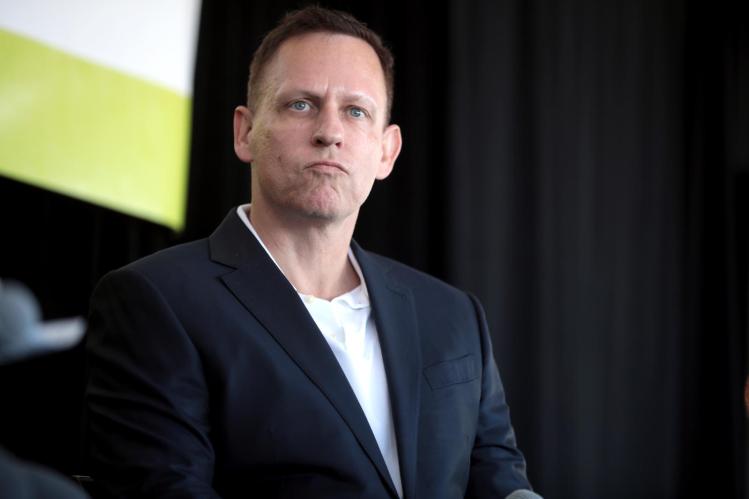
Seldom has a silence betrayed as much as the one that followed when Ross Douthat asked Peter Thiel if he’d like to see the human race persist. Thiel’s hesitation—during an interview on Douthat’s New York Times podcast—seemed the product not of genocidal psychopathy, but of a peculiar and particularly zealous faith in progress.
The pair were discussing Thiel’s sense—shared, at least in broad outline, by Douthat—that our society has reached a point of near stagnation to be understood primarily in technological terms. Frequently expressed in the short-hand “we were promised flying cars and we got 140 characters,” the idea is that our cultural and economic problems can be traced back to a slowdown in the rate of technological progress and stagnation on a range of projects from curing dementia to colonizing Mars.
But perhaps foremost among the “problems” that concern Thiel is one often held to give human life meaning—that is, death. At one point, Thiel bemoans the fact that so few Millennials dream of living forever. He doesn’t want to see the end of humanity per se, he eventually clarified. He just wants us to pursue the transcendence of the human form and its physical limitations.
Standing in the way, he believes, is—I kid you not—the “anti-Christ” of government regulation. Thiel is a bit of a throwback: he prefers to tie his free-market fundamentalism to Christian doctrine—albeit bizarrely suffused with sci-fi Gnosticism—instead of the trendier IQ-obsessed social Darwinism of his peers. (Even an otherwise pliant Douthat felt the need to quibble with Thiel’s incoherent theology; this also gave him the chance to indulge his penchant for accusing people of heresy.) Thiel ends the podcast in full paranoid-style self-parody, tracing the causes of stagnation back to Woodstock and Charles Manson—“the hippies took over”—and fretting over a future world government run by Greta Thunberg–types. Our last chance to escape stagnation through AI and other technological breakthroughs, he worries, may be thwarted by a globalist left in the name of safety.
Thiel belongs to a group of tech-industry paranoiacs—many of them featured on Douthat’s podcast—who have convinced themselves that world governments are persecuting them and holding society back from some Randian heaven on earth. But they largely owe their fortunes to a deregulating and privatizing regime that helped make the internet what it is: a bastion of concentrated power that surveils users, pollutes the public sphere with slop, and heedlessly extracts value from both individuals and vital sectors like journalism and the arts.
The tech industry’s recent move from the center left to the far right may seem part of a backlash against the establishment, and at a cultural level it may be. But on an economic level, as Quinn Slobodian’s recent book Hayek’s Bastards argues, the new right and its tech wing are not so much revolting against neoliberalism as escalating it toward a more naked and nativist version of free-market libertarianism. Having benefited from decades of favorable treatment, much of it from Democratic presidential administrations, the tech industry was spooked by long-overdue anti-monopoly efforts of the Biden administration and has now turned to Trump and MAGA for its next round of goodies.
In particular, it wants protection from AI regulation. While a proposed ten-year moratorium on state and local regulation of AI—driven by lobbying from Silicon Valley venture-capital firms like Andreeson Horowitz—was removed from the final version of Trump’s ugly spending bill, the administration is otherwise giving the AI industry everything it wants. Its recently released “AI Action Plan” is more of a capitulation plan, bought and paid for by the industry. It promises to exempt AI firms from environmental regulations, help them evade possible antitrust litigation from the Federal Trade Commission (FTC), and cut funding to states that the Office of Management and Budget deems to be regulating AI too onerously. In his speech introducing the plan, Trump also suggested that intellectual-property law shouldn’t apply to AI. “You just can’t do it because it’s not doable,” he said of holding AI companies financially responsible for the writing, reporting, and scholarship they’ve hoovered up to create their products.
The prevailing approach to AI represents not so much a technological breakthrough as the application of enormous computing power and data assets to already existing algorithms (this accounts for its extraordinary energy demands). The new large language models are expressions of the vast resources and power of a handful of firms, and of those firms’ ability to get governments to accommodate them.
It’s clear, moreover, that AI will likely recapitulate much of the Silicon Valley playbook. Using investment from venture capitalists and other sources to absorb heavy losses, startups offer their products at low or no cost until they’ve cemented their place in the market and driven out potential competitors. Only then do they begin to concern themselves with making a profit by using their position to extract value from users and clients who have nowhere else to turn. The hype and sense of inevitability fostered by the AI industry is not just marketing but a central part of the business model, which can succeed even when startups fail, as investors cash out or fledgling startups are rolled up into bigger firms.
By cementing partnerships, integrating AI into almost everything, and focusing on user growth and dependence, AI firms are not primarily trying to solve social problems but to insinuate themselves into the lives of individuals and businesses, no matter how many problems this may create in the long run. Far from impeding progress, sensible regulation, including the application of existing law, would help ensure new technology succeeds by creating real value for people, not by entrenching money and power behind it.
If Thiel is right about one thing, it’s that such regulation should not—at least not primarily—be concerned with “safety.” The focus on safety serves a narrative about the efficacy and inevitability of AI created by the industry itself. It plays into the idea that this technology must be controlled by the few, that it must not fall into the wrong hands, and that the United States must not lose its artificially inflated AI “arms race” with China. This framing places the rest of us in the position of spectators who, as in in the nuclear arms race, can only hope that those in charge don’t get us killed.
The truth, of course, is that there is nothing inevitable about the rise and implementation of AI. To the extent that its development—and the development of technology in general—is out of our control, it’s because it’s been taken out of our control. We’ve reached the point where can scarcely even imagine a polity where, as the physicist and technology critic Ursula Franklin wrote, there is “public debate and public input at the point of planning technological enterprises of national scope”—this despite the fact that we pay to build the infrastructure these enterprises depend on. The result is a “real world of technology,” according to Franklin, that is effectively “anti-people”: “People are seen as sources of problems while technology is seen as a source of solutions.”
AI, at least as investors like Thiel see it, is the apotheosis of this attitude. Contempt for human intelligence and agency is practically written into its code. Humanity must make way for technology so that the problems, including the human condition itself, can be solved (and so that confused and frightened billionaires can indulge in fantasies of immortality). It is high time that, as Franklin wrote, technology be considered a “source of problems and grievances” and people “a source of solutions,” capable of exerting control over “the house that technology has built and in which we all live.” Such control wouldn’t just keep us safe from rogue AI bots bent on world domination; it would give us the ability to determine democratically what role this new technology should play in our social, cultural, and economic lives.