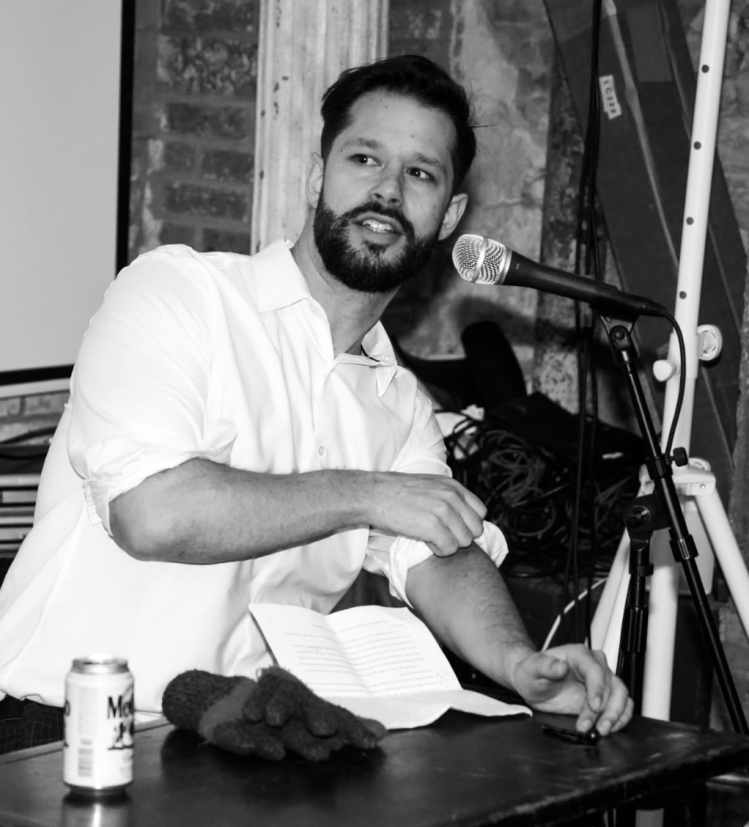
Midway through Stop All the Clocks, the cheeky and elusive debut novel from Noah Kumin, we encounter something unexpected in a sci-fi-inflected conspiracy thriller: a parable about poetic interpretation. At issue is a poem by W. H. Auden, the one that begins:
Stop all the clocks, cut off the telephone,
Prevent the dog from barking with a juicy bone,
Silence the pianos and with muffled drum
Bring out the coffin, let the mourners come.
The poem, we are told, “had originally appeared in a verse play, The Ascent of F6, and served as a mock eulogy for the play’s villain.” Since then, however, “the standards by which it could have been judged as a parody…had eroded.” Now, readers take it seriously—seriously enough that Auden’s lines played a central (and earnest) role in the funeral scene in the 1994 rom-com Four Weddings and a Funeral. And yet, though mistaken, such readers may have stumbled upon a deeper truth than that of which the poet was aware.
This anecdote—introduced through the internal monologue of Kumin’s protagonist—is a clever way of setting up a work that, like the play that Auden co-wrote with Christopher Isherwood, serves as a frame for materials capable of standing apart. Unlike the playwrights, however, Kumin seems to want his novel’s inset materials—its ideas and poems—to escape their container. These help advance an esoteric view of God and the nature of the universe as menaced by digital technologies that seem bound to conquer everything. Though the novel seems to share the widespread misgivings about the creep of technology, it seeks a more complex attitude than conventional anti-tech platitudes and contains hidden depths. The result makes for a provocative and ultimately enigmatic read.
At the center of the novel is Mona Veigh, a brilliant computer programmer who has retired, in her mid-twenties, to an internet-less, phoneless existence on New York City’s sleepy Roosevelt Island. There, she lives in the Octagon, a former insane asylum that—in what sounds like a novelist’s flight of fancy but is a fact—has been redeveloped into upscale sustainable apartments.
Mona’s isolation is both literal and figurative. She has just stepped down from the board of Hildegard, the poetry-writing AI she’d earlier sold for a princely sum to Avram Parr, a mysterious tech investor. Much like the poet John Milton who pursued six years of “studious retirement” after completing his studies at Cambridge, Mona now spends her time poring over critical editions of her treasured Elizabethan and Jacobean poets. In her youth she pursued this study with a muted, religious zeal that was equally alien to the tech world and the academy, both of which, the book suggests, prioritize utility. She is inspired, too, by the life of the medieval anchorite Hildegard von Bingen, who developed a private language, the Lingua Ignota, that confirmed Mona in her conviction that words are never a mere means of communicating.
But there’s a more pressing reason why Mona has decided to disconnect: Avram Parr has recently been found dead of a fentanyl overdose, an apparent suicide—despite the fact that he was pursuing tech-enabled eternal life. Yet when Mona is tracked down by some interviewers for the “culture vertical” Thought Nuggets, hosted on Parr’s Proserpina platform, and one lets it slip that her boss was killed, she feels drawn to investigate. By the novel’s end, there will have been enough cliffhangers, double-crosses, underground lairs, shady dealings, and experiments in biohacking to earn its billing as a thriller.
It goes without saying that there is a strong element of pastiche in these thriller elements, and one of the difficulties of Stop All the Clocks is knowing how seriously to take it. Part of the problem is that present developments in AI and biotech are already quite dystopian enough; has the genre not simply been usurped by reality? Yet whereas the mock tragedy of The Ascent of F6 was meant to undercut its inset poem, Kumin’s thriller-parody does want its poetic ideas to be taken seriously—or at least as seriously as poetry can be taken.
The originality of the work consists not in its satire or suspense, but in the personal search that drives the narrative. As Mona journeys down seeming blind alleys, she meets a series of odd-balls: a possibly duplicitous “Head of People” at Proserpina, Avram’s old company; an obese salt-of-the-earth NYPD detective; and an allegedly Cuban, ex-FBI practitioner of skullduggery. But solving the mystery of Avram’s death is only the ostensible subject of Mona’s quest; her real interest is in solving two metaphysical riddles, apparently distinct from each other, in whose convergence lies a central problem of our time. One is the power of poetry: its ability, apparently by mere incantation, to make Mona feel “there was a reality deeper than what was commonly called reality.” The other is that of computational linguistics—a science that purports to demystify language, the source of poetry’s power. Mona’s ambivalence is expressed in her creation of Hildegard 1.0: an app that purports to address both questions by composing passable imitations of the ineffable.
Mona’s exploration of that “intermingling” is fraught with both perplexity and perversity. She links her love of poetry to her pull toward the dark side of sex: “materialistic explanations…did not satisfy her: Mona desired these things precisely because there was something in them beyond what could be explained.” Yet just as she is torn between different modes of separation from ordinary life—holiness and abjection—she has conflicting intuitions about the relationship between technology and language, and, in turn, between language and world. Sometimes radically distinct, at other times these pairs seem bent on collapsing into each other, perhaps in the sense that one will conquer all the others.
Much of the novel’s thinking is taken up with various forms of rapprochement between tech, language, and world. If tech is rapidly expanding to absorb the world, then is it not merely replicating what language has already accomplished? For Avram Parr, the answer was yes. That’s why he was drawn to Mona’s invention: he wanted to develop a tool to shape public opinion so he can preserve a space for his private projects: founding a colony on Mars to advance the interests of a genetically modified elite. Mona, however, perceives a more elusive connection between word and world, one that is not instrumental, but mystical: “[A]ll the world is just one long poem,” she declares at one point, echoing a famous intuition of Percy Shelley’s. “We’re just the syllables spoken by a creature we don’t understand, in an alien tongue, and now and again the lines repeat.”
With the book’s emphasis on the ineffable, it is rather surprising to learn, in a later, more definitive rumination of Mona’s, that the hidden truth is not something of a categorically different essence from the mathematical, but rather itself subject to computation. The passage is worth quoting at length:
Years ago Mona had read the work of a historian who suggested that the transformations of ideas (and thus of life itself) across centuries might follow some yet unknown mathematical principle. The historian had thought he had found a clue in fractals, those long sequences of numbers that form beautiful, enigmatic spirals when plotted on a graph. No one had discovered fractals until computers were invented: to deduce their pattern required so many iterations that it would have been impossible to find the pattern by hand. But once the pattern was discovered, people noticed that fractals appeared everywhere in nature…
What is Kumin up to here? He seems to be driving at a dualism revealing an underlying monism. In this computational metaphysics, everything exists in two modes—the presence and absence of binary computing—and differs but in degree. Instead of a radical separation of planes, there is a difference in intensities:
It was not that our achievements in the realm of ones and zeroes would allow us to turn the world into heaven on earth. Rather it was that they helped us discern the heaven that had always been there, and the hell too, swirling above and below the median level existence of which we were conscious.
In a crisis moment earlier in the book, Mona was repulsed by the brute and so often ugly materiality of the world; but she has also been put off by the possibility of some kind of digital utopia. “[T]he idea of contentment itself sickened her”; she “knew that displeasure, even chaos, was necessary for what she held most dear in life.” This new vision, which is pointedly not “techno-optimist,” surprises us by proposing a reconciliation between computation and the world that neither occludes nor beautifies the latter, but restores it to us—and us to it—in its fullness of pleasure and pain. Even God is here with us, as a part of our own souls.
But this reconciliation can also sound more like resignation. Earlier, Mona has a vision of an interconnected Washington Square Park. Everyone—from skateboarders to students to drug dealers to chess-hustlers—is glued to their phones, oblivious to the summer’s day, to the point that Mona sees the people as the hosts of their devices. But she surprises herself by experiencing this sight without fear or loathing. In a book rife with residual yearning for the pretechnological world—“a world that had not yet been made exhaustively navigable”—there is something bracing in Mona’s discovery that computing and mystery may not be in tension, that they may even develop a kind of rapport. Still, there is something perplexing in the final twist in Mona’s attitude that comes after the denouement. Is the reader meant to be reassured, or troubled, to learn that Mona, no longer anxious, “no longer read[s] poetry”? Though prompted by a renewal of human sympathy, Mona’s new disposition suggests something of Winston Smith’s reconciliation to Big Brother in Orwell’s 1984.
Kumin, an erudite writer, who has declared his aim as that of “obliterating modernism,” has described his own ambition toward a “workmanlike prose.” That is true enough of his novel’s narrative sections, which can be more plausibly compared with William Gibson’s Neuromancer or the work of Philip K. Dick than, say, the high-concept math-and-science mysticism of Cormac McCarthy’s The Passenger and Stella Maris. Still, in the discursive or mediative passages, we catch a glimpse of a different, more flowing Kumin, the one who renders the character of Mona with sympathy and verve.
Kumin’s sense of language is rangy and unfussy; he loves its minor quirks and quiddities. Folksy locutions such as “plum certain,” “whole nother,” “oopsie daisy” stud his prose and only seemingly contrast with its more hieratic register. These linguistic choices are consistent with his belief that the god lies in the details, in the unnoticed corners and anomalies. And this same sense of linguistic play informs what is perhaps the novel’s most intriguing element: Hildegard 2.0 (note the second generation), the bot whose poems are interspersed, chorus-like, among its chapters.
Far from mere decoration, these are perhaps the motherlode the novel carries stashed in its hull. I’ll let Mona’s description of the first-gen software suffice: “For now Hildegard’s poems come off a bit as parody. But that’s no knock against them. We’ve got so far away…from the heart of what language can do, that we may need a little extra estrangement to bring us back around to the crux of things.”
Whatever else one might say of the vision of tech and the world put forward in the book, these poems do provide, in the tech world’s idiom, a certain “proof of concept.” Though Kumin has not disclosed their method of composition, they are allusive and jagged and jokey enough to allow any number of mysteries to slip through their cracks.