After beating Andrew Cuomo in a surprise blowout last month, Zohran Mamdani was predictably vilified by mainstream economists and pundits. The winner of New York City’s Democratic mayoral primary was maligned as a dangerous utopian harboring, in the words of Larry Summers, “Trotskyite economic policies.” The smears were predictable. A thirty-three-year-old democratic socialist assemblyman unknown until recently, Mamdani breathed new life into the Bernie Sanders coalition and its hopes of upending the economic status quo. It will perhaps come as a surprise, then, that among Mamdani’s plans to redistribute economic power in the city is one that wouldn’t sound out of place at the chamber of commerce: cutting red tape and facilitating market entry for would-be entrepreneurs.
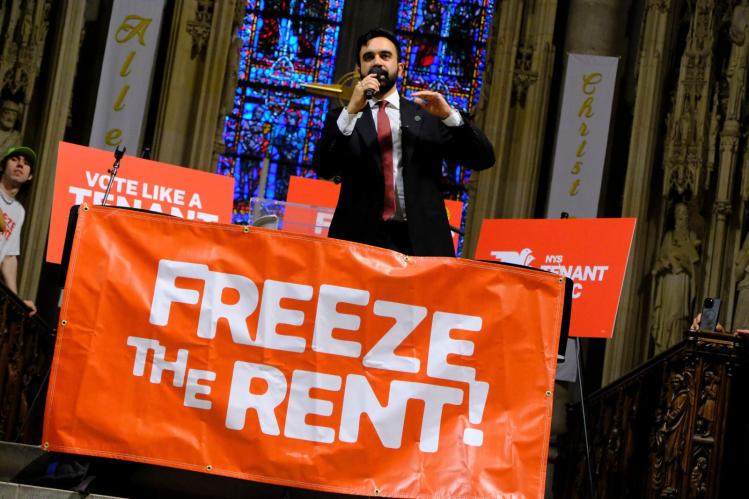
Of course, the more visible aspects of Mamdani’s economic agenda include explicit measures to ease the affordability crisis that has enveloped New York over the last decade. In brisk, memorable videos, Mamdani has cheerily expounded the proposals—free buses, universal daycare, rent freezes, and a plan for five city-owned grocery stores—that have aroused so much ire in the business press. But less attention has been paid to the way Mamdani built support through plans to help small businesses. Specifically, he promises to eliminate or reduce small-business fees, streamline compliance with city agencies, and expedite the process for opening new businesses and storefronts. A Mamdani administration would, according to his small business memo, establish a “Mom-and-Pop Czar” to cut down on bureaucratic limbo and scrap “regulations that do not impact health, safety, and workers’ rights.”
This, decidedly, is not a vision to liquidate the petit bourgeoisie. Though forthright in his opposition to billionaires, Mamdani’s overture to small business sounds as if it were lifted from the centrist-aligned “abundance” agenda. Offered by another, more mainstream candidate, his willingness to pare back regulations would be described as “pro-growth” common sense.
Mamdani’s critics accuse him of being hostile to markets and enterprise, but he is really targeting rent-seeking and predation. These market advantages and privileges accrued through concentration surreptitiously bleed regular New Yorkers of their income and place smaller shops—at their best, a source of local character and community wealth—in the dismal position of raising prices and cutting wages so customers and employees share the burden of rising costs. Mamdani is not, as the business press has it, a rabble-rouser creating animosity toward private businesses in every form. Instead, he regularly speaks about the anticompetitive dynamics that are so often responsible for the economic insecurity afflicting the city’s majority.
Here, the influence of “neo-Brandeisian” thought is strong. To be sure, Mamdani believes in the merit of public goods and wants to secure people against the vagaries of the market. But he also wants a city economy where goods and services flow with fewer middlemen and where government, rather than collecting tolls from smaller fish, polices the big players who disproportionately shape how and how much revenue circulates throughout working-class districts. These stances reflect a willingness on Mamdani’s part to make the public interest the centerpiece of social justice. His politics are a reminder that, at root, municipal socialism isn’t just about more public services and public utilities but also eliminating the rent-seeking that has historically corrupted American cities. Mamdani has recognized that speaking knowledgeably about small-business costs means speaking to the financial stress that permeates entire neighborhoods. He communicated that most local businesses do an honest trade, but when they suffer setbacks, their customers do, too.
As the anti-Mamdani front scrambles to cohere, there will be much dissembling about these points. Indeed, Mamdani’s keen sense of how economic power radiates—rooted, it seems, in a distinctly American antimonopoly tradition—is something his foes desperately want to obscure. Mamdani may well be too sanguine about his prospects to remake city government and restore working-class economic security. But an infantile anticapitalist he is not. Whether he continues to make economic liberty central to his concept of democratic socialism will say much about the American left’s ambition and discipline in the second Trump era.
Easing the burdens on small business might seem ancillary to Mamdani’s vision to make New York affordable again, but those burdens are a central reason everything is so expensive. In a dense city dominated by big finance, small businesses’ rising costs are a major conduit of economic pressures on ordinary consumers: expensive commercial leases, unfavorable lending rates, spiking utility costs, credit-card swipe fees, supply-chain disruptions, anticompetitive wholesale pricing, blanket tariffs, and the municipal fees, fines, and bottlenecks Mamdani has promised to alleviate. Especially for shops operating on tight margins, sharp increases in any one of these pressures can quickly undermine existing business models. To stay afloat, they must pass on the resulting costs—discreetly or not—to regular working people. It takes very little to compel higher markups, reduced services, diminished product quality and choice, slashed as, and so forth. Of course, these pressures often prove too taxing, forcing even well-run, popular businesses to close, thereby sapping away neighborhoods’ lifeblood.
The financial hazards of running a small business have mounted nation-wide in recent decades. Early-stage failure rates have increased, while “the number of businesses launched each year has shrunk by almost two-thirds since 1983,” according to a 2020 article by the Institute for Local Self-Reliance. Even in New York’s lower-rent districts, the baked-in overhead for city businesses has become staggering. A 2019 report by the office of the New York City comptroller, Mamdani’s ally Brad Lander, states that “retail rents rose by 22 percent on average citywide between 2007 and 2017.” Despite a much-ballyhooed post-pandemic boom—this March, the mayor’s office touted a record high of 183,000 small businesses in operation—the barriers to entry remain steep.
These costs subject many would-be entrepreneurs to disheartening tradeoffs. For businesses such as independent cafés, small grocers, hardware stores, artisans, and batch manufacturers, the elevated costs of doing business often mean any goals outside of ruthless efficiency fall by the wayside. It’s hard to provide services to people of limited means or to offer employees a living wage with benefits. New businesses aspiring to provide a community good find their idealistic intentions frustrated.
Bodegas and food-cart vendors—whom Mamdani highlighted in campaign videos—face similarly tough choices. Both are at the mercy of price discrimination and supply-chain chokepoints for in-demand staples, meaning they have to pay more than big retailers. Though bodegas often engender fierce loyalty, they must either jeopardize their typically narrow profit margins by matching the deals larger competitors can offer or give customers something less tangible (camaraderie, neighborly favors) to keep them coming. These pressures exist in both the city’s less privileged areas—like its two dozen food deserts—and its more gentrified locales.
Of course, there is no guarantee small businesses will respond to more breathing room from city government by suspending price hikes or introducing more deals. And it is extremely unlikely that prices for goods like premium coffee, sandwiches, prepared foods, minor hardware, and tech accessories would ever drop—despite the results of an informal survey in Mamdani’s “Halalflation” video. Troubling macroeconomic trends, including potentially higher interest rates brought on by Trump’s tariffs, could also counteract any relief a Mamdani administration might offer. Mamdani must consider, too, that his overtures to the small-business community are not certain to temper pushback against his heady goal of raising the city’s minimum wage to thirty dollars per hour (up from $16.50) by 2030.
Finally, to develop antimonopoly policy, Mamdani will have to corral the city council to research and use its latent power on this front, and he may also have to depend on legislative trends at the state level. Though the city has a greater capacity to act on its own than is commonly assumed, Mamdani’s small-business agenda would benefit from passage of the Twenty-First Century Antitrust Act in the state assembly. Albany, despite its sclerotic reputation, could prove to be a useful partner in helping the city restructure market power. But first, Gov. Kathy Hochul and other Democrats will have to ally with a candidate they’ve been urged to spurn.
It would be easy to construe Mamdani’s outreach to small business as an olive branch intended to peel off voters wary of the activist left. As his poll numbers rose dramatically, Mamdani needed to show he was not an idealist ignorant of small businesses’ economic headwinds and bureaucratic headaches. No doubt he and his advisors sensed it was essential to appeal to younger entrepreneurs, inflation-weary bodega owners, and outer-borough small proprietors, particularly those in immigrant, low-income communities that trended toward Eric Adams in the 2021 primary and might be expected to find a place in Cuomo’s coalition.
Yet, as the proliferation of Mamdani posters in countless store windows suggested, there was more than symbolism to Mamdani’s strategy. Particularly along blocks home to irregular voters or those who swung to Trump last November, this arguably signaled that—more than clever electioneering or social-media hype—Mamdani’s approach to affordability was credible. While Mamdani handily mobilized middle-class progressives who might have otherwise ranked Lander first in the primary, he also drew strong support in eastern Queens and in south Brooklyn neighborhoods like Flatbush, Sunset Park, and Bensonhurst. These are places where the “Brahmin left” is less ensconced, immigrant-run businesses dominate, and lower-propensity voters are more common.
Courting these voters also helped defuse concerns over where the money would come from to pay for Mamdani’s other signature proposals. His plan to raise taxes on millionaires and big corporations echoes Elizabeth Warren’s proposed wealth tax, and he has cast corporate landlords, wealthy tax-evaders, and gig-economy platforms as the main culprits behind the explosion in living costs.
Still, it was bold of Mamdani to identify bureaucracy as an occasional impediment to flourishing neighborhoods. By depicting small businesses as both squeezed by corporate predation and hindered by byzantine regulations that favor the established players, Mamdani has shown himself to be an apt critic of financialized crony capitalism. (As both sympathetic liberals and dispassionate leftists have implied, his critique of financialization is in line with most center-left think tanks’ analyses.) He’s proven he can appeal to those who suspect, rightly, that the old days of petty corruption have given way to a more insidious form of corporate-bureaucratic collusion. Even if the payoff in terms of raw votes from small-business owners proves marginal in November, Mamdani has played to a broad-based affinity for neighborhood businesses in an era of intensifying monopoly power.
Mamdani’s talent for pragmatic populism has been dismissed as mere tactical moderation. But the way he’s connected neighborhood vitality to affordability has galvanized New Yorkers tired of just trudging along. Decades after the Faustian bargain of neoliberal public-private partnerships remade New York’s governance, Mamdani has ingeniously channeled New Yorkers’ enduring egalitarian spirit. As curbs on the power of the financial sector and large real-estate interests dwindled—a trend that hamstrung reform efforts like those of former mayor Bill DeBlasio—this egalitarian spirit has bubbled up to defend what remains of the city’s communal fabric and its neighborhood “institutions.”
This type of solidarity evokes the dormant “prairie populism” of a distant epoch, when rural insurgents like William Jennings Bryan and George Norris fought regional monopolists and distant financial elites. Yet it remains endemic in large cities—which have ironically become the strongest bastions of village-like enterprise left in the United States. Amid the ever-growing presence of Amazon vans, Fresh Direct trucks, luxury brands, and national restaurant chains in its most affluent districts, small businesses still play a vital role in New York’s culture and labor market. The city has become a test case for whether such businesses can survive the rise of private equity and oligopolistic tech firms. This is not only due to New York’s demographic complexity and distinctive economic environment, but because enough working-class New Yorkers cannot envision their city without them. A cross-section of New Yorkers is passionately attached to its mom-and-pops—the neighborhood pharmacy, specialty-food shop, halal cart, bodega. These seemingly mundane businesses keep the “global city” from becoming an impersonal, homogenized mega-mall.
Mamdani is hardly unique among contemporary progressives in his grasp of this dynamic, but he’s proven far more adept at acting on it. Cementing the trust of small business will be central to his ability to govern well. Of all the attacks lobbed by Mamdani’s detractors, charges of inexperience—and ignorance of how the city actually works—are most likely to stick. To have any hope of radically changing the balance of power in the city’s economy, he will have to lean, at least initially, on the most practical tools that offer neighborhood relief. Otherwise, the caricatures of him may gain traction, weakening his expected mandate. His idealism and warm, earnest style, his critics insist, is a façade to distract from a sectarian, “Third Worldist” outlook. His policies are skewered as actually being unprincipled—empty or unworkable promises that will bankrupt the city and deprive the very people Mamdani claims to stand for of economic opportunity and stable, well-administered services.
Mamdani has succeeded thus far—not as the red-starred class antagonist his foes painfully wish he was—but as a happy warrior keen to harness the country’s storied egalitarian tradition in an urban economy distorted by monopoly and bureaucratic capture. More than his rivals, Mamdani has thoughtfully embraced economic diversity as a source of communal well-being and civic pride. He’s argued that in an age in which the global city has become a playground for elites, smart regulation is key to preserving all that makes urban life worth living for the rest of us. If he doesn’t wilt under scrutiny, it’s a message that will resonate long after November’s general election.