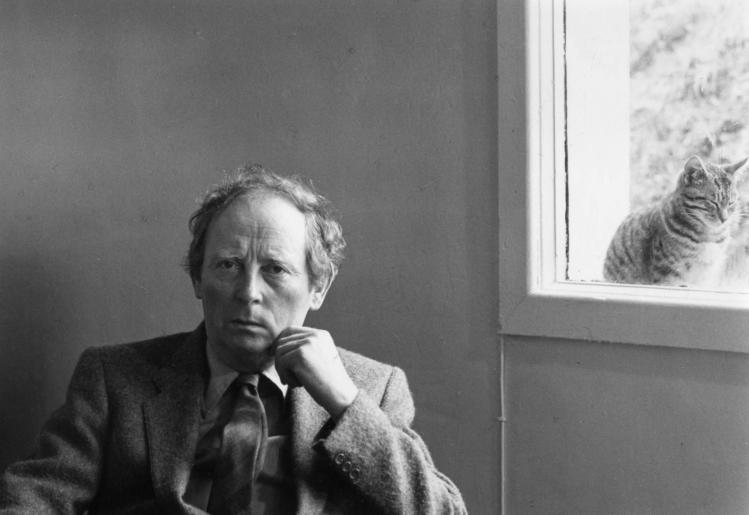
John McGahern’s 1979 novel The Pornographer (NYRB Classics, $17.95, 272 pp.) is, to borrow a phrase from James Joyce, a book of “scrupulous meanness.” The unnamed narrator is a thirty-year-old man from the Irish countryside now living in Dublin. He makes ends meet by writing pornographic tales—a nod to the fact that McGahern’s second novel, The Dark (1965), was banned in Ireland due to its depiction of masturbation. The narrator treats his work with contempt—“My characters were not even people,” he says, “they were athletes”—though contempt doesn’t preclude him from having fun with the enterprise’s fundamental absurdity. (“Colonel Grimshaw mounts his Mavis Carmichael,” he unsexily writes, “and her ever-ready juices grease his ever-seeking bayonet, both rapturous as they hold the ever-rising tide of the seed on the edge of spurting free.”) Still, contempt is the narrator’s main note, both towards himself (he knows he’s an artistic hack and a moral coward) and toward the world. He once loved a girl but had his heart broken. He once believed in God but now doesn’t. He’s a disenchanted man in a disenchanted world.
Early in the novel, the narrator pauses before going into a dance hall where he hopes to fill an empty night and maybe pick up a girl: “The christening party becomes the funeral, the shudder that makes us flesh becomes the shudder that makes us meat.… And in between there is time and work, as passing time, and killing time, and lessening time that’d lessen anyhow, such as this going to the dance.” For the narrator, time is simply something to be endured. “In sobbing silence the clocks tick,” as McGahern writes in his story “The Recruiting Officer.” Though the narrator takes no pride in his writing—he ironically describes it as “the worm at last spinning its silken tent”—at least it occupies his hours: “Seldom is it given, but when it is it is the greatest consolation of the spinning, time passing—sizeable portions of time—without being noticed.… We feel that we have been freed of the burden of time passing, and the happiness is in the feeling and not in the blind forgetful play among the words.” This is writing not to mark time but to kill it, and it rhymes with the narrator’s experience of sex, which for him isn’t about intimacy but distraction. The pen and the penis: both lead, at best, to oblivion.
The plot gets going when the narrator enters the dance hall and, as Anne Enright puts it in her introduction to a new reissue, “picks up with a woman he cannot love and soon does not much like.” If he likes Josephine at first, it’s because of the sex, which calls forth not pornography but poeticizing: “Within her there was this instant of rest, the glory and the awe, that was as close as ever man could be to the presence of the mystery, and live, the caged bird in its moment of pure rest before it was about to be loosed into blinding light.” And if he doesn’t like her soon after, it’s largely because of the resultant pregnancy. Thus begins a bargaining away of all responsibility, from vague promises (“If you’re pregnant, we’re in this together”) to halfhearted suggestions (get an abortion; give the child up for adoption) to a final rejection (once the baby is born in London, the narrator won’t come to meet him).
This dying but never quite dead relationship—again and again, the narrator declares to Josephine that he won’t marry her, suggests that they end things, and then sleeps with her once more—occupies much of the novel. Just as important, though, are the narrator’s regular visits to the hospital to see his aunt, who is dying of cancer. These trips are filled with tenderness. The narrator brings his aunt brandy to ease her pain and then slips her mints when the nurses come by. He listens to complaints both minor (people are too hard on her ne’er-do-well son) and major (“It’s only after years that you get some shape on things,” she says, “and then after all that you have to leave”). The narrator would prefer to avoid such visits but makes them anyway. In these scenes, time isn’t killed but experienced—the hours hurt but they matter—and people aren’t used but cared for.
If The Pornographer’s sex plot reads like nihilism, its death plot reads like humanism. When the narrator visits the dance hall, he sees a Grand Guignol of gross desire and grosser bodies: “All around us on the maple the old youngsters danced. The stained skin did not show in the blue light, but paunches did, bald heads, white hair, tiredness. People do not grow old. Age happens to us, like collisions, that is all. And usually we drive on.” The narrator’s disgust is amusing but ultimately too easy—and too self-flattering. Yes, his desires are ignoble but at least he knows it, unlike those deluded revelers. By contrast, when the narrator visits the hospital and sees his aunt resisting death, the style shifts dramatically:
Through the window above the bed I could see the clear sky of frost, pierced with stars, and the reflection of all the lights of the city beyond the bare trees, and beside them this woman’s fierce desire to live, and in the long ward, all the little groups about, the same desire in each bed, small shining jewels in an infinite unfathomable band. Everywhere there was a joy that was part of weeping.
Here, the narrator’s vision is clear rather than scornful. He sees desire as admirable, the world as vast and beautiful. Before, joy and weeping seemed impossible. Now, they seem part of the very texture of existence. Such thoughts are short-lived. Pages later, he’s not so gently letting Josephine down again (“I enjoy sleeping with you, being with you, but I don’t love you”) and mocking the seriousness of death (“Dying, I suppose, is a sort of vamoosing, isn’t it? It’s not playing the game”).
McGahern, who died in 2006, was a truly great writer. His final novel, By the Lake (2002), is a perfect book, and several of his stories, including “The Wine Breath,” are as good as anything in the twentieth century. At his best, McGahern moved between his two dominant modes—the mean and the majestic; a disdain driven by spite and a charity driven by tenderness—with grace and delicacy. In The Pornographer, the shifts are a little too sudden, the genuine warmth smothered by the inhuman chill. At one point, the narrator describes readying himself to sit down and write his smut: “I washed and changed, combed my hair, and washed my hands again a last time before going over to the typewriter on the marble, and started to leaf through what I had written.” This quasi-ceremonial preparation reminds him of an earlier experience of ritual:
We used to robe in scarlet and white how many years before. Through the small window of the sacristy the sanded footpath lay empty and still between the laurels and back wall of the church, above us the plain tongued boards of the ceiling. It seemed always hushed there, motors and voices and the scrape-drag of feet muffled by the church and tall graveyard trees. Kneelers were no longer being let down on the flagstones. The wine and water and hand linen had been taken out onto the altar. The incessant coughing told that the church was full. The robed priest stood still in front of the covered chalice on the table, and we formed into line at the door as the last bell began to ring. When it ceased the priest lifted the chalice, and we bowed together to the cross, our hearts beating. And then the sacristy door opened on to the side of the altar and all the faces grew out of a dark mass of cloth out beyond the rail. We began to walk, the priest with the covered chalice following behind.
Decorous yet simple, cadenced and absolutely clear: this is an exquisite act of memorial reconstruction. Alas, the next paragraph reminds us that this quietly bravura piece of writing, rich with sensory details (“the plain tongued boards of ceiling” and “the scrape-drag of feet”), is mainly there to show up the empty sensuousness of the narrator’s current life as pornographer: “Among what rank weeds are ceremonies remembered, are continued.” Soon thereafter, we get a long excerpt of the imaginary Colonel and Mavis’s sex-filled trip to Majorca: “‘O Jesus,’ she cries as she feels it searching deeper within her, driving faster and faster.” The sacred has been made profane. If we don’t get it, McGahern underlines it for us.
McGahern’s early work, especially The Barracks (1963) and The Dark, was angry. He had a lot to be angry about: an abusive father and a beloved mother who died too young; a Church that concerned itself more with policing sex and censoring art than with bearing witness to the world’s human and natural beauties. And there was something bracing about the asperity of these novels. His later work, especially By the Lake and his memoir All Will Be Well (2005), occupies a different emotional, aesthetic, and spiritual register. All Will Be Well is filled with catalogs: of plants and animals, people and places. When describing the lanes around his rural childhood home, McGahern names the “thick hedges of whitethorn, ash, blackthorn, alder, sally, rowan, wild cherry, Greek oak, sycamore.” When imagining the funeral procession that took his mother to her grave (his father wouldn’t allow him or his siblings to attend), he sees the hearse “gathering speed as it went by Brady’s pool and Brady’s house and the street where the old Mahon brothers lived, past the deep, dark quarry, across the railway bridge, and up the hill past Mahon’s closed shop to the school.”
Here, we see why McGahern writes: to preserve life; to name it and, by naming it, honor it. Writing involves not so much an obliteration of the self as an absorption into the meaningful world that surrounds the self. McGahern doesn’t write to kill time. He writes to make time live again.