A trip to Haiti is unlike a thousand elsewhere. The small Caribbean country, the size of Massachusetts, is not only the poorest in the Western Hemisphere, but people who have traveled in Africa and India told me they have seen nothing worse. Seventy-five percent of its 7 million people live in abject poverty (starting each day from ground zero and struggling just to begin tomorrow at the same level). Twenty percent are middle-class (that is, able to provide for themselves), 5 percent are wealthy, and 1 percent are super wealthy: they control 40 percent of the nation’s wealth. The contrasts are crushing: men resembling pack animals push carts laden with charcoal through the cratered streets, only to be passed by a cherry-red Lexus riding as if on air.
Following a decade of acute political unrest and economic uncertainty, including the devastating three-year trade embargo imposed to force the reinstatement of President Jean-Bertrand Aristide, Haiti seems poorer than ever. But with the return of Aristide and the first peaceful transfer of a democratically elected administration this past February, there is at least the prospect of some slight change.
You catch the state of things on arrival. At the Port-au-Prince Airport, the baggage area is teeming with returning Haitians. But the baggage carousel is a skeleton of its former self, with whole sections of its rubber plating missing. While standing there, I watch the belt gobble up several suitcases, ripping them open and sending their contents onto the waiting-room floor. The owner of one shrugs. She is surrounded by men jockeying to carry what’s left of the bag. With 70 percent unemployment in the country, waves of people can be found at any hour looking for hire.
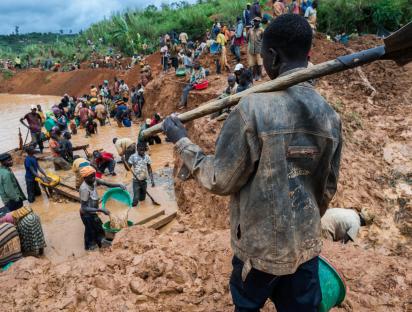
First impressions of Haiti can be devastating. A mountainous country, Haiti has suffered heavy (and almost complete) deforestation this century, followed by unrelieved erosion. (The name of Aristide’s political party, “Lavalas,” means “cleansing torrent,” so prominent are floods in people’s experience.) With no public system for trash collection and sewage disposal, garbage lies piled everywhere and is displaced only by the runoff from the rains. In Port-au-Prince’s massive slums—one of them, Cite Soleil, the world’s largest, is home to 250,000 in a twenty-seven-square-mile area—human refuse floats in open channels through the streets. Built in swamp areas that lie below sea level, these encampments are inundated by sewage whenever it rains. Disease is widespread.
Haiti is not without those who wish it well. I am told there are 160 different aid agencies working in Cite Soleil alone. An experienced British aid worker has commented that he has never seen such a concentration of groups. But a priest with over thirty years of experience in Haiti tells me it might be better if all these groups left the country alone for a few years. (Haiti’s own rice production, for example, is undermined by cheap rice imported from abroad, some of it by aid groups.) Still, the priest notes immediately, assistance cannot be cut off because it is essential for survival. His own rule of thumb: every dollar for assistance ought to be matched by a dollar for development.
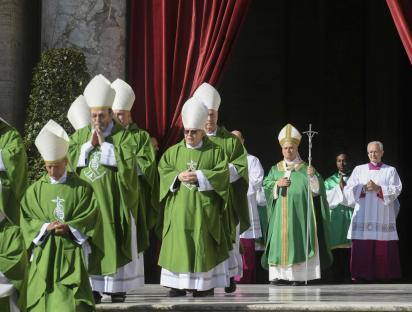
A Catholic missionary tells me that “Haiti is 80 percent Catholic, 20 percent Protestant, and 100 percent Voodoo.” In 1966 the Roman church translated its liturgy into Creole, a watershed event that brought its leadership and institutions into closer contact with the poor. For a period, the official church was even in the vanguard of resistance to the Jean-Claude Duvalier regime, but later reverted to its habit of supporting whatever government wielded power. This proved particularly damaging after the 1991 ouster of Aristide. Recently, the hierarchy has mended some fences, but regaining confidence among the rank-and-file will be hard, slow work.
Aristide, “the father of modern Haiti,” is not a politician in the usual sense. He speaks with a passion for the masses that is unconcerned for nuance, is seen as the people’s advocate, and appears mystically bound to them. He entered politics, he says, to transform “the promise of dignity [for the Haitian people] into living dignity on the daily level” (Dignity, University Press of Virginia). And they have reciprocated with a volatile loyalty. But Aristide’s abbreviated presidency did not demonstrate much organizational ability. He exhorted government bureaucrats to “marry politics and morality,” but did not follow up with effective reform. Though he is now out of office, recently married, and in temporary retreat on an estate outside Port-au-Prince, most assume he will run again for the presidency in five years. To do so he will have to keep his hand in the Lavalas party and maintain his bond with the masses.
The newly installed president, fifty-three-year-old Rene Preval, is an Aristide supporter and his former prime minister. An agronomist by training, Preval may be better suited to run a government than his predecessor. “I know I must translate democracy into improvements in everyday life,” he said at the time of his inauguration. He has his work cut out for him.
Last year the United States provided Haiti $235 million in assistance. This year the Clinton administration has asked for only $115 million, and Congress is inclined to appropriate even less. (One U.S. aid worker tells me that historically every dollar of U.S. government assistance to Haiti has returned seventy cents to the U.S. Today, the bulk of such assistance goes to strengthening foreign investment projects in Haiti.)
Despite the return of democracy and the end of the trade embargo, daily life has not yet improved for most Haitians. Aristide abolished the coup-loving army and replaced it with a new 7,000-man police force. But it is poorly trained and inadequately equipped, and violence is on the rise. Some police officers simply refuse to patrol neighborhoods where they are outgunned by local gangs and drug dealers. There is also the unnerving threat that when the UN pulls out its remaining 1,800 troops in six months, political violence associated with the Duvalierists could return. As for economic development, it has barely gotten back into first gear from being in reverse.
So Haiti remains a mystery, languishing but offering promise, “a hall of mirrors” politically and culturally, as John Hogan once described it (Commonweal, September 22,1989). As our group was about to depart, we noticed a luxuriant trumpet vine entwined in the razor wire of the cyclone fence surrounding a UN military encampment. Perhaps that image captures something of Haiti today: a complex land of violence and exclusion, beauty and ugliness, despair and aspiration, trying to surmount its past in the face of a resistant future.
Patrick Jordan is managing editor of Commonweal. He recently visited Haiti on a three-day trip funded and organized by Food for the Poor.