Horror movies are easy to dismiss as only sudden jolts and gratuitous gore, a genre that circumvents our minds to get at our viscera. There’s some truth to the charge: horror films do tend to sequence jump scares and disgusting images. But this is hardly the whole truth of the genre. Like its cousins science fiction and fantasy, horror—at least in its more ambitious versions—deals in ideas, in thought experiments and what-ifs. It probes the nature of reality and the depths of our psyche. At times, it takes us into the subterranean foundations of law, the moral life, and shared experience. Horror receives much more academic treatment than it once did. Some of this is not very substantive—fandom with footnotes. Some of it, though, offers serious inquiries into the issues the genre can raise.
Despite the genre’s popularity and the prevalence of religious subjects in many horror films (how many exorcism and scary-nun movies have been made?), theologians have not reflected much on horror. That makes the new book Theology of Horror by Ryan G. Duns, SJ, a welcome arrival. It meets a need, and it does so in impressive fashion. It is a rare academic page-turner, written in witty, lively prose. Each of its fifteen chapters offers theological reflection on a different dark facet of horror. Duns gives “readers a way of viewing horror films—some classic, some contemporary—with senses attuned to their metaphysical and theological depths.”
Theology of Horror is wide-ranging, but two major concerns are at its heart. First, it is interested in how horror films insist upon the fallenness of humanity. Thus, Candyman exposes systemic racism and The Devil’s Doorway probes corruption in the Church. In an early chapter, Duns uses René Girard’s mimetic theory to examine The Purge, in which the order and solidarity of a near-future society are secured by an annual night of vengeful violence:
With mimetically attuned senses, we see how desire, rivalry, and scapegoating work on micro and macro levels. Within a closed neighborhood, festering resentment and hate search for ways to be rid of the scandal—and this drives the action throughout The Purge. Within the macrocosm of society, a ritual enshrines practices meant to preserve a status quo created and sustained through violence. The America reborn by the Purge is christened in the blood of victims, primarily the poor and vulnerable, whose elimination brings “peace” and “prosperity.”
As Duns suggests, the extreme dynamics of The Purge can help us see subtle but similar dynamics at play all around us—and within us.
The second major concern of Duns’s study is how horror can make our usual reality uncanny. Horror can startle or scare us into perplexed wonder at the nature of existence. Again and again in horror films, some sinister entity “disrupts and threatens” everyday existence. Duns uses the term metataxis to describe this dynamic: “The metataxis of horror involves, consequently, an incursion into the world that precipitates a breakdown of the dominant order, leaving it to the characters to recognize and respond to this shattering…before it is too late.” As in the film Insidious, this might be the small world of a new home into which a family moves with high hopes, only to discover that the house is decidedly un-homey, that it has a troubled past and is a portal to evil. In A Nightmare on Elm Street, the whole neighborhood turns out to have a troubled past, but at a more basic and intimate level, the world that gets disrupted in the film is the sleep of the neighborhood’s children, as Freddy Krueger manifests a power to inflict physical violence on them through their dreams. At times, the metataxis threatens to disrupt the whole world as we know it. This is the case with the vampire virus that infects most of humanity in I Am Legend. (Duns does not discuss the Netflix show Stranger Things, but his study had me thinking of how the “upside down,” another dimension full of malevolent entities seeking entry into our own world, unsettles reality for characters in the show and for viewers.)
The metataxis of horror often confronts us with the mystery of evil, but it also jolts us into a perplexed wonder that can raise fundamental metaphysical questions: Why is reality the way it is? Is it open to transcendence? Am I open to transcendence? Paradoxically, Duns underscores how the malignant threats of horror can help us see anew the threatened goodness in reality. Duns’s award-winning 2020 study, Spiritual Exercises for a Secular Age: Desmond and the Quest for God, draws on the thought of the contemporary philosopher William Desmond to provide a spiritual “itinerary” out of the contemporary “immanent frame.” Here, too, Duns returns us to core metaphysical questions that help us see anew the mystery of existence. To put the study’s two major concerns together in theological language, horror can help us see with newly attentive eyes both the fallenness and the goodness of creation.
Too much Christian criticism squints at a popular film, book, or song and then claims it really affirms a Christian message deep down. (Of course, there is also plenty of Christian criticism at the other extreme that sees only anti-Christian messages in pop culture.) Duns is far too discerning to be an uncritical horror enthusiast. He offers no categorical blessings, and he does not shy away from needed polemics. Duns recognizes that in many films (say, The Texas Chain Saw Massacre), there are only the barest hints of transcendence in a brutal and godless world. He expresses frustration at one common horror trope (examined in this study via The Devil’s Doorway) in which Christianity is depicted as impotent or all-but-impotent when confronted with the power of Satan. Much more profoundly, he compares the metataxis of a malign entity—such as the inverted incarnation in Rosemary’s Baby—with the metataxis of Jesus Christ. The comparison reminds us how Christ’s advent unsettles, something continually testified to in the gospels. But, of course, the contrast is what matters here. Christ’s advent augurs no reign of darkness but the coming of a kingdom in which love is restored.
Duns is a theology professor at Marquette University, and this book has its origins in a theology course he teaches there. Students watch a different horror film each week and discuss the metaphysical and theological questions it raises. Duns presents Theology of Horror as both a work of scholarship and a potential companion text for other theology professors who want to offer such a class. With its winsome style, clear exposition of complex ideas, well-timed jokes, and vignettes from Duns’s own life, Theology of Horror would undoubtedly work well in the undergraduate classroom. (These qualities also suggest that Duns is quite a skilled teacher himself.)
A theology course built around horror films may seem strange. But Duns, like a growing number of theology teachers, recognizes that when many students are either only loosely affiliated with or skeptical of religion, it is necessary to first awaken them to the fundamental questions. Horror films, when approached with a theological sensibility like Duns’s, can be “frag-events” that unsettle assumptions and stir—even compel—thought:
It may be an unorthodox starting point, but these are imaginative points of ingress into conversations about the nature and meaning of reality. Especially for persons reluctant to study theology or metaphysics, those who are skeptical that these disciplines could have anything to say about horror, entering through their imaginative doorways provides a chance to introduce them to a new way of seeing and living within the world. For those stifled by closed worldviews, horror’s frag-event can offer a salutary breach that lets fresh air into their imaginations and gets them to ponder whether maybe, just maybe, the world is more porous than they might have presumed.
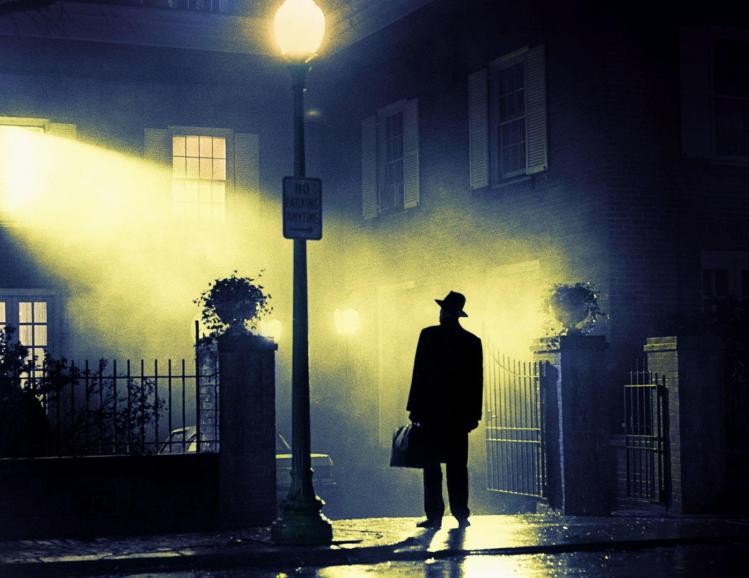
Duns’s study builds from basic questions of metaphysics and anthropology to distinctions between superstitions and sacraments. It ends with a particularly striking chapter on prayer, in connection to the film The Black Phone, and one on discernment, which reflects on The Exorcist. (How could a Jesuit theologian avoid this ultimate pairing?) In short, the study begins with basic questions that awaken the religious sense and ends with the practices of the spiritual life. I suspect many of Duns’s students have been transformed by this trajectory. With this new book, he invites the rest of us to join him in a journey through the gloom toward a consoling light.
Theology of Horror
The Hidden Depths of Popular Films
Ryan G. Duns, SJ
Notre Dame Press
$45 | 344 pp.