I looked up to see her leaning toward me over the back of the next barstool. “Well, do you believe in God?” she asked.
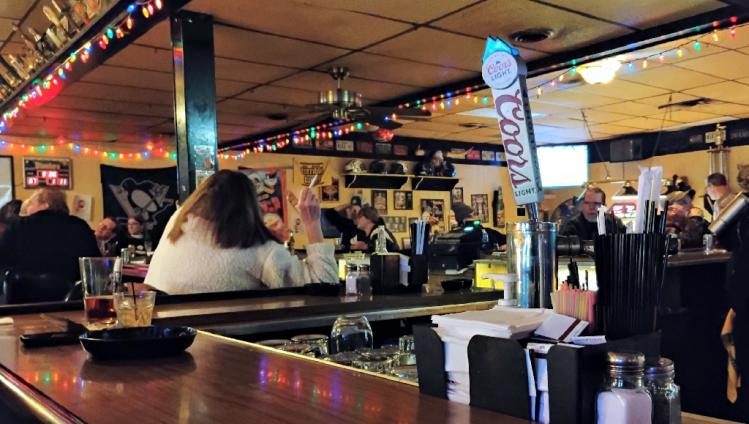
She’d introduced herself a while earlier, to tell me her son loved our conversations at the local townie dive bar, and she wanted to meet me. “He says you talk about everything,” she said. “Pretty much everything,” I said—“even questions like whether we believed in God,” which is not a subject of normal bar conversation. I regretted saying this almost before I’d finished the sentence, because one reason the subject isn’t one for bar conversation is that some very odd people will buttonhole you and tell you, ancient mariner–like, what they think without a break for as long as you’ll listen, and they are never interesting.
The woman had come back because she decided she wanted to know whether I did in fact believe in God. I said I did and she nodded. “I don’t think there’s a God, some judgmental something out there, who just sends people to hell forever whether they deserve it,” she said, looking not at me but over my shoulder, and I nodded. Around here, it’s likely she grew up Catholic, though she may have grown up some kind of Calvinist Evangelical. It would have been helpful to know which. Children of both often remember the condemnations more than anything else, but Catholics often reject the whole thing, while Evangelicals tend to look for a better version. “But I think there’s something out there.”
“I have a theory,” she said, now looking at me. “Everyone gets to decide if they’ll be born. They’re told what’ll happen and get to say yes or no. You know what you’ll go through and you choose it.” You can say no, but if you’re here, you chose to be. “Otherwise, you’re just thrown into the world. People have really shitty lives. You don’t get to choose your parents, where you’re born. You didn’t ask for any of it.”
She thought babies remembered the deal they’d made, but slowly forgot it before they could talk about it. She’d had seven children and the son I know was her only fussy baby. She’d told the doctor he fussed because he didn’t want to be here. “He remembered,” she said. Everyone goes to a great place after they die, she continued. The something out there won’t keep anyone out. If I understood her right, that was the part of the deal that made so many say yes to being born. “That’s my belief,” she said. “It’s no truer than anyone else’s, but it’s my belief.”
It was a theodicy. It made sense of the bad things people go through. I knew from my friend that his mother had lived a hard life, with some horrible losses. To suffer all that without having agreed to it does seem unfair.
Later in the conversation, she said something about past lives. My eyebrows must have gone up a bit, because she said, “Yes. I believe in reincarnation.” She knew too many people who’d had experiences of past lives not to believe in it. She thought you get in this life what you deserved in a previous one. If you suffered, you suffered because you’d hurt someone. “It’s karma!” she said.
Another theodicy. It seemed somewhat at odds with her belief that we choose to be born, unless we choose to be born many times, but it served the same purpose. In the first theodicy, we accept suffering as the cost of getting to a wonderful eternity. In the second, we choose future suffering when we choose to make someone else suffer. In both cases, it’s all on us. Life may be hard, may be horrible, but at least it’s fair. I could see the attraction.
She eventually went back to the friend she’d been talking to. I went back to watching the Penguins game. I’d enjoyed the conversation and felt a little humbled by the moral seriousness of someone who’d been through so much and had every reason to give up caring. I’d tried to explain my own beliefs, but she hadn’t been that interested.
I think I know why. Christianity isn’t fair in the sense she wants it to be. She’s not interested in grace. What she wants is a cosmology that explains the human condition, not one that heals it. I very much admired her desire to take responsibility for her life and to look at the life she’d lived with all its pain and say, “That’s on me.” She assumes, I’m fairly sure (we talked for an hour), that the Christian idea of grace begins with our being thrown into the world, the very idea of life she feels to be so unfair. That God does the throwing wouldn’t make it any better, nor would his offering to rescue us. Her answer to the complaint that we didn’t ask to be born is that we did.
Christians tend to evaluate other people’s beliefs by their foundations and first principles. Does the person believe in God? Does she know who he is and does she listen to him? If she does believe in God but not in the way Christians do, many Christians would assume she’s basically wrong because she can’t get to where she should go from where she’s beginning.
But I think that discounts an important intuition about hope and overvalues a knowledge of foundations. It’s often the wrong way to proceed, at least with people talking about God in bars. If we’re going to credit people as some kind of Christian for starting in the right place, we should also credit them as proto-Christians for ending in the right place. Do they want what Christianity wants? Did they find a way to justify a final good news, affirming at the end of things the world’s goodness and the eternal value of each human being? In a world in which so many people despair, and in which so many reject any idea of hope beyond this world, do they proclaim hope? Do they insist, as my friend did, that despite everything, life is worth living?
My friend’s dual theodicy gives her a way to justify hope, to believe in a sure promise that suffering isn’t the final truth of our lives. People like her may be able to build the structure of belief backward. Perhaps that’s not the most efficient way to do it, but maybe it’s a more reliable way, because they know the place to which their ideas must lead. They might find where they should begin by knowing for sure where they should end.
My friend believes that people live through shitty lives, but someday they’ll find that they made the right decision in choosing to be born. She essentially proclaims the Christian hope that every tear will be wiped from our eyes, and death shall be no more, neither shall there be mourning nor crying nor pain any more, for the former things will have passed away. A partial gospel, to be sure, but a partial gospel is something, and it may be a lot in a world where so many see no possibility of joy or justice at the end.