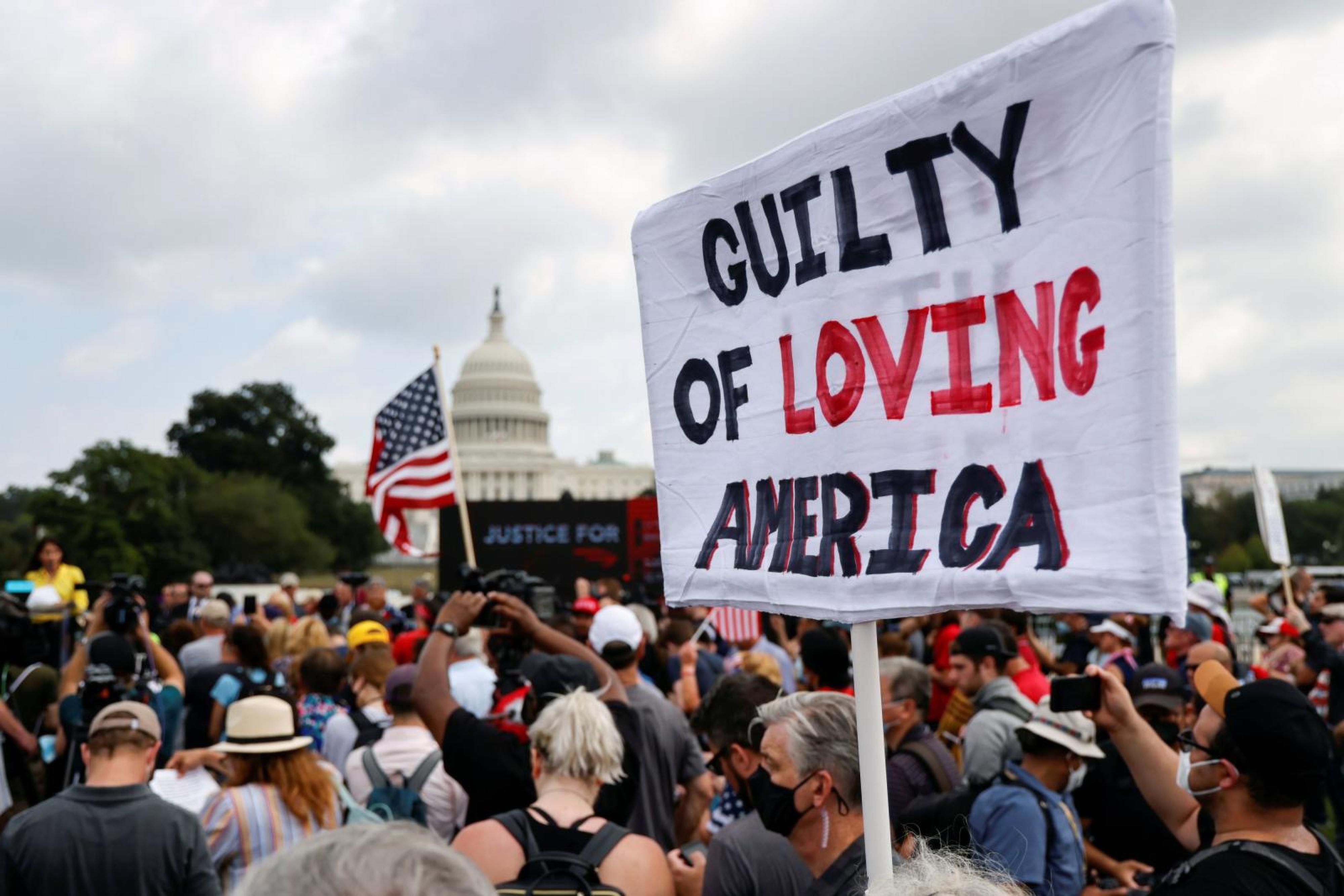
Jared Huffman’s No Prophets gives a disturbing recitation of the many Christian-nationalist groups that have risen to prominence in recent decades. One of them is the New Apostolic Reformation (NAR), a widespread movement whose unapologetic goal is “Christian dominion.” They are a major proponent of an insidious strain of Christianity that has festered in American life. Huffman insists that “NAR’s theology leaves no room for America’s constitutional order.” Like an infection, this strain burst to feverish intensity in the January 6 insurrection at the Capitol.
Huffman has represented California’s Second Congressional District since 2013. He is almost certainly neither the first nor the only atheist in Congress, but he is the first openly atheist member. Rep. Jamie Raskin, who contributes a foreword to No Prophets and who numbers among the Freethought Caucus formed in the House by Huffman in 2018, commends Huffman’s “existential and intellectual coming-out.” No less than Speaker emerita Rep. Nancy Pelosi, too, sees value in humanism as a perspective brought to the chambers of Congress—“beautiful,” she pronounces it. Few are the humanists committed to free thought who seek to impose their way of thinking on others. Those whom Huffman writes about—including those he calls “Rad Trad Catholics”—have a different set of priorities.
No Prophets opens dramatically. As a member of Congress, Huffman had an up-close view of the events of January 6, 2021. Watching from the Longworth House Office Building as the crowd began to swell, he talked on the phone with Rep. Adam Kinzinger, an evangelical Christian who immediately recognized the danger the crowd posed. “Who the hell would think to bring a shofar unless you believe this is a prophetic moment when the people of the Lord are rising up?” Kinzinger asked. Christian nationalism was on the march, and Huffman remains alarmed at the threat it poses to our system of constitutional government.
Huffman’s catalog of the three major groups advancing Christian nationalism is the heart of his narrative. Rad Trad Catholics, skeptical of Vatican II, liturgical reform, and Pope Francis, are probably the group most familiar to Commonweal readers. NAR is a “fast-growing and decentralized group of evangelical faith leaders” identified most with Dutch Sheets and Paula White-Cain, a spiritual advisor to Donald Trump. The reconstructionist “TheoBros” are a diffuse group but possess recognizable characteristics. Under the influence of Doug Wilson, they are led by “mostly millennial male pastors, authors, and influencers who, like Wilson, usually sport beards, a symbol of biblical masculinity, cultural resistance, and traditional values.” Think Pete Hegseth, but also tech billionaires like Peter Thiel and Marc Andreessen—manscaped, muscular, swaggering masculinity rooted in misapprehended biblical ideas.
All three groups are troubling and, despite social and theological differences, there are tendencies common to all of them. A preoccupation with gender roles, for example, seems to span all stripes of the movement. So does disaffection with any social or political culture that does not agree with them perfectly. But it is unwavering loyalty to Donald Trump—of all people—that unites them. Huffman observes perceptively toward the end of his book, “For now, the glue holding this shaky coalition together is Trump” because, being “unaligned with any religious faction” while “appealing to all of them,” Trump’s visible irreligion has allowed these disparate religious supporters to unite around him. They share little in common with Trump himself except the pursuit of nakedly partisan, even fundamentally un-American (unconstitutional) goals by any means necessary. Huffman isn’t the first to lay out these facts, but his account of this new brand of Republican fusionism remains chilling.
Huffman’s book intends to warn us about the nascent theocratic movement those groups represent against democracy in the United States. In making his argument, though, he sprawls a little too much. Chapters on the decline of historical and political literacy, Christian Zionism, and the theocratic misreading of the American founding contextualize the Christians that Huffman writes about. But the chapters land somewhat disjointedly in a narrative that begins with the intensity of his description of January 6.
Almost the entire second half of the book reads more like a familiar suite of complaints from the left against the religious right. Toward the end, I found myself wondering whether Huffman’s purpose is defending secularity against the encroachments of religious extremism or if he’s really just defending the left against the right, or even democracy against authoritarianism. I suppose Huffman and others might argue that there are too few differences among those choices to worry about in 2026. That might be fair. But they are not all the same things, and terminology and clarity matter for a good argument. That confusion matters, for example, when Huffman turns his attention to skepticism about science and the antivax movement. Not surprisingly, he trains his sights for two pages on Robert F. Kennedy Jr., “an anti-vaccine conspiracist whose own family had begged that he never be entrusted with power.” Christian nationalists, indeed, have been cheered by RFK Jr.’s MAHA movement. Yet Kennedy himself summons religion to support his crusade even less frequently than Trump does.
This mild confusion in the argument has one surprising and pleasant effect. It discloses how moderate Huffman actually is in his atheism. Toward the book’s end, Huffman speaks so positively about the Sermon on the Mount, the 2025 preinaugural sermon of Bishop Mariann Budde, and the “compassion” religious belief can bring to public life that he persuades us that he can see believers as allies. No matter how much Huffman inveighs against religion in political life and insists (rightly) on the strong Jeffersonian foundation under a separation of church and state, he ultimately emerges as an entirely American secularist, asking for something quite different from continental läicité. He invites Christians as well as Jews, Muslims, Hindus, Buddhists, and other believers to bring from their traditions a “moral vocabulary” that is vital to our shared political enterprise. Huffman’s language is almost exactly the same as Cardinal Joseph Bernardin’s. For Huffman, religious believers must be free to believe and contribute from what we believe. But they must not take anyone else’s freedom to believe or not believe, and the United States can never be a Christian nation.
I am grateful to Huffman for this book. As one who pays attention professionally to the intersection of religion and politics, I have been observing the rise of Christian nationalism for two decades. My alarm about it never became too great. The participants seemed like misfits and kooks, or maybe Star Trek fans insulating themselves in a subculture, speaking in Klingon mostly to each other. But Huffman has helped me recognize that the water all around me has slowly been coming to a boil. Everyone knows American public life has been breaking apart at the seams, and religious belief has been ripping the stitches. It is a warning for all Americans to heed—nonbelievers and believers alike.
No Prophets
The Fight to Save Democracy from Christian Nationalism
Jared Huffman
W. W. Norton & Company
$28.99 | 240 pp.