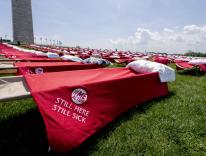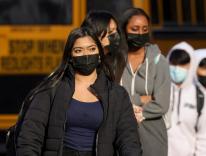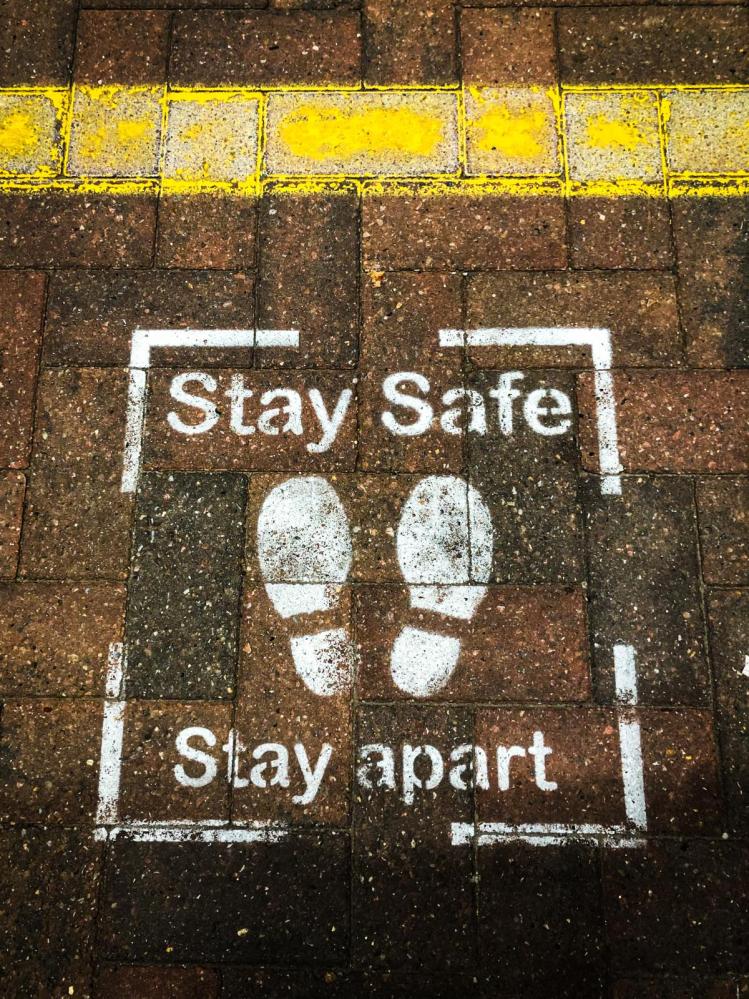
Occasionally, one still sees the physical traces. A weathered, scuffed-up sticker on the floor of a business, faded letters reading “PLEASE KEEP 6 FT DISTANCE.” A universally ignored sign on a salon door stating that masks are required. An unused delivery window on a fast-casual eatery from when they closed the dining room. The reminders of the worldwide pandemic that has so far taken more than 7 million lives are everywhere, though apparently no one cares much to notice them.
I pass by these signs every day, their instructions powerless, fading into the visual noise of the city. They’re everywhere, but what do they mean now? That we won, that it’s over? That we failed? Are they mementos of the dead, or reassurances that we survived? Or reminders of the powerlessness of words and rules when order has broken down?
In March 2021, as most of us still waited for vaccines but the end to lockdown was in sight, New York Magazine’s Justin Davidson asked the question, “How Will We Remember This?” By then more than a million Americans had died, more than twice the number of Americans who lost their lives in all the wars of the twentieth century. Certainly, we would need some kind of commemoration. So the magazine invited fifteen design firms and collaboratives to design memorials. The proposals ranged from the grand to the muted, from the universal to the specific. But they all have one thing in common: they remain unbuilt. New York City has no official COVID-19 memorial. A city-council bill to study a memorial on Hart Island has languished in committee for years. Another bill at the state level has died, once again, in the assembly. And New York City is by no means alone; most cities have no specific commemoration for what happened in 2020, and there is nothing being contemplated on the federal level.
Perhaps we don’t want to remember. Perhaps we’d rather forget. In many ways, it’s already happening: a vague haze about what, exactly, happened in 2020. People have started to forget who was in charge. In 2023, Lauren Boebert accused Joe Biden of being responsible for school closures that took place at the beginning of the pandemic, and last year another GOP representative, Mike Collins, likewise blamed the protests from the summer of 2020 on Biden as well. But it’s not just politicians trying to score cheap points; the forgetting has begun to seep into popular culture as well. Rachel Reid’s enormously popular 2019 novel, Heated Rivalry, covers the years from 2008 to 2017; its sequel, as Abigail Nussbaum noted on Bluesky, begins two years after Heated Rivalry and covers a period of about a year. And yet it exists in some nameless, timeless present in which the pandemic never appears. To Davidson’s question, “How Will We Remember This?,” I often think the answer is simple: we won’t.
That forgetting is, depending on your perspective, anywhere from understandable to odd to disgraceful. But as the recent past has receded into the rearview mirror, I’ve thought a great deal about what this close proximity to death, followed by a massive forgetting, might do to us. We know that repressed trauma can have lasting psychological effects on individuals, but what about entire countries? What if the refusal to remember and grieve has had other effects on our world, effects that, like post-traumatic symptoms, might not be immediately obvious? What if it explained a different facet of the post-pandemic world: the rightward lurch toward authoritarianism throughout the world, including in the United States?
In thinking through the repression of a deadly pandemic, I’ve returned time and again to Ernest Becker’s 1973 book, The Denial of Death. Becker theorized that a fundamental component of the human condition—perhaps the fundamental component—was the fear of death, a fear so strong and singular that many of our endeavors were devoted to denying its reality. As he argued,
Man is not just a naturally and lusty destructive animal who lays waste around him because he feels omnipotent and impregnable. Rather, he is a trembling animal who pulls the world down around his shoulders as he clutches for protection and support and tries to affirm in a cowardly way his feeble powers.
Becker, who served in the U.S. Army during World War II and helped liberate a Nazi concentration camp, came to see the warmongering, hatred, and calamity in the world around him as originating in our refusal to admit our own frailty. Man, Becker believed, is “one who asserts himself out of defiance of his own weakness, who tries to be a god unto himself, the master of his fate, a self-created man.” Such defiant self-creation, he continued, can become “demonic”: a passion which, carried to its extreme, “gave us Hitler and Vietnam: a rage against our impotence, a defiance of our animal condition, our pathetic creature limitations. If we don’t have the omnipotence of gods, we at least can destroy like gods.”
Becker seemed to argue that many social ills of his day could be explained by a desperate fear of mortality, one that we move heaven and earth to repress. His work, coming as it did near the end of the Vietnam War, struck a chord in the American consciousness: it won the Pulitzer Prize for General Nonfiction in 1974, shortly after Becker himself had succumbed to cancer. But Becker’s theories were light on evidence, and he offered little proof for his deeply felt but ultimately provisional hypothesis. A decade later, three sociologists—Jeff Greenberg, Sheldon Solomon, and Tom Pyszczynski—decided to see if they could fill in the gaps in Becker’s ideas. They founded a subfield in sociology now known as Terror Management Theory (TMT), based on the idea that our trembling fear of death can lead to unexpected consequences and behavior.
I was drawn to this idea as one thing became clear to me: our world, since 2020, has grown more and more fearful. Every year, Chapman University compiles a survey of “American fears,” cataloging our anxieties about everything from terrorism to public speaking to nuclear war to alien abduction. Each year, the ranking shifts slightly, as new fears gain prominence in our collective social consciousness. But over the past few years, the percentage of Americans expressing fear toward almost every single category has gone up. Some of this reflects obvious political realities: fear of “corrupt government officials,” for example, went from 60.1 percent in 2023 to 65.2 percent in 2024, and fear of the outbreak of a new war went from 52.3 percent to 55 percent. But fears about things that had nothing to do with politics also increased: Americans’ fear of insects increased from 25.3 percent to 26.3 percent and their fear of blood from 7.7 percent to 9.3 percent.
During the same period, the national political mood began shifting to the right. Gallup’s research on American attitudes about immigration, for example, which tracked the question “Should immigration be increased or decreased?,” reported that in June 2020 Americans were tilting toward more immigration (34 percent wanted an increase, 28 percent a decrease). But within a year, the numbers were even (33 percent to 31 percent), and then the “decreased” number began to spike: by 2024, 55 percent of Americans wanted less immigration, as opposed to only 18 percent who wanted more. And it’s not just immigration: Republican voters’ acceptance of legalized gay marriage fell significantly, from 55 percent in 2021 to 41 percent in 2025—by far the biggest drop since Gallup began tracking the question. Belief in the “morality” of gay marriage was even sharper, from 56 percent down to 38 percent. Meanwhile, receptivity for authoritarian leaders increased during the Biden years: in 2021, Morning Consult found that about 26 percent of Americans were receptive to right-wing authoritarian ideals (including political violence), while in 2024 the Public Religion Research Institute found that number to be 40 percent.
TMT theorists would see those two trends as related. An increased awareness of death (what TMT refers to as “mortality salience”) can, they theorize, lead some people to embrace right-leaning positions: anti-immigration stances, trans- and homophobic beliefs, preferences for traditional marriage models, and an openness to authoritarian leadership. In 2021, for example, Robert A. Hinckley found that those living in counties with high mortality rates were more likely to express attitudes in line with authoritarianism and right-wing populism. He studied poll responses to statements correlated with authoritarianism—for example, “Trump will make a strong leader for our country,” “I’d rather put my trust in the wisdom of ordinary people than the opinions of experts and intellectuals,” and that the police should be allowed “to stop or detain people of a different race or ethnicity if these groups are thought to be more likely to commit crimes”—and cross-referenced those responses with the mortality rates where the respondents lived, as well as any fear of terrorism or job loss they expressed. What Hinckley found confirmed the basic premise of TMT: people who live in places with high mortality rates or who are otherwise afraid of their own mortality, regardless of how they feel about authoritarianism in general, support the kind of statements that authoritarians also prefer. As Hinckley concluded, “moderate to high levels of local existential threat can trigger the perception that Trump is a strong leader and support for right-wing populist ideas among non-authoritarians to the degree that their attitudes are indistinguishable from authoritarians.”
Hinckley’s study came to me as I watched a March 2025 CNN segment where reporter Elle Reeve went to Brantley County, Georgia, a Trump stronghold, a month after his inauguration. Among the people Reeve interviewed was shopkeeper Kathy Hendrix, who boasted of how well her Trump merchandise was selling, including a t-shirt with a picture of Trump that read “Daddy’s Home” that she couldn’t keep in stock. When Reeve asked her, “Why do people like that, calling Trump ‘daddy’?” Hendrix told her:
There is a security in Daddy. Momma is the one that runs everything, momma is the one that does everything, but there is a security in daddy. When daddy wraps his arms around you, you feel like the whole world is just…you’re safe. And everything is gonna be okay.
It’s a revealing moment. For all their bravado and swagger, all their vitriol toward anyone unlike them, at least some of Trump’s supporters seem to cling to him because they’re scared, and they’re looking for someone to take care of them and make them feel safe.
Solomon, one of the founders of TMT, told me that a variety of contemporary social issues, from the pandemic to ecological disaster to economic instability, all “increase both conscious and unconscious death awareness,” which “typically results in behavioral and attitudinal reactions that often align with the rightwing direction.” In a world when everything seems out of control, some of us grope blindly in the dark for stability and security, seeking someone who can make it all okay. Gripped by the panic of fear, we reject complexity and nuance, clinging instead to the simple answer that can reduce the world into something more straightforward and manageable.
Solomon was quick to clarify that death anxiety isn’t the sole cause of anything; nothing is ever that simple. Even within the field of TMT, there’s significant disagreement as to what, exactly, mortality salience leads to. Indeed, researchers have sometimes come to a very different conclusion about its effects. Some TMT studies have found that people, when confronted with death, won’t necessarily move rightward, but will instead double down on their previously held beliefs. Those with leftwing beliefs will lurch further left. In 1998, TMT researchers asked subjects to write about either their own death or a control topic, and then presented them with someone who either disparaged their political views or supported them. The participants then decided how much hot sauce that person would have to consume. The more aware of mortality the subjects were, the more likely they were to reward someone who agreed with them while punishing political opponents with more hot sauce.
Greenberg believes, as he explained to me, that
in general, when death thoughts are close to consciousness, people move in the direction they already were leaning, more so than necessarily a conservative shift. So the polarization was I think very much affected by Covid, but I don’t think it was necessarily a conservative shift. Biden got elected after Covid happened. So the idea that people shifted conservative is pretty unclear. There was a huge DEI push that coincided with Biden’s election.
For Greenberg, this helps explain why the protests surrounding George Floyd’s death in summer 2020 were so much more intense and widespread than the protests over other deaths of Black Americans at the hands of police—Tamir Rice, for example, or Eric Garner. The fear of death and omnipresence of mortality through that spring and summer, he argues, drove people who were already left-leaning to redouble rather than abandon their commitments to social justice and civil rights.
Pyszczynski echoed this. He told me that people adopt specific worldviews to “protect themselves from existential anxiety, especially death anxiety,” by providing meaning, structure, and a sense of permanence. As he explained:
That might lead some people to shift towards the right if the right is seemingly providing more structure, more meaning, and more sense of heroism. In the United States and in most countries nowadays, the right tends to be more nationalistic, emphasizing the greatness of people. It’s more structured, it’s more definitive, and in some ways simpler and more black and white. If people need that, then, when they need protection from death, they might go towards the right.
But that by no means describes all of us, and Pyszczynski went on to say that if someone is left-leaning, and “that’s doing a good job for them, they might shift more towards the left. I also think it’s true that leftwing ideologies can do that too. Both sides claim the moral high ground.”
So does mortality salience lead to a definitive rightwing lurch, or increased polarization on both sides? After forty years, TMT’s founders admit there’s still a lot they don’t know. Psyzczynski told me that figuring out why a fear of death leads to one outcome or the other is “one of the big issues that remains to be tackled.” He believes that “there’s really clear evidence that death anxiety motivates political ideology,” but exactly which ideology mortality salience will motivate “needs further explanation.”
We know that sometimes it leads people to cling to their existing beliefs and values and ideologies because that’s where they’re getting their security, and other times it leads them to look for something that’s especially reassuring and structured and comforting, because that’s what they want from a worldview.
This ambivalence at the heart of TMT’s theory is something its detractors point to as a significant flaw. John Troyer, who directs the Centre for Death and Society at the University of Bath, is one of those who’s studied TMT extensively and ultimately thinks that “fear of death” as a concept is too broad to be useful. “Personally, I don’t buy that there is this innate fear of death,” he told me, “because it gets used then as this excuse, or this rationalization for what I would simply describe as propaganda, or politics.” If you want people to fear immigrants, Troyer reasons, you don’t just say, “They’re coming for your jobs,” you say, “They’re going to kill you and your family.” The threat of mortality is there, but as an amplifier, not a root cause.
Perhaps. But the more I delved into the research around TMT and talked to those involved, the less convinced I was that there was a definitive answer to cut through the noise of the day-to-day events around me. I began to realize that I had fixated on the idea of TMT precisely because it did—in my admittedly limited understanding—offer that easy, single solution to the increasingly entropic world around me. Turning to the “denial of death” as a silver bullet that explained the past few years became, for me, a defense mechanism against the chaos and disorder of the world: a single solution that reduced the world to a simple machine of cause and effect. The real world is just messier and more convoluted than that, and I’d come close to falling into the same trap I’d recognized in others.
But I remain intrigued by TMT’s overall goal to encourage individuals to be more cognizant and aware of our fear of death. And I remain convinced that “managing” that fear—developing a more conscious awareness of death, both on an individual and communal level—can allow us to make decisions that aren’t fear-based. In this, of course, we draw from a millennia-old tradition. While Becker was himself sometimes critical of religion, one can see in his call something not unlike Catholicism’s memento mori or similar attitudes toward death in other religions such as Tibetan Buddhism—that there is wisdom in keeping in mind our inevitable end.
Jacqueline Rose, in her 2023 book The Plague: Living Death in Our Times, makes the point that “to think of death as an avoidable intruder into how we order our lives, especially in the West, is an act of defiance that is doomed to fail.” For Rose, to “live death” and admit the limits of being human is an essential act of care. Writing in the wake not just of Covid, but of Vladimir Putin’s invasion of Ukraine, Rose notes that killing “is one of the most effective, but also desperate and self-defeating, ways of warding off one’s own death (a fantasy demonstrated by the need of serial killers to kill over and over again).” And perhaps, if our limits were more fully acknowledged, “the world would look less murderous.” Our commitment to ending needless death begins, Rose would argue, with welcoming its presence into our daily lives rather than running from it. At their best, a major element of TMT, Catholicism, Buddhism, and many other practices and religions is a form of this “living death,” to use Rose’s term: an awareness and comfort with the thought of our own mortality that helps ensure our lives are not governed by fear.
That has proven easier said than done, and I write this as another needless war—this time between the United States and Iran—spills out of control, run by warmongers who perhaps think they can outrun their own deaths if they can kill enough of “the enemy.”
But the least I can do is try to be more mindful of the faded signs mandating masks, the half-peeled stickers telling me to keep six feet away from others. Rather than simply ignore them as visual noise—where they threaten to work on me unconsciously—I’ve learned to take them as public mementos mori, reminders of those days when many of us nearly died, and others did. A time when each of us faced something about ourselves and learned from the process. I now take these faded, forgotten memorials as reminders of what I learned about myself. Asking me to stay six feet apart, and asking me a great deal more besides.
We welcome your comments about this article. Please send your response to [email protected].