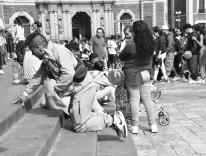
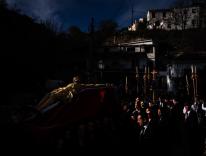
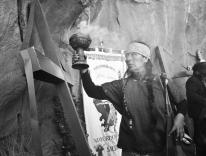
As church bells rang, bottle rockets exploded overhead, and a banda de viento played traditional festive music, a colorful procession left the Iglesia de los Reyes in the Los Reyes neighborhood of Izúcar de Matamoros, a small city in the Mexican state of Puebla. This was the start of the Cofradía Santísimo Sacramento (Brotherhood of the Blessed Sacrament), a day-long celebration.
The Cofradía takes place every year on June 29—the feast day of Saints Peter and Paul—though no one seems to know why it’s held on this particular day. According to Jeny Casbal, the director of culture in Izúcar, the Cofradía was brought to Mexico from Spain more than four hundred years ago. The most important ritual of the Cofradía is the transfer of the platito—a small silver disc representing the Eucharist—from the mayordomo who has taken care of it during the previous year to a new mayordomo. Mayordomos and mayordomas are lay religious leaders who play an important role in supporting the Catholic Church in Mexico.
Izúcar is divided into fourteen neighborhoods—seven east of the Nexapa River and seven west of it. The Cofradía alternates yearly between the two sides of the river. Ten neighborhoods participate in the event, each of them hosting it once a decade. This year, the platito was transferred from Lucio Villalba Barragán, the mayordomo of the Los Reyes neighborhood, to Leonardo Fidel Flores Azcué, the mayordomo of the Magdalena neighborhood.
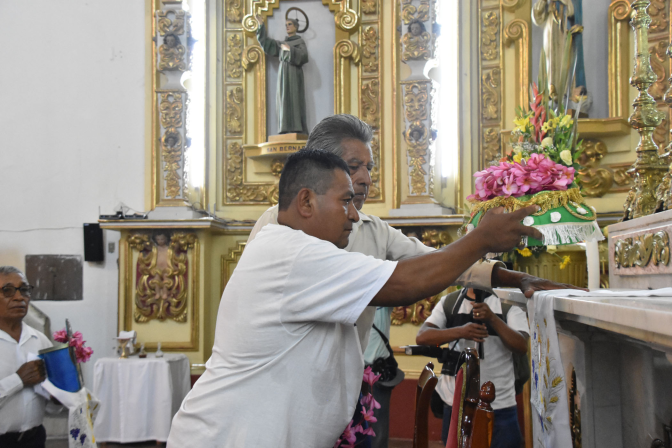
The mayordomos have a number of responsibilities during their one-year term. They organize special Masses, including a Minerva Mass celebrated on the third Sunday of every month. This Mass is followed by a procession in the church atria. “We have [the Minerva Masses] to be closer to God and to strengthen our faith,” Barragán told me. “[We] are responsible for paying for the Mass, but more often than not individuals ask us to let them pay for it as a way of fulfilling a vow.” The mayordomos also coordinate colectas (collections). Every Monday and Thursday, volunteers fan out through their neighborhoods soliciting donations for the Cofradía. The mayordomo provides food after the Minerva Mass and after every colecta. For the Cofradía itself, the mayordomos organize the Mass and processions, hire bands, order fireworks, and provide food for several hundred people. “It is an enormous responsibility,” Azcué told me. “I do this to show my belief in God, my faith in God, and also to conserve this tradition. And we are grateful to have water. Part of the reason for the Cofradía is to give thanks to God for the water that we need for planting.” Throughout the year of their term, the mayordomos must care for the platito with the help of twelve volunteers called dibutados. Each dibutado keeps the platito in his home for a month.
As this year’s procession departed from the Iglesia de los Reyes, it was led by three young women carrying staffs decorated with white flowers. Next came dibutadas carrying baskets of rose petals and, finally, six dibutados carrying the alcancías (money boxes) they’ve used to collect money for the Cofradía. In the middle of the dibutados, Mauricio Vásquez Piedra carried the platito on a cushion surrounded by crowns of beautiful pink Cacaloxúchitl flowers. As the procession passed through the neighborhoods of Izúcar, it picked up many more people, arriving, after roughly an hour, at its destination: the Templo Santo Domingo, a stunning sixteenth-century church where, after a Mass, the platito would be transferred to the new mayordomo.
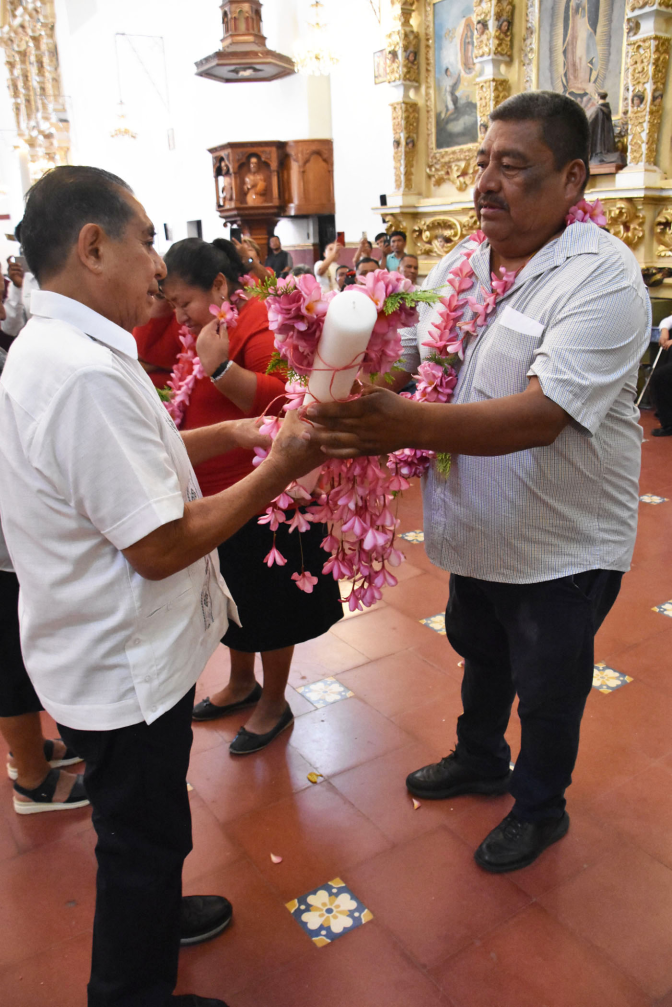
Barragán, the outgoing mayordomo, and all his dibutados and dibutadas entered the church wearing garlands of Cacaloxúchitl flowers. Each outgoing dibutado and dibutada placed his or her garland on an incoming one. Barragán handed Azcué a large candle and then transferred his own garland. “The candle is the symbol of the divine light, an offering and a devotion,” explained Casbal. “The flowers represent a live offering of beauty, purity, and gratitude to God and the saints. They symbolize life, the flourishing of faith.” Finally, Barragán handed the platito over to the priest, who then passed it to Azcué, its guardian for the year to come.
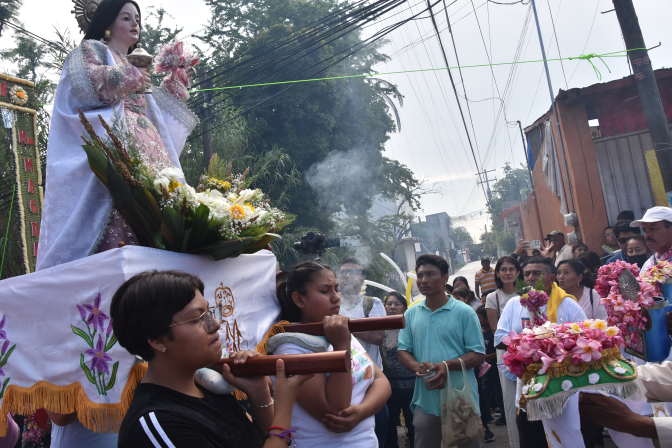
The transfer ceremony over, Barragán, his dibutados, and a few hundred residents of the Los Reyes neighborhood filed out of the church to a thunderous round of bottle rockets and then walked in procession to the Magdalena neighborhood, passing through six of the city’s neighborhoods along the way. In each neighborhood the procession took several descansos (rests) in front of altars that had been set up in the street. When they finally reached the Magdalena neighborhood, the new mayordomo and dibutados were waiting to greet them with a statue of St. Mary Magdalene—the neighborhood’s patron saint. After the platito was presented to the saint, the procession continued, finally arriving at the Magdalena church about two hours after it left Templo Santo Domingo. There, beautiful incense burners made especially for the occasion were used to purify the alcancías.
Then it was time to eat. María Lameta Salícia told me that she and the other volunteer cooks had prepared food for 1,200 people the day before. “We worked from seven in the morning until three or four in the afternoon. We have mole, tamales, arroz and tortillas made by hand. We do it for the church and for God.”
Izúcar is a working-class city. Barragán has an ironworks shop; Azcué is a retired teacher. The dibutados and other locals who contribute to the Cofradía aren’t rich. But they gladly offer their time and money to keep this tradition alive. It is an expression of their faith, a faith that runs deep in this city. As Azcué pointed out, being the mayordomo is an enormous responsibility. I was surprised when Barragán told me he has done it twice now. I asked him if he’d want to do it again when the Cofradía returns to his neighborhood in ten years. “If I’m still alive then, maybe I will be one again,” he said. “It depends on God.”
We welcome your comments about this article. Please send your response to [email protected].