My mom will be received into the Catholic Church this year. She first became a Christian among Pentecostals in high school and later met my Baptist father at a bible study. She married him and, few years later with me on the way, they found the Evangelical Covenant Church. They settled in and raised us kids there. No utopian, my mother always made the best of the church as it was. She took its opportunities to grow and serve but was also honest about its limitations and failings. Now and then it broke her heart. But this past year, now widowed and relocated to a small town in Oregon, she finally gave up on Evangelicalism altogether. In the end, my mom swam the Tiber to get away from Christian nationalism. She just couldn’t take it anymore.
Her story—socially conservative Evangelical turns to Rome to escape MAGA church culture—runs against a gale of high-profile Catholic conversion stories. In those narratives, dissidents alienated from elite liberalism find in the bosom of the Church respite, surety, and—in the consumerist desert of late-capitalism—more amenable vibes. Their ranks include vice president J. D. Vance and Harvard legal scholar Adrian Vermeule. It is true that the Church’s gravitas and profound intellectual tradition can provide right-drifting members of our culture’s elite strata a respectable haven of faith. Indeed, I suspect that “respectability” is one of its major attractions. Why not trade in the Toyota of nondenominational Christian nationalism for the Lexus of Catholic postliberalism?
Less cynically, I should acknowledge that, as Mark Lilla noted in a review of Patrick Deneen’s 2023 book Regime Change, such conversions are just as often motivated by an earnest search for “meaning and direction,” “intellectual companionship,” “structure and spiritual depth.” I should know. Twenty years ago, I nearly became an early adopter of postliberal Catholicism myself.
The low-church pietism of my adolescence did not, blessedly, suffer from the anti-intellectualism afflicting many of its Evangelical cousins. I liked church and loved God, and the adults in my world affirmed the questions I had about the faith. But, beyond Christian-bookstore apologetics, they didn’t have many resources for answering them. My follow-up questions were met with awkward silence.
I eventually found the resources I needed in the Catholic intellectual tradition, but I encountered it for the first time—with God’s providential irony—at a small, Evangelical college. To that point, I’d been a catastrophic student, eking into North Park University in Chicago on the strength of my SAT scores and church affiliation. Lacking direction, I settled on a communications major, which seemed suitably vague, but during a late-night chat, someone suggested I might like philosophy. So, without having yet taken a single philosophy class, I marched down to the registrar and declared a second major. The subsequent semester, God’s sheltering hand cast its shadow: I took ancient philosophy and fell immediately, madly in love. I walked away from class after class vibrating with the excitement of each new question.
I got a very Catholic education at my little Evangelical school. Though none of them were Catholic, all my philosophy professors had earned their PhDs at Jesuit universities. The course “Medieval Thought” meant reading Augustine, Boethius, and Aquinas. “Contemporary European Thought” meant reading Edmund Husserl and Martin Heidegger, non-Catholics who we nonetheless studied through their anglophone Catholic interpreters. In a course called “Anglo-American Thought,” we read Catholic philosopher Alasdair MacIntyre, Anglican thinker John Milbank, and Jesuit theologian Bernard Lonergan. In general, the boundary between philosophy and theology was not given too much mind. Earnest and slightly naïve in the way of young, middle-class Evangelicals, our philosophical awakening was always going to surface difficult questions about faith and identity. Our teachers had the good sense to avoid policing whatever boundaries exist between faith and reason.
For many of us, it only took a little learning for the foundations of our church youth-group theology to fracture irretrievably. Direct, uncritical appeal to the biblical text imploded as a backstop for religious authority. As the war in Iraq dragged on, the alliance between Evangelicalism and American hegemony became less and less defensible. But we were not ready yet to let go of our Christian identity, so we groped around in our studies for new foundations, new ways to fit ourselves into the world. MacIntyre’s criticisms of liberal modernity constructed for us a positive notion of tradition in place of the malign one our Protestant upbringings had derided. Stanley Hauerwas gave us permission to relinquish patriotic zeal when hanging on would have compromised our Christian witness. John Milbank and other Radical Orthodox thinkers gave us an erudite story to tell about our antipathy to secularism.
This re-narration of our faith and its place in American life was no mere classroom affair. We found our way into more traditional, “high church” places of worship: Episcopalian, Catholic, Orthodox. The Episcopalians relieved some of us of what we’d come to see as a shallow hunt for “relevance.” The Catholics offered, via the Magisterium, a replacement foundation for doctrine and morals. The Orthodox offered catnip to wavering Protestants: a claim to liturgical continuity with the early Church. One by one, I watched my classmates defect from the Evangelicalism of their childhood.
I very nearly joined them. During a semester abroad in Australia, I stayed with a family of cradle Catholics who attended Mary Mackillop Memorial Chapel in North Sydney. Tagging along, I tried Catholicism on for the first time. I even knelt at the tomb of the chapel’s since-canonized namesake and prayed for her intercession—a decidedly un-Evangelical petition. But it didn’t take, not then. My imagination was too shaped by the informality of pietist worship to be swept away by high liturgy of whatever stripe. Neither could I quite swallow the elision of the Magisterium’s ecclesial authority with a foundation in the sense we Evangelicals meant it. And I’d taken MacIntyre’s revivification of tradition too much to heart to be swayed by appeals to authentic primitivism in Christian life or worship. Instead, I thought, I’d fill my arms with as many good things from these traditions as I could. Then, eventually, I’d head home to Evangelicalism, bearing the resources I wished someone had offered me. So off I went to graduate school, still an Evangelical—if now an eccentric one.
In retrospect, I can see the undertow of God’s providence pull on my story again. In the home stretch of my Master’s program in philosophy, I met a law student in a bar and we became inseparable. About eight months later, I proposed. Eleven months after that, Annie and I were married.
We got married, as it happened, in a Catholic church in Austin, Texas. Around the time we met, the travails of law school had sent Annie back to Mass for the first time in her adult life, and she really wanted to celebrate a Mass with the wedding ceremony. But I was concerned: wasn’t it awkward that we were to be sacramentally united in marriage, but then divided at the Lord’s table? Fr. Steve, God bless him, asked me if I could affirm what the Church teaches about the Eucharist. Ever the philosopher, I began to explain the Aristotelian metaphysics of transubstantiation. He stopped me and said he’d talk to a canon lawyer about a dispensation. At my wedding, I received the Eucharist at a Catholic altar for the first time—still an Evangelical.
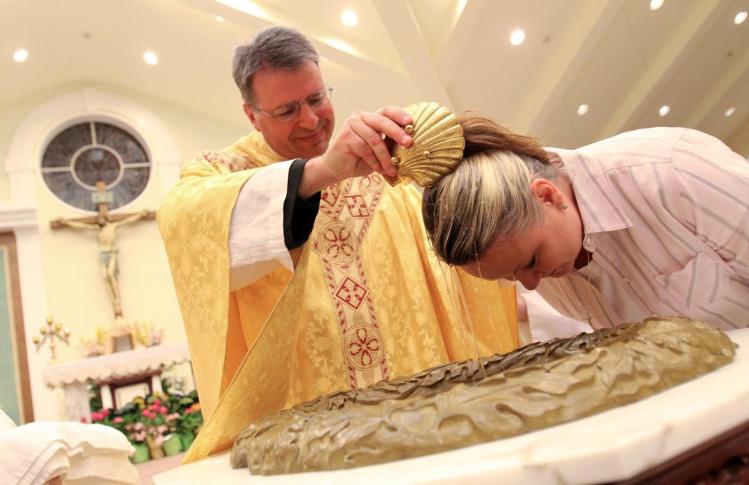
The next year we moved to Milwaukee so I could start a PhD program in theology. We started having kids. We baptized my oldest at the cathedral in Milwaukee. My friend Jakob made him a baptismal garment in the style of a Benedictine habit. We attended Mass there regularly, and Annie sang in the choir. I crossed my arms on my chest each Sunday and received my outsider’s blessing. In the Spring of 2017, we had our second child, my first daughter. She was scheduled to be baptized later that summer, and I suddenly felt a little silly. What was I holding out for? To what “home” did I imagine I was going to bring the plundered riches of the Catholic tradition? Hadn’t I already made a new home? And wasn’t it, with each baptism, increasingly located in the Catholic Church? I dug up my old baptismal certificate, had a meeting with Fr. Jeff, and then, the night before we baptized my daughter, I was received.
Almost exactly ten years after I had first considered becoming Catholic for intellectual or cultural reasons, I had become one for interpersonal reasons. Indeed, in that intervening decade, the Church taught me that the person is a higher value than a culture. For Catholicism, the dignity of the person does not depend on a certain culture or social order. Instead, it is what Bernard Lonergan called an “originating” value, because it is from flourishing persons that a more just society and culture can emerge.
Catholic thought also links the value of the person to not only their “relationality” but also to their liberty. As Dignitatis Infinita put it two years ago, “the choice to express that dignity,” in the form of society or a certain culture “depends on each person’s free and responsible decision.” And so, in recent years, I’ve reconceived my own politics as something like a Catholic liberalism. This has even allowed me to rediscover and affirm, by contrast with postliberal nativism and Trumpist hostility to our highest traditions, a buried vein of American patriotism in myself.
Ultimately, I am grateful that I was allowed to seek reception into the Church not as an act by which I made myself into a Catholic, but as an act recognizing that God had already made me one despite myself. Most importantly, I was afforded the grace to recognize that God’s primary instrument in that making was my family and my friends, and not my books or intellectual inclinations. The Church, as Lumen gentium reminds us, is not a culture, but a people.
We welcome your comments about this article. Please send your response to [email protected].