Anton Cermak, Chicago’s first foreign-born mayor, understood something about American politics and culture that many have since worked hard to forget. “I didn’t come over on the Mayflower,” Cermak said. “I got here as soon as I could.”
Born in 1873 in what is today the Czech Republic, Cermak saw his ethnic roots as a source of strength rather than shame. He brought together many Catholics who had recently arrived in America—Poles, Irish, Italians—as well as Jewish immigrants, to challenge entrenched, mostly Protestant interests. The push to end Prohibition became a powerful, unifying cause. While different ethnic groups still competed and retained their own identities and institutions, they formed an enduring political coalition.
That coalition depended on something less present today among Americans with European roots: living memory of arrival, struggle, and belonging that had to be earned. As that memory fades, it becomes easier to claim that some Americans have always belonged, and that others never will.
The significance of white ethnic identities has diminished in recent generations. In 1990, only 10 percent of Americans declined to report their ancestry. By 2020, close to a third of white respondents declined to specify their ethnic background. Intermarriage, suburbanization, and generational distance from the last major waves of European immigration help to explain why white Americans have become less connected to their roots, and why ethnic fraternal organizations and language-based mutual-aid societies have seen steep declines in membership. The trend is also visible in American Catholicism. Since 1970, hundreds of ethnic Catholic parishes across the country have been closed or merged. None of these developments is nefarious; nobody should yearn for the ethnic politics or patronage networks of yesteryear. But a weakening of white ethnic identities does not merely flatten the past; it also reorganizes power and identity in the present.
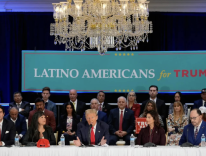
Consider how Americanness is defined by the most powerful figure in the United States. Donald Trump is the grandson of Friedrich Drumpf, a German immigrant who arrived in the United States in 1885. Yet Trump rarely speaks of Germany. He does not talk about Bavaria, Lutheranism, Ellis Island, or assimilation. He presents himself not as German American but as America itself: pure, undiluted, unmarked by history. By diminishing his own immigrant roots, Trump models a new performance of Americanness and encourages a new kind of national identity.
White ethnic memories cut against MAGA’s fable. They recall tenements and parish halls, suspicious landlords and questioned loyalties. They stand as a reminder that many of the people now invited into a broad, aggrieved whiteness were once treated as not quite American themselves. These memories destabilize MAGA’s core claim: that some Americans belong naturally and others never will.
Conservative thought leaders have promoted the idea that some people are “Heritage Americans,” a concept that provides intellectual scaffolding for Trump’s idea of Americanness. According to this thinking, the United States is not based on a set of ideas but connected to the strength of a specific stock or type. It is a view that J. D. Vance has offered both on the campaign trail and as vice president. At the Republican National Convention, Vance described Americans as “a group of people with a common history and a common future.” At the Claremont Institute last summer he went further, mentioning a deeper claim on the country among “people whose ancestors fought in the Civil War.”
The idea of Heritage Americans is not new. It has echoes in nineteenth-century nativism, now refashioned in support of a consolidated whiteness. Groups who were once told they did not belong are now told they have always belonged, provided they accept a new hierarchy that places newer immigrants permanently at the bottom.
While inclusion among these Heritage Americans is meant to instill pride, Trump has worked the same audiences from the other side—telling the white middle class that their acceptance within elite institutions has always been conditional. “Anyone who dissents from their orthodoxy must be punished, canceled, or banished,” Trump has claimed about so-called elites, who he says don’t understand the country’s values or the lives of everyday Americans.
Here, an emphasis on white privilege in corners of the left may have inadvertently helped Trump’s cause. Yes, the history of slavery, segregation, and Jim Crow have real effects in the present. At the same time, treating whiteness as a monolith helps reinforce the same white solidarity encouraged by the MAGA movement. The white son of a Protestant banker in Philadelphia with a Stanford degree and the white son of a Polish meatpacker outside Milwaukee with a GED do not possess the same privileges. This is not a denial of the existence of racial hierarchy. It is an example of how flattening whiteness can obscure the different histories that once made cross-ethnic coalitions possible and could do so again.
Recent responses to Trump’s immigration policies point to how ethnic memories can remain a potent political force. Where they remain embedded in institutions, parishes, unions, and membership-based civic organizations, they can meaningfully shape political behavior. Take the recent success of two cities with dense white ethnic histories, Chicago and Minneapolis, in resisting ICE operations. Coordination among faith communities, labor organizations, and nonprofits helped people resist Operation Midway Blitz and Operation Metro Surge. Sustained political pressure in both cities was not simply a product of progressive resistance but of something older: ethnic institutions transferring accumulated power to newer communities under threat.
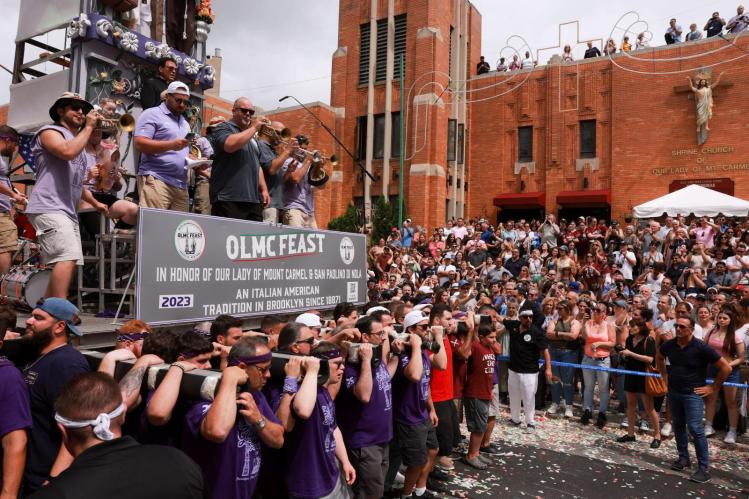
In Chicago, you can still see the older map beneath the modern one: parish boundaries, old union halls, neighborhood festivals that started as ethnic self-assertion and are now part of the social fabric. Their enduring relevance shows up in places like St. Jerome’s Parish in Chicago’s Rogers Park neighborhood. A community built by German, Irish, and Polish immigrants now provides multilingual worship and mutual aid, and during this year’s ICE surge, it offered legal services for newer arrivals. In Minneapolis, a congregation founded by Swedish immigrants in the nineteenth century, St. Paul’s–San Pablo Lutheran Church, coordinated rapid response and support for families threatened by ICE enforcement. Dozens of congregations across the two cities provided similar support.
The same is true of labor unions in Chicago and Minneapolis. UNITE HERE Local 1 in Chicago, first organized for Eastern European and Jewish hotel and garment workers, recruited legal observers and staffed networks to monitor ICE activity. SEIU Local 26 and UNITE HERE Local 17 in Minneapolis, born out of early twentieth-century labor struggles, organized food aid and economic days of action.
Contrast that with two cities where white ethnic identity and memory is weaker: Phoenix and Memphis. Grassroots organizing in Arizona’s largest city failed to prevent the Phoenix City Council’s agreement to cooperate with ICE last fall, even with the Council’s Democratic majority. At four percent in 2024, Arizona has close to its lowest rate of union membership on record. Membership-based pressure has been difficult to generate. These present-day limits have historic roots, with Phoenix’s rapid growth in the twentieth century producing transient neighborhoods and weaker civic ties. Elected officials are more insulated from organized, cross-ethnic pressure.
Phoenix has a different history from Memphis, a city where whiteness formed in opposition to Blackness. But in Tennessee’s second-largest city, a similar pattern applies. Weaker protections for private-sector unions have been part of Memphis’s appeal to companies in industries like warehousing and logistics. In this environment, membership-based pressure is difficult to generate. Catholics comprise a mere five percent of the population in Memphis, and so there are fewer parishes to serve as hubs for community organization. While faith-based immigrant support has remained strong, outreach has been more oriented toward service and integration, not political mobilization. The city’s cooperation with ICE continues, with the Trump administration holding up its partnership with Memphis as a model of cooperation between local and federal authorities.
The contrast here is not between progressive cities and conservative ones. It is between places with thick ethnic memories, where ethnic institutions accumulated power and transferred it to newer communities, and cities where ethnic institutions never developed sufficiently to create political power.
There is no way to “Make Ethnicity Great Again.” Still, institutions that preserve ethnic memory retain considerable power in the present day, even as their specific ethnic character has become less explicit. The work of parishes, unions, and membership-based organizations has helped to make way for new Americans for generations. Their recent success and larger history show how the United States has never been defined by a single group of core Americans. In this country, there are only hyphens, all the way down.
As we respond to the latest attempt to refashion American identity into something exclusionary, we might remember Mayor Cermak’s words from a century ago. Most of us didn’t get here on the Mayflower. We got here just as soon as we could.
We welcome your comments about this article. Please send your response to [email protected].