The startling subtitle of Stephen Harrigan’s book makes a big claim: that the apparitions of the Virgin to three Portuguese children in 1917 were entwined with global events of the twentieth century. But Harrigan earns the right to make that claim. His scrupulously researched history of the six apparitions is reason enough to read this account of the phenomenon that captivated—and alarmed—mid-century Catholic children’s imaginations (Harrigan’s as well as mine). Pre–Vatican II Catholics grew up with the tantalizing and terrifying Fátima mysteries, their promise of “secrets” about war and peace, and “the conversion of Russia” to be revealed—or not. We waited with bated breath.
But Harrigan’s achievement is not only in his meticulous, even dogged determination to get the details of the children’s lives right and to investigate the political upheavals pressing upon Portugal at the time and continuing into the feverish atmosphere of the Cold War. Underneath it all is Harrigan’s own story of growing up in a devout Catholic family. This aspect of memoir is a glinting river that floats all the rest and gives the book its remarkable force.
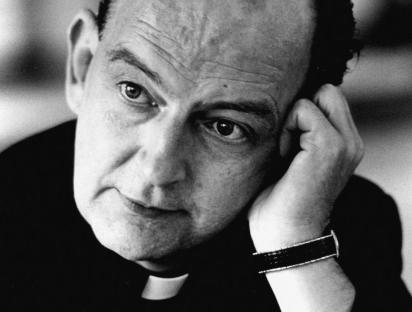
The Fátima story lies at the heart of a pre–Vatican II Catholic world fervid with faith and fear, mostly of “atheistic Communism.” Praying for “the conversion of Russia” was a signal Fátima directive. Harrigan conjures with sharp detail and occasional deadpan humor the devotions in American Catholic homes of the time. (His description of watching Bishop Fulton J. Sheen, a weird Dracula lookalike, swanning around in full clerical regalia on his Emmy-winning television show Life Is Worth Living is worth the price of admission alone.) This mid-century domestic piety—the nightly family rosary, children on their knees around the parents’ bed—may be mostly a thing of the past. But as Harrigan remarks in the book’s final section, “Pilgrimage,” when he goes to Fátima himself, the crowds keep on coming. Like the great shrines of Lourdes and Guadalupe, Fátima remains fully booked.
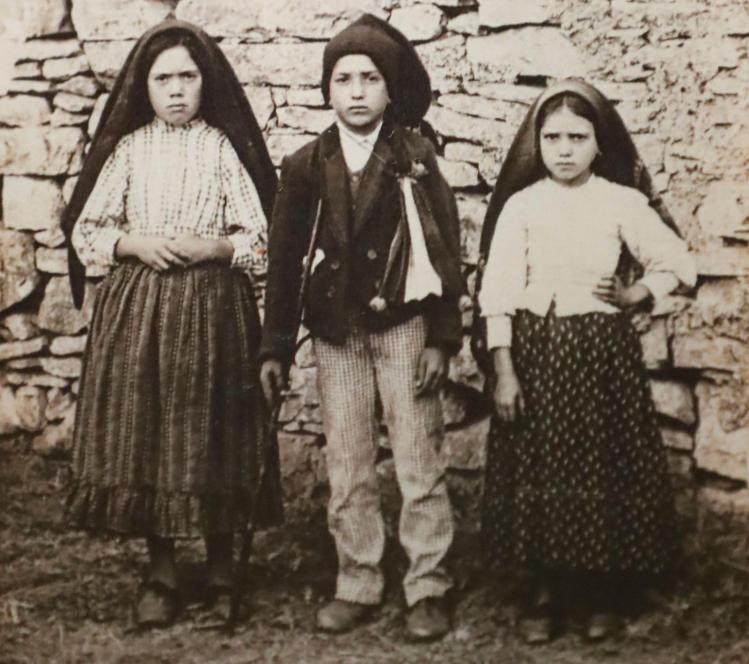
Only one of the three children—Lúcia Santos, the eldest, who was ten at the time of the apparitions—lived past childhood. In fact, she had an exceptionally long life; she died in 2005, just shy of her ninety-eighth birthday, cloistered most of those years as a Carmelite nun. She was a celebrity from childhood, crushed and dismayed by public attention. But, naturally enough, she also found fame enticing, “this gnawing beast that gets into everything.” Popes came to see her, though the letters she wrote in middle age outlining “secrets” about the world’s future remained obscure, the stuff of fear and trembling, until they were made public in 2000.
Her younger cousins Francisco and Jacinta Marto died miserably within two years of the 1917 apparitions from the “Spanish flu,” which likely originated, as Harrigan reminds us, not in Spain but in an army camp in Haskell County, Kansas. Soldiers there were deployed to Europe in the last year of the Great War, infecting the continent and reinfecting America upon their return. The same influenza took Mary McCarthy’s mother and father in 1918 when the family arrived in Minneapolis after a train trip from Seattle. Their deaths, when Mary was six, form the opening of her classic memoir, Memories of a Catholic Girlhood. Harrigan’s book, even with its reportorial research of twentieth-century politics, joins McCarthy’s 1957 book as an enduring Catholic memoir.
Harrigan’s chapters are punctuated with his reminders—confessions in a way—that he is “an ex-but-never-quite-ex-enough Catholic.” But then, having an edgy relationship with one’s cradle Catholicism may be the best way to be a reliable reporter of this religion. Harrigan deftly threads his needle, never succumbing to tedious self-congratulating “recovering Catholic” smugness. He remains fascinated, even tender about his formative faith. He understands that his hard-won secularity harbors “some phantom need to belong to something I can no longer belong to.” He may be baffled by this impulse, but he’s not going to pretend it isn’t there. And no, other religions don’t quite cut it. He admits with some perplexity that after trying the seemingly familiar Episcopal church, he found “there was something that seemed too reasonable to me about the Episcopal service.”
“There is no God,” George Santayana is supposed to have said, “and Mary is his mother.” One of the intriguing aspects of the Fátima apparitions is that it is Mary, not Jesus, who alights on the holm oak in the sheep pasture where the children see her. She bears stern (if secret) prophecies of potential horrors ahead, but even more powerfully, she is Mother—ever attentive, endlessly comforting. Suffering is inevitable, even horrific, but she is here to soothe you.
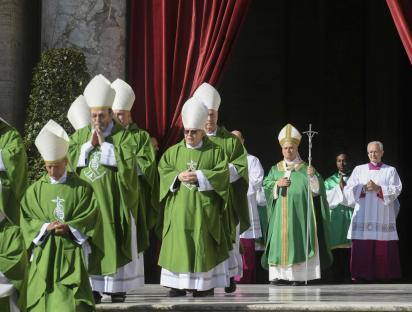
As the children describe her, Mary is no scolding hag. She is young, and a loveliness attends her. Though she eventually shows them her heart—pierced with thorns from the sinfulness of the world—she is “more beautiful than anyone I have ever seen,” Francisco reports. Her pain is not physical. She does not hang on a cross, but alights on a verdant branch (which, of course, is soon destroyed as “the faithful” rip off bits and pieces for relics). Hers is the broken spirit of the attentive observer of this vexed life of ours. She is the one who, as the Gospel says, “ponders things in her heart.” With grieving solidarity and a keen eye, she takes in the world’s mayhem. She does not ask for a chapel to be erected in her son’s honor, instead instructing the pope and all the bishops (Lúcia is firm on this gathering of the entire hierarchy—all male, of course) to dedicate the world to her own Immaculate Heart.
Harrigan admirably presents this magical experience from the children’s point of view (also from the middle-aged and elderly accounts of Lúcia, who can seem a bit daft at times) while keeping a guarded distance from his formative faith. We also follow him through archives and interviews with fervent or scornful students of this century-long saga. This back-and-forth creates a narrative drive that has the allure of a mystery story. I kept turning the pages.
And real crime does play into the story. Pope John Paul II is shot while being driven through St. Peter’s Square in his popemobile by the would-be assassin Mehmet Ali Ağca on—you can’t make this stuff up—May 13, 1981, the sixty-fourth anniversary of the first Fátima apparition. The pope eventually visits Fátima and meets Lúcia. The bullet that by all medical accounts should have killed him is placed, like a jewel, in the crown atop the statue of Mary there.
By the time Harrigan goes to Fátima in 2023, there is no longer a Soviet Union whose conversion must be prayed for, though over a year into the invasion of Ukraine, it would be difficult, he says, “to convince anybody that Russia had been ‘converted.’”
But he makes the trip, as so many pilgrims still do. People are no longer fretting over the Third Secret that was so slow to be revealed, but they’re still looking for something. At the end of his visit, Harrigan dines with the owner of the hotel where he’s staying. “They just feel good here,” the hotelier says of the pilgrims. “They like to pray. They’re searching not only for peace in the world. They’re searching for internal peace.”
Sorrowful Mysteries
The Shepherd Children of Fatima and the Fate of the Twentieth Century
Stephen Harrigan
Knopf
$28 | 256 pp.