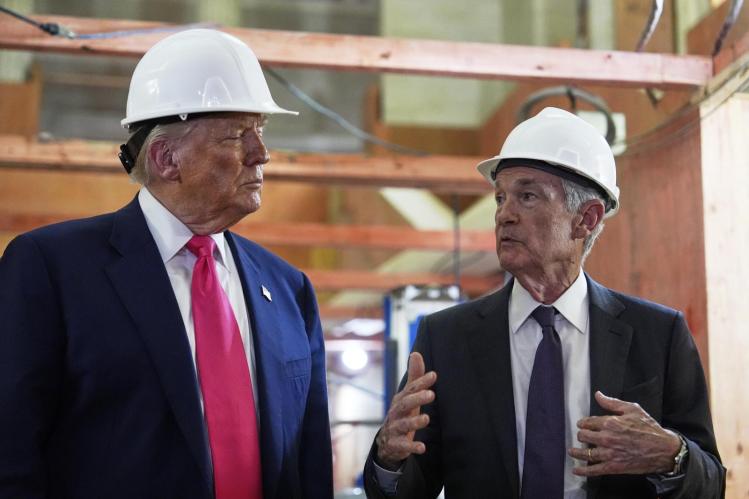
After many months of publicly disparaging U.S. Federal Reserve chair Jerome Powell as a “jerk,” a “numbskull,” and both an “average mentally person” and “a very stupid person,” President Donald Trump formally announced in late January that he was taking the completely expected step of declining to reappoint Powell for another four-year term as head of the nation’s central bank. In his place, Trump has selected attorney and financier Kevin Warsh, a former member of the Fed’s Board of Governors who served during the administrations of George W. Bush and Barack Obama, to take over the job when the current chair’s term expires in May.
Warsh—a Stanford and Harvard Law School graduate who began his career at Morgan Stanley, married a wealthy cosmetics heiress, held multiple positions in the Bush 43 White House, and became the youngest Fed governor in history—is a surprisingly conventional choice for a president who clearly values personal loyalty over establishment credentials. Many observers seem relieved that Trump chose not to hand such an influential role to an unqualified sycophant, but the fact that Warsh has apparently shifted his views on reducing interest rates to more closely align with those of the president suggests that the White House may soon wield more influence over the central bank.
The never-before-seen campaign of intimidation that Trump has waged against Powell and other Fed officials in an attempt to pressure them into lowering rates—so as to boost his flagging approval ratings—has involved not only the aforementioned torrent of petty insults, but a spurious criminal investigation and an unconstitutional firing. Against that backdrop, economist Claudia Sahm has rightly pointed out that “anyone who got the nomination [to become chair] would be under some suspicion.”
In speaking out against Trump’s efforts to bully the Fed into doing his bidding, critics have usually framed the attacks as threats to the “independence” of the central bank, which operates at a unique remove from the other branches of government, and have insisted that the Fed must retain its freedom to act as it sees fit. In the long run, however, the solution to authoritarianism doesn’t lie in further insulating public bodies from the democratic process, but in guaranteeing that they effectively meet the needs of ordinary people—who become more vulnerable to the appeals of demagogues when they do not.
Among economists, the longstanding concern with preserving “central-bank independence” has ostensibly been motivated by an assumption that giving elected officials too much power over monetary policy (i.e., the management of interest rates and the money supply) would inevitably lead to decisions that prioritize short-term benefits over long-term prosperity. As one common version of the argument would have it, politicians facing reelection have strong incentives to keep interest rates excessively low, since voters will reward them for being able to borrow money on the cheap. But as the ability to take on more debt enables everyone to increase their spending, the result will be higher prices for all. Historical episodes of runaway hyperinflation, like those seen in Weimar Germany or Zimbabwe in the mid-2000s, are often held up as cautionary tales of what happens when monetary policy is not cordoned off from the political sphere.
This line of thinking, however, would seem to apply to much more than just monetary policy. Should politicians not be kept away from the crafting of fiscal policy too? After all, many of them regularly succumb to the temptation to keep taxes as low as possible while neglecting to fund investments that only pay off years down the line, like major infrastructure projects or biomedical research and development. Former Fed vice chair and Princeton economics professor Alan Blinder, for one, has actually maintained that “we have drawn the line in the wrong place, leaving too many policy decisions in the realm of politics and too few in the realm of technocracy…. The argument for the Fed’s independence applies just as forcefully to many other areas of government policy.”
But making sure that technocrats remain focused on promoting the common good when isolated from the “realm of politics” is difficult. Supreme Court justices are granted lifetime tenure, supposedly to ensure that they are guided by the rule of law rather than electoral considerations, yet this has not stopped some of them from issuing decisions that twist the meaning of statutes and the Constitution to advance partisan ends. Short-term political pressures may nudge institutions toward myopic thinking, but excessive “independence” can make them more susceptible to capture by powerful interests. The challenge, whether in the case of the judiciary or of the central bank, is to strike a balance between autonomy and accountability.
Many of this administration’s critics seem certain that such a balance had already been struck in the case of the Fed, and that all that is needed is a return to the pre-Trump status quo ante. What is not widely appreciated, however, is that the Fed is not a typical government agency, but rather a sui generis public-private hybrid in which a number of the top decision-makers are subject to little if any democratic oversight. The Federal Open Market Committee (FOMC), which votes on critical matters of monetary policy like the Fed’s interest-rate target, is composed of the seven-member Board of Governors (which includes the chair), the president of the Federal Reserve Bank of New York, and a rotating subset of four of the other eleven regional Fed bank presidents.
But while the governors are nominated by the president and confirmed by the Senate, the regional bank presidents are chosen by the boards of the regional Fed banks themselves, which are dominated by representatives of private financial institutions. Scholars like Wharton’s Peter Conti-Brown have argued that this complicated structure raises serious constitutional red flags, since almost half of the seats on the FOMC are occupied by people who never have to answer to democratically elected representatives. Worse, there can and have been times when vacancies on the Board of Governors have led to the Senate-confirmed members of the FOMC becoming an outright minority.
As someone who had the opportunity to spend two years after college as a research assistant at the New York Fed, I’m convinced that the overwhelming majority of employees across the Fed system are genuinely committed to serving the public interest as best they understand it. (And contrary to Treasury Secretary Scott Bessent’s assertion that employment at the central bank is simply a form of “universal basic income for academic economists,” I distinctly remember having to work for my paycheck.)
But one doesn’t have to buy into cartoonish conspiracy theories about the Fed actively plotting against the American people to see how it might be problematic for the financial industry to hold such sway over monetary policy in the United States. The fact that organized capital has an interest in limiting the growth of workers’ wages may help to explain why the FOMC, despite being charged by law with a “dual mandate” to promote both price stability and full employment, has historically been willing to tolerate significant job loss as an acceptable cost of efforts to suppress inflation. As Gerald Epstein and Aaron Medlin of the University of Massachusetts–Amherst put it in 2023, “the Fed has been laser-focused on keeping inflation extremely low no matter the harm it may cause to the labor market.”
Public policy of any kind, including monetary policy, should be wisely formulated and competently implemented. That obviously requires the involvement of experts, and the current administration is offering some especially vivid lessons in what happens when experts are driven away from public service. We can only hope that Kevin Warsh, should he be confirmed as the new Fed chair, sees to it that the central bank does not witness the same kind of purge of career professionals that has been inflicted on numerous government agencies during Trump’s second term.
But expertise is no substitute for democratic deliberation about collective priorities or fundamental values. Just as we expect to have some small measure of input, via our elected representatives, into decisions about taxation, government spending, or regulation, we should likewise see questions of how to set interest rates or adjust the money supply as legitimate subjects of political debate.
In thinking ahead to a future after Donald Trump’s presidency, reformers of a progressive or socialist bent should follow in the footsteps of movements like the late nineteenth-century Populist Party and make a fairer monetary system just as central a part of their political agenda as a fairer tax system. In our day, this could mean demanding not only a more democratically accountable Fed but more public or cooperative ownership of financial institutions as well. Monetary policy is simply too important to be left in the hands of either would-be autocrats or private bankers. It affects us all, and we should all get a say.