In a New Year’s Address that will go down in history, not for the temporal scope of its inflated banalities—“Everything seems easier when we look back at the past and perhaps even when we look into the future”—but for its questionable credulity, Danish prime minister Mette Frederiksen called NATO “stronger than ever before.” She praised recent progress on security in the North Atlantic, while warning that “Europe must be able to do even more by itself.” Then she said what she cannot genuinely have believed at the time: “On this, I completely agree with the many recent American presidents. Also Trump.”
Three days later, fresh from ordering the kidnapping of Venezuela’s President Maduro, President Trump told reporters aboard Air Force One: “We need Greenland from the standpoint of national security.” Hours later, and in dramatic contrast to her New Year’s message, Mette Frederiksen somberly told a Danish broadcaster that if the United States chooses to attack another NATO country, “everything would come to an end.”
So began the latest, and so far the most volatile, chapter of Trump’s campaign to seize Greenland from Denmark. It reached a breaking point on January 17, when the president threatened tariffs on eight European countries as punishment for failing to support his imperial ambitions. In a letter that in any healthy, functioning democracy would have landed the president in a padded cell, Trump addressed Norway’s Prime Minister Jonas Gahr Støre: “Considering your Country decided not to give me the Nobel Peace Prize for having stopped 8 Wars PLUS, I no longer feel an obligation to think purely of Peace, although it will always be predominant, but can now think about what is good and proper for the United States of America.”
The insanity of this message should not obscure the fact that American interest in Greenland long predates Trump, and will presumably outlast him. In 1867, U.S. secretary of state William H. Seward first floated the idea of entering into negotiations with Denmark over the purchase of Greenland, not least because of its “superb fisheries” and rare-mineral deposits (and because he wanted to establish a prisoner’s colony there). In 1941, the United States reached an agreement with Danish ambassador Henrik Kauffmann to assume responsibility for the defense of Greenland and to prevent Nazi Germany, which had invaded Denmark in 1940, from laying claim to the island. After the war, American troops could not be persuaded to leave Greenland, and Denmark could not be persuaded to sell it. It took until 1951 for them to reach a compromise: a joint defense and security agreement under cover of NATO that preserved Danish sovereignty over Greenland but gave the United States the right to keep and even expand its military presence.
The Trump administration, which resembles Nazi Germany at least in its fetish for territorial expansion, claims the United States needs Greenland in order to build the so-called Golden Dome missile shield, a science-fiction fantasy reminiscent of the Reagan-era Strategic Defense Initiative, also known as “Star Wars.” The new project could cost as much as $3.6 trillion, and Congress has already approved a significant chunk of that money. As well as being a fiscal nightmare, a military expert told me the idea is logistically and technologically implausible.
Does any of this really matter? When President Trump gets an idea into his head, his administration of sycophants and yes-men instantly sets about bending reality to appease him, never mind the consequences. Although it’s too soon to say how all this will end, the Trump administration’s determined efforts to alienate Europe are already bearing fruit. Denmark, a once faithful ally that followed the United States into its disastrous wars in Afghanistan and Iraq, is already exploring ways to reduce its dependence on American security and internet technology. So are many other European countries.
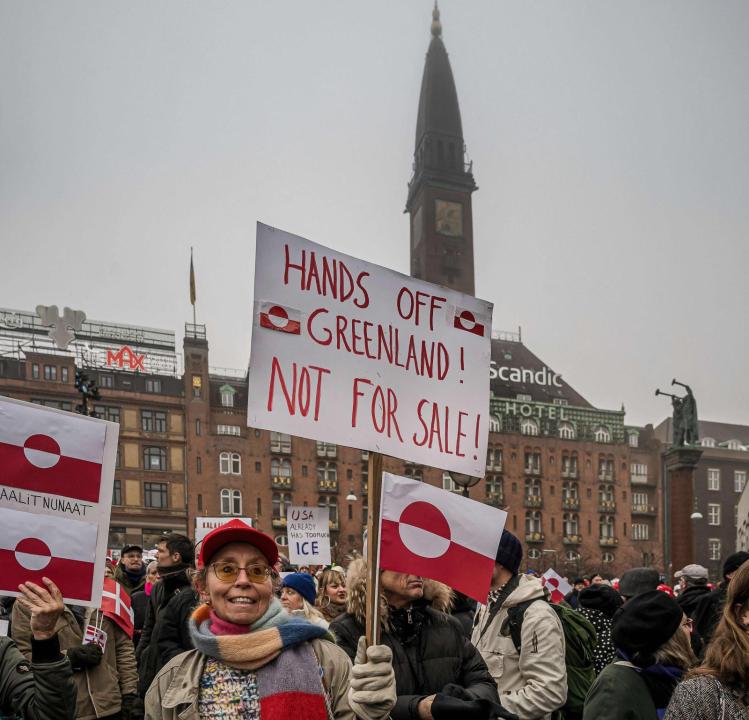
Meanwhile, Danish and Greenlandic politicians have been at pains to present a united front to the rest of the world. Their efforts were bolstered on January 17, when tens of thousands of Danes and Greenlanders gathered in cities across Denmark, not only to protest the United States, but to support Greenland. From City Hall and from the main entrance of Tivoli, Copenhagen’s historic theme park, the Greenlandic flag was prominently displayed. On a stage in front of City Hall, one protester loudly declared: “Today, we are all Greenlanders!”
But what about tomorrow? When I walked past Tivoli and across City Hall Square earlier, there wasn’t a Greenlandic flag in sight. In general, you’re more likely to come across Ukrainian or Palestinian flags than Greenlandic ones when you walk around Copenhagen—a small but symbolic reminder of the strange indifference of the Danish population toward their fellow citizens in Greenland. As recently as 2017, a demonstration in support of Rigsfællesskabet, the political arrangement encompassing Denmark, Greenland, and the Faroe Islands, drew just twenty-six people, including a Faroese camera crew. In 2016, when Greenland first declared that it was “irreversibly” on the road to independence from Denmark, the Danish paid no attention. It took Trump’s saber-rattling for all that to begin to change.
This matters, because whatever the outcome, it’s Greenlanders who will bear the brunt of it. As they did during the Second World War and at the height of the Cold War, they now find themselves swept up in a geostrategic power struggle with an uncertain outcome. “We would like to emphasize once again our desire for the U.S.’s disdain for our country to end,” five of Greenland’s political parties said recently in a joint statement. “The future of Greenland must be decided by the Greenlandic people.” They could have added that Greenlanders already know what being subject to America’s military-industrial complex looks like: decades and decades of pollution. Of the countless military facilities the United States has built in Greenland since 1941—from airstrips to weather stations to naval bases—most have been abandoned and left to rot, leaking diesel oil, radioactive waste, and other toxic chemicals. No U.S. government has ever offered to clean up its mess.
But what’s different this time around is the Trump administration’s repeated threat of an invasion. Though the president appeared to rule out taking Greenland by force in his rambling and racist speech in Davos, the world should know better by now than to take him at his word. In any case, a lot of damage has already been done. Years of stress, fear, and uncertainty continue to take their toll on Greenland’s population. A forty-eight-year-old building contractor recently told a Danish newspaper that he’d had a nightmare in which American soldiers walked around the streets of Nuuk shooting Greenlanders through their car windows. “Just like ICE,” he said.