In The Know-Nothing Campaign Against Higher Learning (Prickly Paradigm Press, 2026), James Chandler, a literary critic and cultural historian at the University of Chicago, explains how the second Trump administration has gone about attacking the country’s universities, which Chandler believes are vital to American democracy. He traces this assault to the nativist Know-Nothings of the 1850s. The Know-Nothings saw the Catholic Church as an internationalist threat to American sovereignty and fought over what was taught in public schools. The new Know-Nothings, Chandler argues, have recast those fears as attacks on “global intellectual elites,” on foreign students, and on the curricula of America’s universities. Commonweal contributor Daniel Steinmetz-Jenkins recently spoke with Chandler about his new book (which he describes here as a “pamphlet”). They discuss the Trump administration’s attack on universities, the future of higher education, and some of the thinkers who have shaped Chandler’s position on democracy and education, such as Alexis Tocqueville and John Stuart Mill. The interview was conducted by email.
Daniel Steinmetz-Jenkins: The title of your book refers to the Know-Nothing movement of the 1850s. Can you explain some of its main features and how you connect them to Trumpism? How does this historical comparison offer insights that we might otherwise miss?
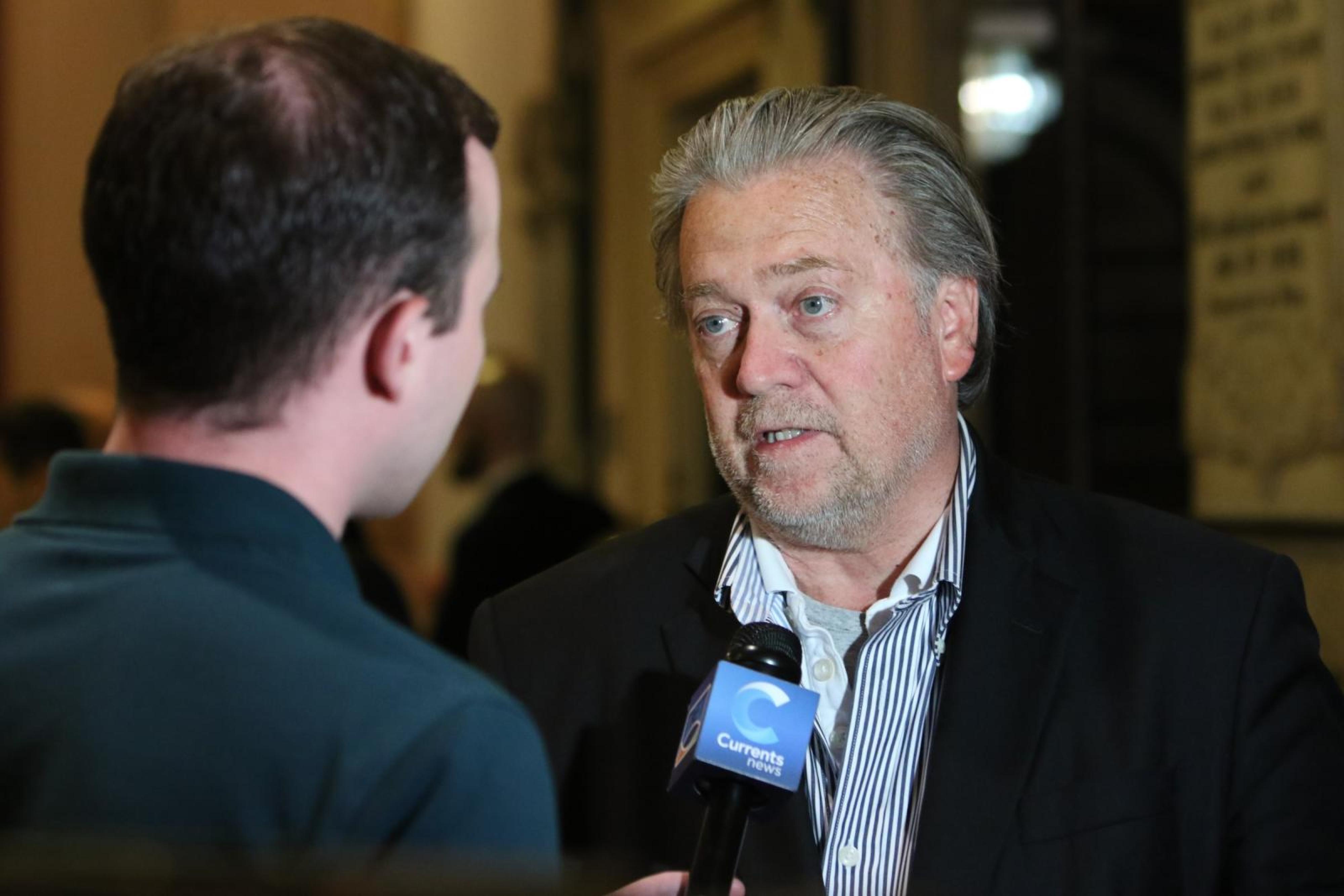
James Chandler: The Know-Nothing movement was short-lived but also pivotal because it effected the transition from the Whig Party to the Republican Party as we know it. It was a nativist or “America first” movement and immensely powerful for a short period. In the mid-1850s, 140 members had been elected to Congress and Know-Nothing mayors governed many major cities. It was an intensely anti-Catholic response to the surge in Irish and German emigration after 1845. Know-Nothings saw the Catholic Church as an internationalist threat to American sovereignty, and they fought ideological battles over curricular issues in schools. Though it wasn’t in the first instance anti-intellectual, the movement came to embrace the Know-Nothing label. When Steve Bannon refers to himself and his supporters as “Know-Nothing vulgarians,” he is using the label to merge his aggressive anti-elitism with anti-internationalism. The striking irony that Bannon—a descendent of Irish immigrants—and Trump—a descendent of German immigrants—should have teamed up to promote MAGA anti-immigration measures was anticipated by Thomas Nast in an 1871 cartoon: “Throwing Down the Ladders by which They Arose.” It showed a new Know-Nothing group, under the leadership of “Patrick” and “Hans” struggling atop a “wall of China” to keep out Chinese immigrants. There have been many discussions of Trumpism in relation to the Tea Party Movement, to McCarthyism, and to Fascist movements in Germany and America. American populism under Jackson in the 1830s is an even earlier precedent. But I think Bannon invoked the Know-Nothings for their special relevance to his cause.
DSJ: You present Trump as being something of a political tabula rasa until he meets Steven Bannon and David Bossie, who stamp their ideology onto him. Is that the right way to read your argument? Or, to put it another way, how much of what we now call Trumpism actually preceded Trump?
JC: “Political tabula rasa” might be a little too strong, but it seems clear that Trump had nothing close to a settled ideological agenda when he first met with Bannon and David Bossie in Trump Tower in 2012, nor perhaps for some time afterward. He was a real-estate magnate with a checkered history, the star of a reality TV show, and a man with a new penchant for generating false rumors about President Obama’s birth certificate—he was also someone badly wounded by Obama’s skewering of him at the National Press Club dinner. He had public appeal but no political orientation. He had changed party affiliation several times over the previous dozen years: from Republican to Democrat in 2001, from Democrat back to Republican in 2009 (right after Obama’s election), to “no party affiliation” in 2011, and then back to Republican in 2012. I think this was part of his attractiveness to Bannon and Bossie. After Bossie’s momentous win in the Citizen’s United decision, and Bannon’s subsequent taking of the helm at Breitbart News in the wake of its founder’s death in 2012, they weren’t looking for the kind of leadership that comes of a developed political outlook. They were looking for a malleable figurehead, and they found him in Donald Trump.
DSJ: Tell us about the process by which Trump was won over to these ideas. You make a big deal, for instance, of Bannon’s 2015 Breitbart interviews with Trump, in which the two men do not always seem to be on the same ideological page.
JC: I do make a big deal about the 2015 interviews between Bannon and Trump, and I’m surprised they aren’t better known and more carefully studied. They mark the moment of Bannon’s reunion with Trump after Trump’s decision not to take on the incumbent Obama in 2012. Bannon and Bossie may have decided they had their man, but he himself wasn’t ready, or perhaps the moment wasn’t yet right. When that changed in 2015, Bannon saw his chance to offer Trump a mutually advantageous arrangement—a deal. Bannon would mobilize his passionate and disaffected constituents at Breitbart in support of Trump, and Trump would learn the codes that would make him appealing to that constituency.
Interviewing Trump in November, the very month when the MAGA slogan was launched, Bannon is a wheedling “Steve” putting words into the mouth of “Mr. Trump.” Sure, there was probably some level of prior agreement on some issues, especially in foreign policy. But in those interviews the two men express divergent views about, for example, immigration: Trump says he wants people to come in, but to come in the right way. Bannon, at this point declaring himself one of the “Know-Nothing vulgarians,” says he is more hostile to immigrants generally. And they seem very far apart, almost comically so, about intellectual elites in general and universities in particular. When Bannon bashes elites and intellectuals, “Mr. Trump” actually upbraids him with the reminder that he, Trump, is both an elite and an intellectual, someone who excelled academically (he did not) and continues to shine in all spheres of knowledge and intellect.
The next key moments in Bannon’s remaking of Trump came late in the 2015 election campaign. In August, Trump asked Bannon to take the place of Paul Manafort as his campaign manager, and by September Bannon had added Bossie to the team. But in early October came the crisis of the Access Hollywood tape. Now Bannon and Bossie had Trump where they wanted him, and his very next speech, delivered at Mar-a-Lago in mid-October, was a Nativist rant about the international threat to American sovereignty. Because Trump later distanced himself from Bannon, in part because Bannon began to tell this very story, it is easy to forget how important Bannon’s Know-Nothingism was to the making of MAGA as a political force over the last decade.
DSJ: It was fascinating to read your commentary about Trump’s connection to professional wrestling, and especially your attempt to connect this to Roland Barthes’s essay, “The World of Wrestling.” Can you explain the wrestling idea of “kayfabe” and how it pertains to Trump in your judgment?
JC: Bannon may have refashioned Trump’s views to appeal to the “Know-Nothing vulgarians,” but the part of Trump’s appeal that comes of his connection to the world of professional wrestling is of much longer standing. His close friendship with Vince and Linda McMahon goes back many years, as he was already quick to acknowledge when he was inducted into the World Wrestling Entertainment Hall of Fame back in 2013. Trump’s antics in the WWE, such as his “Battle of the Billionaires” with McMahon himself, has clearly gained him a certain cachet among his MAGA followers. Of greater interest to me, though, is the way in which Trump’s political gestures came to be coded within the framework of “kayfabe,” a term coined in the 1980s to name the conventions of openly shared illusion that make professional wrestling the kind of show it is. There had a been a couple of things published before last year on Trumpism and wrestling, even Trumpism and “kayfabe,” but I went back to Roland Barthes’s wonderful 1957 essay, “The World of Wrestling.” I discovered just how prescient Barthes was, not just about the WWE (a point actually made in the pages of Sports Illustrated in the early 1990s), but also about Trump-world, with its now familiar playbook for blending the real and the fake. Barthes also argued that, in “the spectacle without thought” that is the world of wrestling, an unbridled impulse for retaliation, staged with melodramatic excess, takes the place of justice itself. This struck me as a pretty good way of capturing much of what’s going on in Trump-world.
DSJ: Let’s transition to the main subject of your book, which is higher education. Why, in your estimation, is Trump targeting universities, and how does this connect to what you describe as a new Know-Nothingism?
JC: As I said earlier, I don’t think Trump was particularly anti-university at the point when he put his hat in the political ring back in 2015. He was proud of his Ivy League education and boasted of his intellectual prowess. I see Bannon as providing the initial signals that this posture wouldn’t go down well with the Breitbart crowd. Bannon himself makes the connection with 1850s Nativism, not just in avowing himself and his followers to be “Know-Nothing vulgarians,” but also in his repeated condemnations of “global intellectual elites,” or even “global scientific elites.” Needless to say, the bashing of universities by right-wing ideologues has come and gone in waves over the decades. More recently, we’ve had the influence of the American Heritage Foundation and also of Christopher Rufo, architect of Ron DeSantis’s takeover of education at all levels in Florida. (Nicholas Dirks writes well about Rufo in his online response to my pamphlet.) Others jumped on the bandwagon, like J. D. Vance, who in a very short time moved from calling Trump an American Hitler to declaring that “professors are the enemy.” The 2024 student protests against the devastation in Gaza clearly became an important factor motivating the Trump administration’s assault on universities, especially as Project Esther emerged from the American Heritage Foundation with an aggressive agenda for combatting what it regarded as antisemitism. The remarkable assumption seems to have been that the student protesters, many of them Jewish, weren’t protesting what was happening in Gaza for the same reason the rest of the world was, but rather because they had been indoctrinated by left-wing antisemitic faculty (many themselves Jewish and even Israeli). My favorite op-ed piece from this period was Michelle Golberg’s “The Christian Evangelicals Accusing Jews of Antisemitism.” Linda McMahon’s accusatory letter to the president of Harvard about these issues—as I try to show in chapter two of my pamphlet—is little more than a piece of kayfabe.
DSJ: Why are Alexis de Tocqueville and John Stuart Mill important for thinking about the connection between higher education and democracy today?
JC: Well, I didn’t undertake this pamphlet with the thought that I would end up producing a defense of 1830s classical liberalism. In the end, though, 1830s American populism under Andrew Jackson, Trump’s hero, offered a useful second context for understanding the campaign against higher learning in our own moment.
When Tocqueville came to America in 1831, and actually met with Jackson, he found much to be impressed by, especially what he called the “equality of conditions” here. One of his prime examples is education. He thought it was enviable that every American citizen was entitled to a primary education. What troubled him, though, was that so few Americans had an advanced education. The lawyers were an important exception, but their knowledge tended to be focused on arcane and technical aspects of the law. The lawyers were a good thing but not, by Tocqueville’s lights, good enough.
One aspect of what he famously called the “tyranny of the majority” under democratic populism was that American citizens, whom Tocqueville judged to be decent and good, were vulnerable to flattery about their own capacities in a way that left them prey to the manipulations of unscrupulous leaders. As the French courtiers in the ancient regime flattered their sovereign ruler, King Louis XIV, so American leaders now flatter their sovereign, the people themselves. And for the same reason: to gain power. The solution, for Tocqueville, was higher education, and Mill agreed in his 1836 review of Tocqueville’s book when it appeared in English translation. But Mill went further: in collaboration with his father, James Mill, and Jeremy Bentham, he helped to found the University of London that same year, 1836, as an institution that would admit students without respect to religious affiliation, gender, or ethnicity.
DSJ: Readers might find it difficult to follow your argument as you go back and forth between the nineteenth century and the present, and along the way discuss the Know-Nothing movement, Tocqueville, Mill, Barthes, Bannon, Trump, and many others. Is there a throughline that holds the argument together?
JC: Fair question. The pamphlet emerged from a couple of pieces I published in 2025, and I suppose it can feel like a collection of essays. I don’t know if there is a single throughline that holds it all together, but there might be a couple of intertwined threads that do some of that work.
One of them is the by-now familiar notion that the last decade of Trumpism has witnessed a programmatic destabilization of knowledge institutions. I see that encapsulated in the assault on the modern university conceived by Mill, an assault on the twin foundations of the open liberal discussion of ideas and the unbridled pursuit of the natural and social sciences. The second strand of the book takes up the pervasive issue of irony in our moment. I was drawn to that question partly in recognition of my own dependence on satirists like Jon Stewart and Stephen Colbert to maintain my political sanity. The irony strand in the book has three aspects. One is the ubiquity of “situation irony” in our moment—a WWE executive as secretary of education, a weekend Fox News host as secretary of defense, a vaccine denier as HHS director. The second is the notion of satire, in the tradition of Swift, as a form of “liberal irony” that undertakes, from the radical middle, an opening up of perspectives on social and political absurdity. And the third is the notion of kayfabe in its mobilization as a would-be prophylactic against the work of satire. I suppose at bottom I’m interested in the connection that has emerged between liberal irony and destabilized liberal knowledge institutions.
DSJ: Long before Trump came along, universities in this county had serious problems. Indeed, you acknowledge this by citing Wendy Brown’s critique of the neoliberal university, which had already hollowed out many liberal values of higher education. So is Trump less the cause of the problems you describe than a symptom of a much deeper crisis in higher education?
JC: In my darkest moments, perhaps like many teachers and academics these days, I fear that the mess we have landed in represents a colossal failure of American education generally. Had we done a better job, I sometimes say to myself, the Trumps and Bannons of this world would find fewer supporters. In that sense, “Trump” looks like a symptom rather than a cause. But “education” here would have to include education top to bottom, which requires support at all levels. If Trump is the result of a failure of education, is that failure a result of underfunding at federal, state, and local levels? I don’t know enough to answer that question authoritatively.
As for higher education, I agree with Wendy Brown that public universities deserve all the support they can get. The problem is that they often don’t get it. That was part of Robert M. Hutchins’s argument in defense of private universities like the University of Chicago when he published The Higher Learning in America back in 1936. The funds raised by private universities have unquestionably helped make American higher education preeminent, at least for now. The massive endowments of some universities—Linda McMahon points out that Harvard’s is larger than the GDP of 100 countries—make them targets of Trump administration attacks but also afford them a degree of security in the face of the threats. And private universities, for all their problems, have not fallen prey as some public systems have to strong-arm moves by state governments, not just in Ron DeSantis’s Florida but also in Glenn Youngkin’s Virginia.
But the private universities, dependent as they have become on big flows of donor support to remain competitive, have left themselves prey to their boards of trustees, despite the historic efforts by the American Association of University Professors to protect against such infringements. The University of Pennsylvania is one of the more conspicuous examples of that problem. And, of course, the larger point is that we don’t know what all those private funds might have done had they been used to support public universities. What I feel sure of, though, is that whatever the ills of higher education in today’s America they are likely to be made worse, not better, by measures taken by the Trump administration.
DSJ: What, then, are you actually defending when you defend the university against him?
JC: Most uncontroversially, I’m defending scientists and their pursuit of discoveries yet to be made, some of which have been delayed or perhaps even missed entirely because of retaliatory funding cuts. I’m defending the hard-won consensus achieved by university scientists about momentous issues like climate change. I’m defending the social scientists who, as a New York Times op-ed coauthored by my colleague James Evans recently argued, are seeing funding slashed at the very moment when their research in dealing with the management of AI has made them, especially in the face of Trump’s laissez-faire approach, perhaps more indispensable than ever. But my home domain is the humanities, and it would be disingenuous not to admit that they now seem to me in very great jeopardy—certainly not entirely on account of Trump, but partly on account of what Wendy Brown calls the “hulling out” of the universities’ liberal traditions. To help me answer this question I went back to a 1965 essay published in Daedalus, the journal of the American Academy of Arts and Sciences, by the great literary critic Northrop Frye: “Varieties of Literary Utopia.” It addresses the strong connection going back to Plato between utopian thinking and educational theory. Conceding that “not all utopian writers are Platonists,” Frye argues that “nearly all of them make their utopias depend on education for their permanent establishment.” Literature and “structure,” as always, lie at the center of things for Frye:
It seems clear that the literary convention of an ideal state is really a by-product of a systematic view of education. That is, education, considered as a unified view of reality, grasps society by its intelligible rather than its actual form, and the utopia is a projection of the ability to see society, not as an aggregate of buildings and bodies, but as a structure of arts and sciences. The thought suggests itself that the paralysis in utopian imagination…in our society may be connected with a confusion about both the objectives and the inner structure of our educational system.
Frye made his name with a remarkable first book about William Blake, and he was unabashed in his commitment to what Blake called “imagination.” “Utopian thought is imaginative,” he continued, “with its roots in literature, and the literary imagination is less concerned with achieving ends than with visualizing possibilities.” Higher education as a place that advances science without prejudice and fosters imagination with utopian aspirations—that is the institution I want to defend from Trump’s crew, who seem to believe in neither.
DSJ: Do you think the university can survive the current assault while also implementing the kind of internal reforms that you think they need?
JC: This is the hardest question you have posed, and I honestly don’t think I’m qualified to answer it. Reforms will be needed, but not those proposed by Trump’s crew. I will say only this. Were I starting out on a life in the academy instead of finishing one up next year, it would be one of the questions I would be doing everything in my power to rally my colleagues to join me in addressing.
We welcome your comments about this article. Please send your response to [email protected].