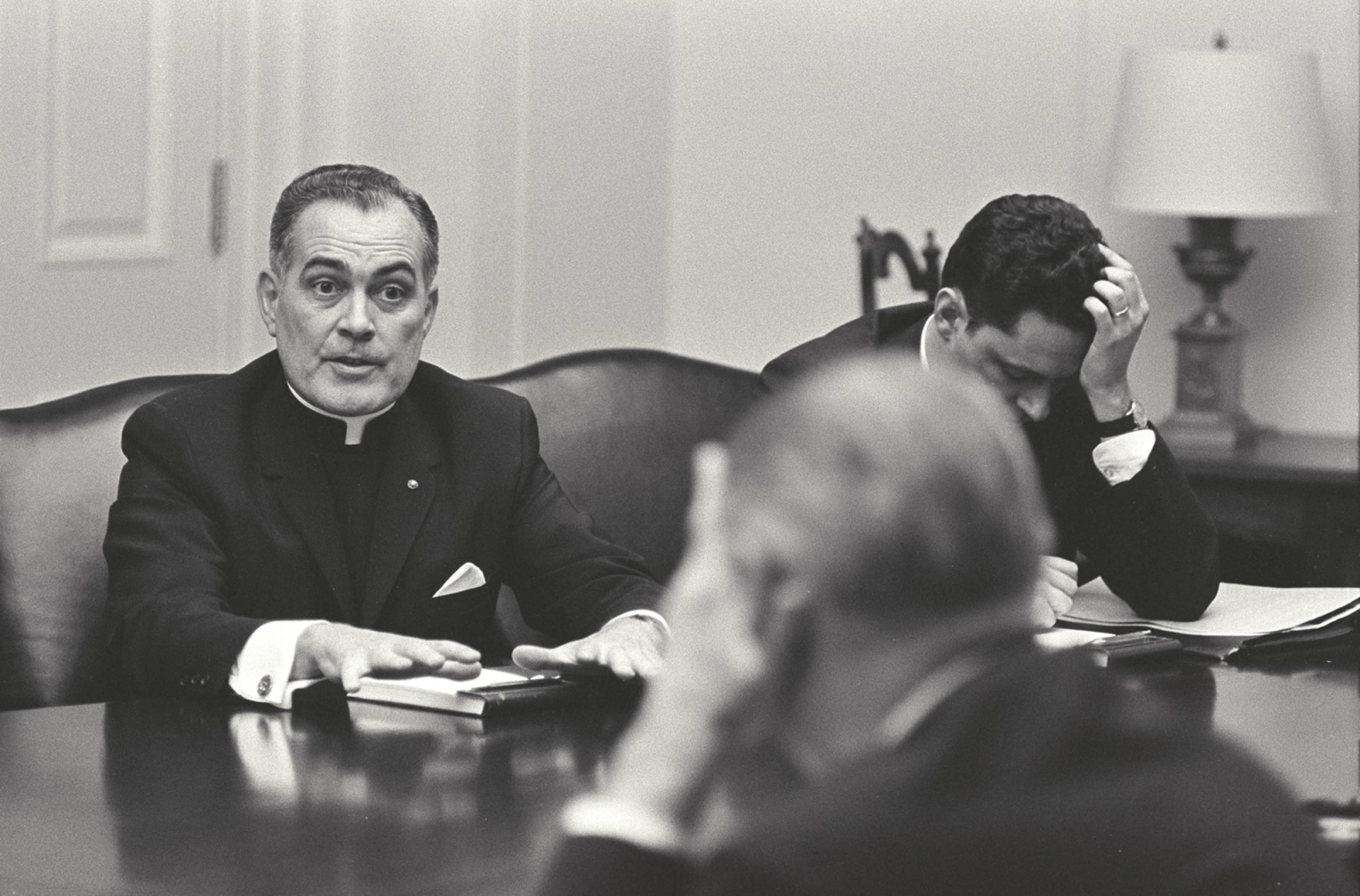
The University of Notre Dame retreat center in Land O’Lakes, Wisconsin, sits near the border between Wisconsin and Michigan. In July 1967, Notre Dame president Fr. Theodore Hesburgh, CSC, convened twenty-six men (yes, all men) at the lake—university presidents, religious superiors, a handful of theologians, and one bishop—and over four days they produced a document that would do more to define the modern American Catholic university than any encyclical issued in their lifetimes. What motivated them were two pressures. The first was from the Church. A year before, the University of Dayton fired four professors, claiming they were in violation of Church teachings. Two months later, St. John’s University in New York fired thirty-one professors of theology and philosophy in the middle of the fall term, for the same reason. The second pressure was foundational: a case pending before the Supreme Court, Horace Mann League v. Board of Public Works of Maryland, threatened public funds to any Catholic university. In 1966, when the court handed down its decision, it found that public funds could not go to religious institutions.
The Land O’Lakes Statement, written against that backdrop, runs only a few thousand words and addressed both concerns. Most of it is forgettable. One sentence is not. To perform its teaching and research functions effectively, the statement declared, the Catholic university must have “a true autonomy and academic freedom in the face of authority of whatever kind, lay or clerical, external to the academic community itself.”
The line was less a declaration of independence from Rome—though it was that—than a declaration that Catholic universities were universities first and foremost. The presidents who signed it knew exactly what they were doing. Hesburgh, who chaired the International Federation of Catholic Universities, had received an instruction in 1954 from his own congregation’s superior general to withdraw a book from Notre Dame Press because it contained a contested essay by the Jesuit theologian John Courtney Murray on religious freedom. The bishops, in the Hesburgh circle’s view, had become an obstacle to the university’s educational mission. Vatican II had cracked the older settlement open. Gaudium et spes had given the universities a vocabulary for what they were already trying to do. The American Catholic university was about to become an American university that was also Catholic, and Land O’Lakes was its founding charter.
The Vatican and conservative Catholic organizations pushed back. And in 1990, John Paul II issued Ex corde Ecclesiae, the apostolic constitution that formally repudiated the Land O’Lakes claim. The constitution was largely ignored in practice.
Conservative Catholics never forgave Catholic-university leaders. For sixty years now, an entire genre of Catholic complaint—from the early William F. Buckley Jr. through Richard John Neuhaus to the present First Things and the publications of the Cardinal Newman Society—has seen American Catholic universities as fallen institutions.
By the time the postliberal intellectual project of the late 2010s coalesced around figures like Patrick Deneen, Adrian Vermeule, and Gladden Pappin, the American Catholic university returned to the Catholic right’s imagination. Many Catholic postliberals felt called to redeem society by recapturing institutions, including universities. By Donald Trump’s second term, and with a Catholic vice president schooled in the postliberal canon, the project had some public power. It started pushing back against all higher education, including Catholic universities.
Then something the integralist intellectuals had not predicted happened: Catholic universities did not surrender. Rather, they started pushing back, leaning on their Catholic mission.
For five days in early April 2026, the president attacked the pope on Truth Social. Trump called the pope “weak on crime, and terrible for foreign policy.” He warned Leo against meddling in “political matters.” He suggested that the pope’s election had been illegitimate, an arrangement of “the Catholic Church” to install an American counterweight to the Trump administration. The pope publicly opposed the U.S. war on Iran and condemned Trump’s threat to annihilate “a whole civilization.” He had referred to a “delusion of omnipotence” driving global instability. Vance, a 2019 convert to Catholicism whose intellectual formation had run through the integralist right, publicly disputed the pope’s just-war reading. Defense Secretary Pete Hegseth described the war as “divinely ordained.”
On April 13, 2026, the president of the University of Notre Dame, Fr. Robert A. Dowd, CSC, issued a brief statement. It was three paragraphs long and subtle for those who didn’t know to read between the lines. It thanked Pope Leo XIV for “proclaim[ing] the Gospel of Christ by upholding human dignity and serving as a tireless advocate for peace.” It asked the Notre Dame community to pray for peace. It did not name Donald Trump. It did not need to.
Dowd’s statement was not the first time a Catholic institution pushed back. In March 2025, William Treanor, then-dean of Georgetown Law School, invoked the First Amendment and the school’s “Jesuit and Catholic mission” in defending its social-justice programs. In August 2025, Notre Dame quietly renamed its Center for Diversity, Equity, and Inclusion after Sr. Thea Bowman, the Franciscan Sister of Perpetual Adoration who was the first African American to receive Notre Dame’s Laetare Medal and a national symbol of racial justice within the Church. In May 2025, the heads of Notre Dame, Georgetown, Boston College, Fordham, Seattle University, and a dozen other universities signed a letter denouncing what one of them, Eduardo Peñalver (president then of Seattle University and now of Georgetown), called the federal government’s “extraordinary” interference in the internal operations of universities. In April 2026, Susan Burns, the president of the University of Mount Saint Vincent in the Bronx, wrote a public letter arguing that the administration’s higher-education cuts violated the Catholic preferential option for the poor. “Catholic institutions cannot stand by,” she wrote, “while government policies systematically dismantle pathways to opportunity for the students we are called to serve.”
The postliberal Catholic intellectual current was the most ambitious Catholic political theology in the twenty-first century. Its claim was that liberalism, meaning classical liberalism, had failed. The mediating institutions that Tocqueville described as holding liberalism together—local associations, churches, and neighborhood ties—had been hollowed by markets, screens, and a managerial state that had no interest in their survival. Liberalism did not produce a thicker society on the other side of all its emancipations.
The postliberal program was less coherent. The state, freed from liberalism and the diminished power of the cultural elite, would direct its power toward the “common good”—family, community, the unborn, the elderly, the dignity of work, and, in the hands of writers like Vermeule, the substantive moral judgments embedded in the natural-law tradition. Vermeule’s common-good constitutionalism elaborated the doctrine in legal form. Sohrab Ahmari, not quite an integralist, called for economic reform in his book Tyranny, Inc. Deneen’s Regime Change, as the title says, demanded a deliberate displacement of the existing American managerial elite by a new aristoi formed in the older virtues, ratified by a popular movement that had grown sick of the liberal project and was ready to use the state to dismantle it.
Vance was steeped in this tradition, having converted in 2019 in part under the influence of Rod Dreher; he befriended Chad Pecknold and Deneen; he appeared at Napa Institute conferences; he sat for interviews with Catholic journalists and influencers. He called his conversion essay in The Lamp “How I Joined the Resistance.” The 2024 Trump-Vance ticket gave the project its first real institutional purchase. By early 2025, the integralists were inside the administration as it prepared to use the federal government to follow The Heritage Foundation’s Project 2025—a postliberal blueprint to discipline universities, cancel grants, investigate institutions for racial discrimination and antisemitism, and threaten federal funding over diversity offices. It aimed to recast the long American debate about race in higher education as a constitutional matter the executive could resolve by fiat.
By March 2025, the Department of Education had opened investigations into Notre Dame and Georgetown over their diversity, equity, and inclusion (DEI) programs, and over Notre Dame’s partnership with the PhD Project, a doctoral pipeline initiative for underrepresented students in business graduate programs. In May 2025, the University of St. Thomas in Minnesota lost a $6.8 million grant on the same theory. By autumn 2025, hundreds of universities had received notices of borrower-defense-to-repayment claims, and Catholic institutions were facing the One Big Beautiful Bill Act’s tiered endowment tax—a tax structured with a precision the integralists would have admired. While aimed at Ivy-plus institutions, it also bit hard on Catholic institutions like Notre Dame, whose endowments crossed the $2 million per-student threshold. By spring 2026, the General Services Administration had proposed contractor certifications requiring federal grantees to abjure “racially discriminatory DEI activities”; the Department of Education’s Accreditation, Innovation, and Modernization “Negotiated Rulemaking” panel had begun its first session in Washington; and a 151-page draft regulation, described by one accreditation expert as a “cluster bomb,” had dropped on American higher education. The mechanism was visible. The state was being used exactly as the postliberal blueprint said it should.
What the integralists got wrong was thinking that Catholic universities would remain compliant and quiet. The presidents of those universities were the heirs of Land O’Lakes. Ex corde had tried to reverse it but could not. Many conservative Catholics assumed that the Catholic identity that remained in those institutions—chapels, statues, “in the Jesuit tradition” boilerplate—was merely decorative. Dignity-of-the-person language was DEI under another name. A serious Catholic political project would have to retake those universities the way the right had retaken the Supreme Court.
The integralists read Land O’Lakes as a surrender to secular norms when it is best read the other way. It was an assertion that the work of a Catholic university (teaching, research, the formation of conscience) could not be performed under direct hierarchical control. It was based on an understanding of subsidiarity that the work of faith needed to be done by those closest to the work itself. Land O’Lakes did not separate the universities from Catholic teaching. The statement’s central claim was Augustinian, not secular: that truth-seeking was the form love took within institutions of inquiry, and that it required the freedom to follow arguments where they led, including, sometimes, into disagreement with whoever occupied the local bishop’s seat.
What the universities took from Land O’Lakes, in other words, was not a license to abandon Catholic teaching, but the responsibility for it. The hierarchy could no longer issue instructions, but the universities could no longer pretend that fidelity was someone else’s problem—namely, men with collars. The administration and faculty had to do the work themselves on each campus. Yes, they did the work imperfectly and continue to struggle around issues such as unionization. Anyone who has spent time inside one of these institutions can name the contradictions. But they did the work seriously and continuously for sixty years. By 2025, the result was an institutional Catholicism that was thicker than its critics admitted, more deeply embedded in faculty hiring, curricular design, and student-life programming than the First Things readership ever credited, and considerably more willing to act on Catholic social teaching.
When Trump’s second administration arrived to discipline institutions of higher education, it discovered that the site of resistance was, of all places, Catholic universities. Their Catholic identity was not actually a thin liberal varnish but a sixty-year tradition of dignity-of-the-person commitments that ran through Catholic social teaching and through the lived experience of Jesuit, Holy Cross, Vincentian, Mercy, and Lasallian formations. To ask them to dismantle their commitments to first-generation students was to ask them to dismantle something they had been doing under different names for generations. To ask them to stop describing the dignity of every person as a foundational principle was to ask them to stop being Catholic. Some complied superficially by renaming offices, scrubbing websites, and deflecting attention. None of them gave up their mission. Instead, they leaned into it more fully.
The Vance circle did not see this coming because it had read the universities through the integralist diagnostic, which is to say, it had read them as artifacts of Land O’Lakes in the polemical version that lives in the conservative Catholic press. The actual Land O’Lakes legacy (the slow, mostly unspectacular institutional formation of dignity-of-the-person Catholicism inside several hundred American institutions of higher learning) was invisible to them. They mistook the absence of the older episcopal control for the absence of Catholic life. They were surprised when the universities began to behave in ways that revealed they had a Catholic life of their own.
The Catholic theologian Massimo Faggioli, in pieces for Commonweal dating back to 2025, has tried to name what was happening: an attack on Catholic universities, mounted in the name of the Catholic faith, by a political movement whose Catholic sponsors had paid little attention to what those universities had actually become. Faggioli has observed that asking American Catholic universities to renounce their DEI-type programs in 2026 was, functionally, equivalent to asking them to renounce their Catholicity. Renouncing the dignity of the person, in other words, is not available to a Catholic institution.
This is, however, not a revival of liberal Catholicism in the 1970s sense: the Kennedy–Cuomo synthesis, the public-intellectual Catholicism that placed Catholic moral language at the service of a center-left politics and was relatively unembarrassed about doing so. Catholic-university presidents are administrators and run very large and complex operations. Their primary instinct is to preserve their institutional operating capacity. It is not that liberal Catholicism has revived. It is that ordinary institutional self-preservation for Catholic universities in 2026 looks, well, Catholic.
Nor is what is happening particularly progressive. The presidents mentioned in this essay are, with rare exceptions, theologically conventional Catholics. Patricia McGuire of Trinity Washington has been writing the same things in defense of Catholic mission for a quarter-century. Eduardo Peñalver of Georgetown is a former law professor whose academic work runs to property rights and the public interest. Fr. Dowd of Notre Dame is a Holy Cross priest whose research focused on African Catholicism and democratization; he is, by the standards of the American hierarchy, a centrist. They are Catholics with very large institutions to run.
It would be easy to dismiss the integralist critique entirely. It would also be wrong. Catholic universities did, over the course of decades, accommodate themselves to academic norms in ways that were not always defensible on Catholic grounds. Some core curricula thinned out into elective sequences that gave students the option to graduate without a serious encounter with the Catholic intellectual tradition. Some diversity offices, in the 2010s, adopted frames that owed little to Catholic social teaching. The Land O’Lakes generation’s confidence that academic freedom and Catholic mission were perfectly compatible was, sometimes, slippery and glib. The right answer to the integralist challenge was to insist on Catholic core curricula, to invest in Catholic theology departments, to take the long-form pastoral mission of the university seriously. The integralists chose, instead, to ally with a federal administration whose project required dismantling the institutional Church’s commitment to immigrants, first-generation students, those on the margins, and to the academic freedom under which Catholic theological inquiry had functioned for sixty years. They chose a short-term political ally over the long-term institutional reform their own diagnosis recommended. The Catholic universities are now in the strange position of doing the integralists’ true work of defending Catholic identity in the public square, while the integralists spend their political capital opposing them.
This is also not, primarily, an argument about Pope Leo XIV. He is not the cause. American Catholic universities have spent sixty years building and deepening their Catholic identity. When a federal administration demanded that they end those practices, they discovered they could not. Pope Leo’s public condemnations of the Iran War on just-war grounds and his encyclical Magnifica humanitas gave universities a vocabulary for what they were already doing. They were not waiting for him. They were already moving in the same direction.
There is a useful word for what is happening: counterreformation. The original counterreformation was the Catholic response to a radical theological project that sought to reorganize Christian life around principles the Roman Church considered destructive of older bonds. It was conducted, like all such reformations, partly at the level of doctrine (think Trent and the Catechism), but mostly at the level of institutions: new orders, new universities, new hospitals, new pastoral practices. It was slow. It was procedural. It restructured Catholic life by redirecting Catholic institutional energy into the long work of formation rather than the short work of polemic. Its great achievement, sometimes obscured by its rhetorical excesses and religious wars, was that it survived its enemies by outlasting them.
Something analogous is happening in the United States. The radical theological project, in this case, is not Lutheranism. It is the integralist effort to use federal powers to discipline the dignity-of-the-person Catholicism that the American institutional Church has formed over the past sixty years. The integralist effort is intellectually serious. It has a real diagnosis of liberal failure. It has a real intuition about the thinness of the present American settlement. Its constructive program does not, however, have a constituency proportionate to its ambitions, and it does not have the universities. Pope Leo’s election, the Hungarian electorate’s verdict, and Fr. Dowd’s April 13 statement are not coordinated events. They are, however, indicators of the same fact. The integralist political theology has reached the executive of the United States and discovered that the executive is a small piece of the actual American Catholic institutional landscape. The universities are the larger piece. The universities have stopped pretending that Land O’Lakes settled what it did not settle, and they have started pretending less, in the only way administrators ever do—by attaching their names to letters, renaming offices, issuing brief statements that decline to dignify presidential broadsides with a response, writing to Catholic magazines and news outlets. But mostly, they quietly continue doing what they have been doing since long before this current political moment, and that is to do what their Catholic mission requires.
This is the counterreformation. It is not loud. It will not be quoted at length on cable. Its principal proofs are not university press releases, presidential statements, faculty-senate resolutions, and one-paragraph briefs filed in federal court by general counsels’ offices. The proof is the day-to-day work done on campus. It will move across the Association of Catholic Colleges and Universities, the Association of Jesuit Colleges and Universities, the Holy Cross houses, and the dozen Vincentian institutions whose presidents may not yet know they are part of a movement. It will succeed, if it succeeds, by exhausting the integralist project’s capacity to attend to it all at once. Trump cannot tweet at every Catholic university. First Things cannot publish counter-essays at the rate needed. The Heritage Foundation does not have the institutional bandwidth to discipline two hundred sites of Catholic formation simultaneously. The universities have one advantage the integralists do not: they have been doing this work for a very, very long time, and they intend to keep doing it.
The April 13 statement from the Notre Dame president is the punctuation, not the sentence. The sentence was written in 1967. Land O’Lakes, read carefully, was not the moment Catholic universities walked away from Rome. It was the moment they accepted the responsibility for being Catholic without supervision. The integralist project assumed that responsibility had been abandoned. The institutional record of the past two years suggests it was simply being practiced quietly, in the only way institutions ever do anything serious: slowly, procedurally, and without expecting to be thanked.
We welcome your comments about this article. Please send your response to [email protected].