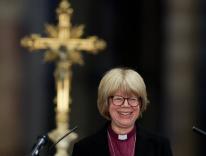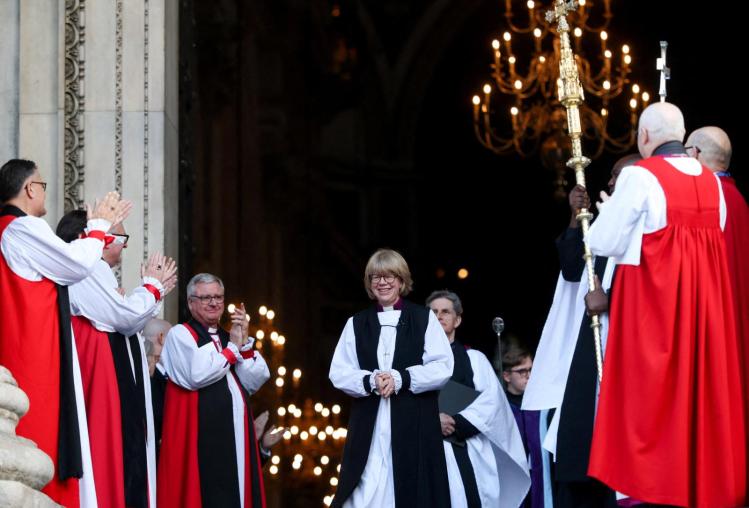
On March 25, Dame Sarah Mullally will make history when she is installed as the first female archbishop of Canterbury. As the 106th archbishop, she will become the leader of the Church of England and spiritual head of the Anglican Communion, which comprises more than 85 million people worldwide. In preparation for this historic inauguration, Mullally also became the first modern archbishop of Canterbury to participate in the medieval Becket Camino: an eighty-seven-mile pilgrimage route from London to Canterbury. For more than a thousand years, Canterbury Cathedral has been the destination of religious pilgrims. Mullally’s participation in the ancient ritual represents a sign of ecumenism as she prepares to lead the Church of England.
Canterbury is the oldest cathedral in England, founded by St. Augustine of Canterbury (not to be confused with Augustine of Hippo) in 597 when Pope Gregory I sent him to convert the Anglo-Saxons. One of the pilgrimage routes is referred to as the Augustine Camino (“road” or “way”), which traces Augustine’s path to Kent and later to Canterbury. The second English route is the Via Francigena, which traces the path that Archbishop Sigeric took to Rome to collect his pallium (liturgical vestment) in 990. The third route, most relevant to today’s news, is the Becket Camino, which has its origins in one of the largest church-state disputes in medieval history.
While some may view today’s Anglican Church as deeply divided, it does not compare to some of the warring disputes that played out in medieval Canterbury. In twelfth-century England, King Henry II and Thomas Becket, Archbishop of Canterbury, clashed over whose courts had jurisdiction over “criminous clerks” (clergymembers who committed secular crimes)—the church courts or the state. After six years of heated debate about legal rights of the clergy, King Henry II reportedly uttered his famous line—“Will no one rid me of this turbulent priest?”—and four knights murdered Becket on the altar of the Canterbury Cathedral on December 29, 1170. There are five surviving written accounts of the martyrdom by eyewitnesses, making it one of the best-documented events in the Middle Ages.
Becket’s cult grew quickly as pilgrims flocked to Canterbury in droves to pray at his tomb. Within three years, Pope Alexander III canonized him. In 1174, King Henry II sought to publicly atone for his role in the assassination: he walked three miles barefoot to Becket’s tomb as part of his penance, and upon confessing his sins, allowed all bishops who were present to beat him several times with a rod. In the ensuing years, Canterbury continued to grow as a pilgrimage destination where pilgrims sought to venerate Becket’s relics. It also became the fabled destination of the pilgrims in Geoffrey Chaucer’s Canterbury Tales, the late fourteenth-century collection of short stories now considered to be one of the great works of English literature. Written in Middle English, it is a collection of twenty-four tales about a group of pilgrims on their way to visit Canterbury. The wildly popular work reveals the enduring fascination with Canterbury and the wide-ranging reasons pilgrims chose to visit the medieval cathedral.
But when King Henry VIII ordered the dissolution of all monasteries across England from 1536 to 1540, Thomas Becket’s shrine in Canterbury Cathedral was destroyed. As part of the English Reformation, Thomas Cromwell, the chief advisor to Henry VIII, banned the practice of pilgrimage in 1538. Within the Anglican Communion, pilgrimage was only revived in the early twentieth century, most notably in 1923 with the joint Catholic-Anglican restoration of the Walsingham Shrine (second only to Canterbury in popularity in the Middle Ages, but destroyed during the Reformation). Both communities helped rebuild the medieval shrine that is now once again a major destination for pilgrims across England.
Walking with a pilgrim’s staff and a scallop shell attached to her backpack (a symbol of the Camino de Santiago pilgrimage in Spain), Mullally left St. Paul’s Cathedral in London on March 17. Hundreds joined her along the way; she made stops for prayer at places such as Southwark Cathedral, the Shrine of St. Jude in Faversham, Lesnes Abbey, and Rochester Cathedral, ultimately arriving in Canterbury on March 22. Upon completing the strenuous six-day pilgrimage, Dame Sarah remarked that it was “deeply humbling to be following in the footsteps of those who have walked this ancient route.”
Mullally’s pilgrimage ended just ahead of the March 25 installation ceremony. Two thousand people are expected to gather at Canterbury Cathedral for the enthronement service, which will contain readings in multiple languages, highlighting the global role of Mullally’s position. Representatives from the Catholic Church, present on behalf of Pope Leo XIV, will be joined by Archbishop of Westminster Rev. Richard Moth, who is the leader of Catholics in England and Wales. William, Prince of Wales, will attend on behalf of his father, King Charles III, and Prime Minister Keir Starmer will be in attendance as well. Mullally says that she will pray for a “fractured world” as she formally becomes the leader of the Anglican Church, a message reminiscent of the call to “build bridges” Pope Leo made when he first stepped onto the balcony on May 8, 2025.
In October 2025, Pope Leo XIV and King Charles III prayed together in the Sistine Chapel of St. Peter’s Basilica. It was the first time that an English monarch and the pope had joined together in prayer since King Henry VIII declared himself the head of the Anglican Church in 1534, and their prayer together was widely heralded as a sign of ecumenism between the Catholic and Anglican faiths. In a similar manner, the pilgrimage Mullally made echoed a Catholic tradition that is still embraced by Anglicans today. These recent events are the result of distinct choices to embrace unity across two of the largest Christian denominations.
In the prologue of The Canterbury Tales, Chaucer notes (in Middle English) that in springtime, “Thanne longen folk to goon on pilgrimages” (“Then folk long to go on pilgrimage”). It is clear that Mullally felt that deep-seated longing to partake in the medieval ritual. She may have followed a route traveled by thousands of pilgrims before her, but Mullally is also forging her own path in history: as the Church of England’s first female leader.
We welcome your comments about this article. Please send your response to [email protected].