I’ve been to the lab so many times that it has started to feel like home. In the twelve years I’ve been coming, not much has changed. This time, the buzzer was out of commission at the back entrance—the door used by the test subjects. Ushered in by a woman wearing maroon scrubs, I took in the smell of gauze, the room’s sterile palette of beige and gray, scrubs in every color. There was a certain warmth associated with this facility, even if the temperature always hovered around sixty-five degrees.
You might imagine that the world’s drugs are tested in sterile, state-of-the-art labs, with blue-gloved scientists in crisp white coats, though it’s more likely that you don’t think of where they’re tested at all. The truth is, they’re tested here: in aging, nondescript office buildings. And more likely than not, they’re tested on people like me, whose circumstances have put them in a difficult position.
The receptionist gave me a seat placement number and directions to a small screening room, handing me a manila folder that contained our informed consent form and W-9. We would be expected to fill out a 1099 at the end of the year, paying back 10–15 percent of our untaxed earnings. This was the gig economy at work. Contract research organizations, better known as CROs, conduct the majority of Phase I studies on behalf of pharmaceutical and biotech companies, hiring contractors like me to participate in clinical trials. I read the informed consent as instructed, lingering on this paragraph: If you seek emergency care, or hospitalization is required, alert the treating physician that you are participating in this research study. Please be aware that some insurance plans may not pay for research-related injuries. I hoped that nothing went wrong, because I didn’t have health insurance.
This particular study was testing a potential treatment for Duchenne muscular dystrophy, an inherited muscle-wasting disorder. If I thought about the drug as a treatment and not a potential risk, it didn’t scare me. But the writing, in bold capital letters on the front page of the consent form, did: THIS IS THE FIRST STUDY IN WHICH THE STUDY DRUG IS BEING GIVEN TO HUMANS. In first-in-human trials, small cohorts are given increasing doses of an investigational medicine until the highest one tolerated by humans is found. I had done several first-in-human trials, but I was usually in the second or third group: number thirteen, say, or thirty, to try the novel compound. The pay was lower, but at least I usually got to know what happened to those first few.
A staff member led me and two men quickly through the informed consent, skipping around to the most critical sections, which she read aloud at a rapid pace. Because no humans had taken the drug yet, there were no known side effects. But there was guesswork. The study drug was bound to a receptor that aided in the transport of iron to the body’s cells, so there was a possibility that you’d be unable to use iron to make red blood cells. For how long, it didn’t say, because they simply didn’t know. There was also the possibility that the study drug could change how a protein called dystrophin was made in the body, which could result in muscle pain, weakness, or a “change in the heart muscle.” If that wasn’t enough, the study would include two muscle needle biopsies taken throughout the duration of the study, where up to six small pieces of leg muscle would be removed to investigate how much of the study drug had been absorbed. Fact: the procedure would be done in a sterile operating room. Fact: the incision would be about an inch. Possibility: reduced mobility for up to a month. More facts and possibilities rolled off the nurse practitioner’s tongue. She spoke with confidence, and for a moment, I felt safe.
It didn’t last long. I looked at the men on my right and left, trying to gauge their body language. We were, of course, all here for the money—$6,300 in total if we completed the entire study without any infractions, like tardiness to a procedure. I wondered if this was their first time, and if not, if they felt the same as I did: that this study was scarier than normal.
After a pause, the guy to my right asked the nurse practitioner in Spanish-inflected English about bleeding. Would the biopsy cause a lot of blood? Would there be bandages? The man on my left stared deeply at the popcorn wall. On his arm, in red ink, a tattoo read, “Faith is stronger than fear.” In the past, that kind of logic guided me through studies like this. I was young, careful; I’d bounce back from whatever happened. But I no longer had that faith. It had gone sometime in my midthirties—gone with Covid, when I realized how precious health was.
You might like: M. Anthony Mills on science and the culture-war
Every human research subject has a line they won’t cross—but it’s a tenuous one, subject to financial need as much as choice. The first several studies I participated in were for a synthetic opioid called buprenorphine, often used today to treat opioid withdrawal. Opioids were omnipresent in the small Alabama town where I grew up, and I figured that if I was taking them recreationally, I may as well get paid for it. They were familiar, so in my mind, they were safe. But after two years or so, the opioid studies were gone. I might have stopped testing drugs then and there, but I had become dependent on the money. Still, there were some things I swore off. Psych drugs were always a no, a boundary fueled by the horror stories I heard from fellow subjects. So were studies with spinal taps. (There are more than you think.)
The nurse practitioner finished her spiel, and then in came the doctor to answer questions, but nobody had any more. Shrunken beneath his white coat, the doctor gave a few cheery, offhand remarks about how important it was to fight muscular dystrophy, peering at the informed consent to jog his memory. It will probably be fine, I reasoned, considering the alternative: How else would I pay rent, how else would I cover my credit-card bill? And if I said no: How much longer until I found another study? I had already come so far in this one, passing the phone pre-screen and the in-person screening, and I still had to return for the in-house stay, hoping all the while that my labs stayed in range.
The nurse released us to the “urine” station to provide samples, and that’s when I realized that even though my line had shifted over time, this study still crossed it. I trailed the other two men, seeking the first opportunity to speak to the nurse alone—I didn’t want to infect the others with my anxiety, which I knew from experience spread fast in the confinement of a testing facility. By the reception desk, I informed her I wanted to unenroll. When, perplexed, she asked me why, I simply said, “Too sketchy.”
If I was not the ideal candidate for this study, who was? Who should test the riskiest drugs, even ones that could—if all went well, statistically a big if—help humanity?
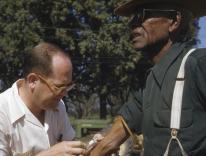
In The Professional Guinea Pig, Roberto Abadie describes the ideal test subject as having “an idealized body, healthy, disciplined, and willing.” This is true, if you’re creating an ideal test subject in a lab. But in real life, “willing” is the newest addition to the list. Throughout modern history, with few exceptions, the most vulnerable people have tested our drugs, from enslaved people to prisoners to soldiers to institutionalized children and adults, many with physical and mental disabilities. “Willing,” although central to the Nuremberg Code, was in practice an addition only established after public fury about the 1972 Tuskegee syphilis study forced major clinical-testing reforms.
A more honest addition to the list? “Would endure anything for the money.” Today, society’s most vulnerable people—formerly incarcerated people, veterans with mental-health issues, and immigrants without work permits—participate in Phase I studies at high rates, often seeking out this work because it’s the best thing available to them. There’s even a disparity between clinical trial phases. The subjects of Phase II trials, for instance, which involve people who have the condition the investigational drug is aiming to treat, are disproportionately white. On the other hand, the subjects for Phase I, or first-in-human trials, are disproportionately Black and Hispanic, research by Jill A. Fisher has found. Testing labs are cosmopolitan places where Igbo, Portuguese, Spanish, and Swahili bounce off the walls. What unites the diverse subjects is precarity, economic or otherwise.
During a study, no one speaks about the study drug—unless something is really wrong. Instead, subjects ask each other about our dreams. Getting a new car. Opening a business. Sending money to family far away. Saving for a house. Leaving the screening, I thought about the outside lives of the men I screened with, wondering how they did their cost-benefit analyses. What might they endure if they, like me, said no?
The informed consent is the bedrock of the modern clinical trial, and it has one crucial job: to briefly detail, in terms that are comprehensible for a lay reader, a study’s definite and possible risks. As a potential subject reads it, they have to make their own calculations, weighing them against their own needs. But sometimes a subject’s needs outweigh the risks, and so they lie to get in. Or they enroll without fully understanding the risks, like María Elisa Rangel, a Mexican immigrant who died while enrolled in a clinical trial in Arizona in 2015 for an investigational epilepsy drug. Rangel had DRESS syndrome, which is a severe allergic reaction to certain medications—especially anticonvulsants used for epilepsy.
In mid-2023, a research subject died by suicide during a study at the New York State Psychiatric Institute at Columbia. There, researchers were testing the Parkinson’s drug levodopa as a possible treatment for late-life depression. In news stories detailing the tragic circumstances of the subject’s death, questions abounded about whether she lied about her mental health during the screening. It’s true that lying is so common among subjects, and so known among recruiters, as to be almost unremarkable. But reading about the case, I found it to be entirely the wrong question. The better question, to me, is one of ethical consent. If a subject applies for a clinical trial under the threat of repossession, or eviction, or some other life-changing consequence, the choice to lie, like the choice to consent, suddenly appears like much less of a choice.
Everyone has a nagging existential question related to the job they do. This is mine: What does it mean that the most vulnerable people test our drugs—drugs that will be out of their price range if, or when, they come on the market? You might say this is a common problem, and you’d be right: house cleaners clean hotel rooms that they can’t afford to stay in, dishwashers clean plates at restaurants where they can’t afford to eat, and carpenters build houses they could never afford to buy. The difference with clinical testing is that this disparity is invisible. That is, we don’t think about the people who test our drugs—and maybe we should.
After a couple of weeks, I found a different study to screen for. One condition for participating in the study, which was testing a drug for treating autoimmune diseases, was that I was forbidden to take any vaccines for six months afterwards. This meant that if I got in, I couldn’t take a flu shot during flu season or a Covid booster when I was due. There was another thing: in order to qualify, I had to stop taking the antivirals that prevented me from contracting HIV in Louisiana, one of the silent epicenters of the AIDS epidemic. I stayed until the end of the screening, weighing the risks of the drug, of getting off PrEP, and of being vulnerable to Covid, against my mounting financial need.
By the end of the screening, I decided that the risks outweighed the benefits. All around me, hopefuls scribbled their signature on the different sheets of the informed consent packet. I didn’t anticipate that I would return. But I signed anyway, just in case.
We welcome your comments about this article. Please send your response to [email protected].