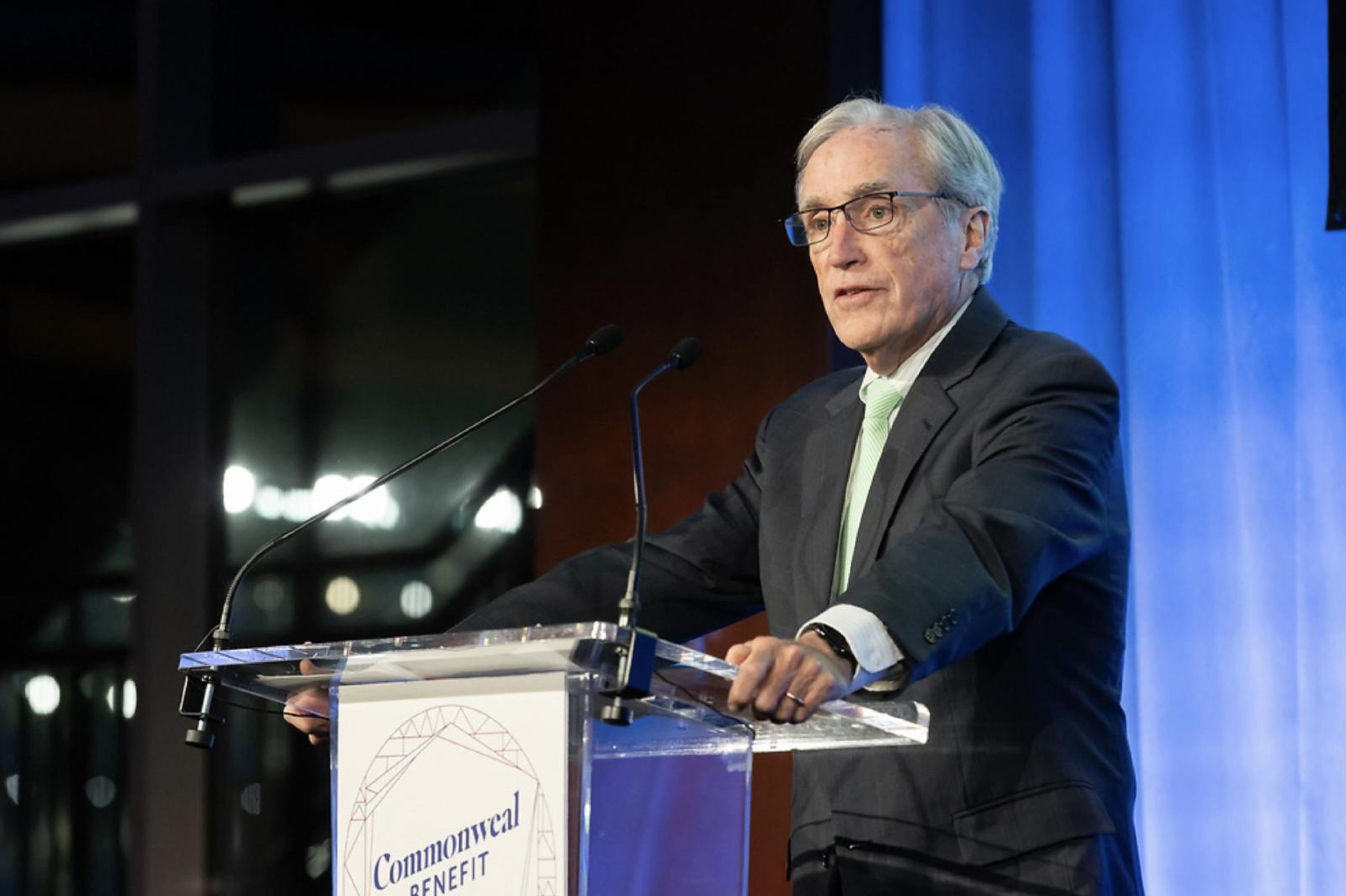
John J. Brennan, chairman emeritus of the Notre Dame Board of Trustees and former CEO of Vanguard, delivered the following remarks at the Commonweal Benefit Dinner on October 5, 2026, in New York City.
Good evening. It is an honor to stand before you tonight, and a particular joy to speak about, and introduce, a man I have known, deeply respected, and admired for two decades.
When Commonweal created its Centennial Award to mark a hundred years of thoughtful, independent Catholic journalism, it set a high bar. The magazine was founded on a simple but demanding conviction: that faith and reason belong in conversation with one another, and that Catholics have something to contribute to the common life of this country. Tonight we honor someone who has spent his life living out that conviction: Fr. John Jenkins.
Fr. John’s story begins, fittingly, with philosophy. He studied it at Notre Dame, was ordained a priest of the Congregation of Holy Cross in 1983 and went on to earn his doctorate in that subject at Oxford. He returned to teach philosophy at Notre Dame, and anyone who has sat across a table from him knows that, though his Notre Dame vocation evolved from teacher to leader, he never stopped being a teacher. He approaches every discussion with an open mind, asks thoughtful and probing questions, and listens to the answers. He will continue to push until he is satisfied that the discussion has been a success.
In my case, my first engagement with Fr. John cemented a first impression of a very unusual and compelling person—and leader—in my mind. I picked up the phone in my office one day and a voice said, “I didn’t expect to get you.” I replied with an absolute lack of warmth: “Well, if you called my number, who DID you expect to get?” After that odd beginning, he proceeded to interview me about topics on his mind that he thought were important to Notre Dame, its mission, and its future. From that first unexpected conversation, one of the most gratifying relationships I could imagine evolved and it is one that I cherish every day.
It was easy for me to see why the Board of Trustees at Notre Dame early on had had the vision to see that Fr. John could one day be their leader. And, in 2005, they elected him the seventeenth president of Our Lady’s University, and he led it for nearly two decades. Under his leadership, Notre Dame grew as a highly respected research university, while holding fast to its deepest purpose: educating the whole person—mind, body and spirit—to be a force for good in the world. That is not an easy balance. Most institutions choose between ambition and identity. Fr. John insisted that Notre Dame did not have to choose. He believed that being more fully Catholic could make it a better university, and being a great university could make it more faithfully Catholic.
But what brings us here tonight goes beyond buildings or rankings. It is the way he leads—anchored in his faith. Fr. John has always been clear with his constituents about what matters and where everyone’s energy and attention should be focused. That’s been true since he laid out his vision for Notre Dame in his inauguration speech and it remains true today. That clarity is one of the reasons that he has engendered incredible followership with his teams wherever he’s been.
One of the topics about which Father John has been especially clear and where he’s been one of the country’s most persistent advocates is civil discourse. Here a just a few ways he has demonstrated his commitment:
- He served for years on the Commission on Presidential Debates, a particularly challenging duty in a very challenging era in our country.
- He has spoken often, and with real conviction, about the need to disagree without making the disagreement personal. And he not only preaches it. He practices it.
- Unlike many of his peers, he encouraged his colleagues at Notre Dame to bring difficult conversations to campus, and welcomed voices from across our divides, trusting that a university, and a Church, are strong enough to hear hard things.
- In the end, he promotes the idea that the opposite of truth is not disagreement, but the refusal to engage.
That is a very Commonweal idea. For a century, this magazine has held that Catholics can debate issues in good faith, with rigor and clarity, about religion, politics, and culture, and that such arguments are themselves a service to the common good. Father John has shown what that looks like when it is done not just in the media but in the daily, complicated work of leading an institution.
Those who know him recognize that one of Fr. John’s most obvious virtues is his humility. In fact, in that first phone call, in response to my gruff “Who is this?”, he introduced himself by saying “My name is John Jenkins, I work at Notre Dame.” Not “President John Jenkins”, not “Fr. John Jenkins.” Merely one of many people at Notre Dame. And, as I got to know him better, that introduction fit his personality perfectly. Rather than accept credit for an achievement, he is quick to deflect praise toward the students, faculty, staff, and Holy Cross community he serves. C.S. Lewis described Fr. John perfectly when he said, “True humility is not thinking less of yourself; it’s thinking about yourself less.”
One more quick story. Several of us were having dinner across the street from Madison Square Garden before a tournament basketball game several years ago, when some people rushed in to say that a man was gravely ill and there would be EMTs arriving through a door near us. Fr. John jumped up and asked if he could help. He quickly left our dinner to minister to the family of the man who had suffered a heart attack and stayed with the family for a couple of hours. As the rest of us walked over to the game, with Fr John enmeshed with the family, one of our guests—a man from a different faith tradition—who only knew him as the highly successful president of the university, said to me, somewhat incredulously, “He really is a priest first, isn’t he?”
The answer to that inquiry was, of course, Amen. Fr. John is indeed a priest first, last, and always. Beneath the administrator, the scholar, and the public figure is a man who has dedicated his life to God, to the Church, and to Holy Cross.
Father John, you once took on one of the most visible jobs in American Catholic life,
- And you did it with intelligence, courage and grace.
- You succeeded in that role beyond all of our expectations.
- But, just as importantly, you reminded us daily that faith does not require us to retreat from the public square, and that reason does not require us to leave our faith at the door. We are all better off for having a role model like you to follow.
No one deserves Commonweal’s Centennial Award more than you, and it is my privilege to join Commonweal in thanking you, and in celebrating you, tonight.
So, ladies and gentlemen, please join me in welcoming and honoring Reverend John I. Jenkins, C.S.C., the 2026 Commonweal Centennial Award recipient.