One day, an ancient anecdote tells us, Diogenes the Cynic walked around backward in the public arcade. When people started laughing at him, he promptly admonished them: “Aren’t you ashamed that while you’re walking in the wrong direction along life’s path, you scoff at me for walking backwards?” As often happens with a Cynic anecdote (or a chreia, as they called it in ancient Greece), it’s largely irrelevant whether the story is accurate or not. Such anecdotes, about real or imagined events, point to a larger and more important story about the human situation, one that trumps our narrow concerns with historical accuracy. How much is factual and how much is imagined in what we know about the Buddha’s life? But does it really matter? Prince Siddhartha may well have been entirely fictitious—like Don Quixote, Madame Bovary, or Ivan Karamazov—and that doesn’t have much of an effect on his spiritual significance or the impact of Buddhist anecdotes on people’s lives. The same goes for Diogenes.
In this chreia, Diogenes urges us to turn our lives around—literally, to revolutionize our existence. In its original sense, the word “revolution” signifies precisely that: a rotation, a rolling back, a turning around. So much in our lives is ossified or even dead because it comes from mere habit and routine, is acquired through mindless imitation of others, or is thrown at us by society in the form of whims, fashions, and commonplaces. The default mode of our existence is to be buried under a pile of social detritus: empty rituals and clichés, small talk and pious lies. This is the social glue that keeps us together and, at the same time, what hides us from ourselves, rendering our lives largely inauthentic. If we are to find ourselves beneath this pile of blinding convention, we need to start by questioning everything that is “generally accepted” and “long-established.” And for that task, we could learn from the ancient Cynics. Cynicism, quipped Oscar Wilde, is merely “the art of seeing things as they are instead of as they should be.”
Inger N. I. Kuin’s new book presents Diogenes of Sinope, one of the original Cynics, as a thinker with a “revolutionary” philosophy, someone who challenged those he encountered to “turn around” their lives. As Kuin puts it, Diogenes’s “ideas and unique understanding of what it meant to do philosophy planted the seeds for a revolution in the minds of his contemporaries that would bloom in the next generation—and, at different times and different places, in many generations after.” While Kuin’s suggestion that Diogenes was also revolutionary in the modern, primarily political sense of the word is not particularly convincing, her framing of Diogenes’s philosophy as revolutionary in nature—as a tool to turn your life around—is both persuasive and praiseworthy.
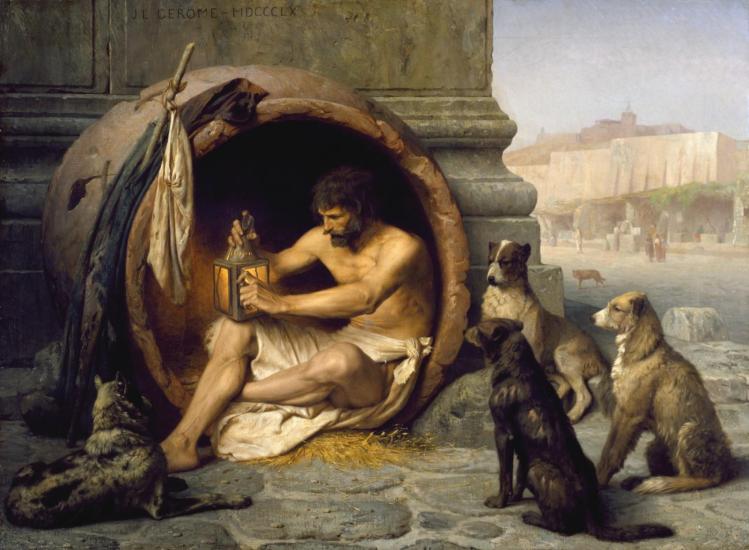
Diogenes led by example. He started out as a banker in Sinope (in today’s Turkey) and ended up a beggar in Athens. A respected citizen of his native city, where he had high status and a spacious home, he became a fugitive and an exile living in a storage jar. Yet for Diogenes, this radical transformation was no mere biographical accident but part of his radical philosophical project: a life of poverty brings you closer to the state of nature and puts you in a better position to understand belonging or not belonging. When someone asked him which city he was a citizen of, the philosopher memorably answered: “I am kosmopolites” (“a citizen of the world”), in the process coining a term that would have its own impressive philosophical career in the centuries to come.
Unbelievably, Diogenes turned even his criminal record, because of which he had to flee Sinope, into a philosophical pedigree. In his home city, he had been caught in a scandal involving counterfeit Sinopean currency. Later, in Athens, he would explain that his skills of changing the value of coins came in handy as he was seeking to reevaluate the customs of Athenian society. To a Greek, this may have sounded like mere wordplay (the same word, nomisma, was used for both coins and customs), but Diogenes had a serious point. Some other art or discipline is almost always involved in the work of a great philosopher. One may philosophize with the mindset and methods of a playwright (Plato), a musician (Nietzsche), or a geometer (Spinoza). So what is the mindset of a counterfeiter? Rejection of authority, contempt for social conventions and community norms, a passion for rule-breaking and a compulsion to transgress—Diogenes had them all.
“The revolution Diogenes envisioned,” Kuin writes, consists of “conceiving a form of human well-being independent of the community: he turned his back on the polis and its trappings (wealth, status, power) to create happiness within, by means of using one’s reason and training the body.” At the core of Diogenes’s revolutionary project, then, was a rejection of the multitude, with its reliance on conventional values, fleeting whims, and passing fashions. Diogenes proposed instead the cultivation of one’s inner life and a remodeling of it in light of higher values and more demanding tasks. That’s why, for Diogenes, a philosophical idea was nothing if it was not embodied in the philosopher’s life. “With Diogenes,” writes Kuin, “thinking, lived experience, and corporeity were inseparable. He gave no lectures but lived out his ideal of radical autonomy in his large pot. If you wanted to learn from him, you had to join him and observe him up close.”
Central to Diogenes’s philosophical program was the practice of dissent. Strictly speaking, you can’t even start living—properly, authentically, on your own terms—without a decisive act of dissent. You as an individual come into existence through individuation—that is, by attaining a sense of your own self, a sense of your distinctness from others. Of course, before discovering your distinctness from others, you must be with them: you grow up with them, observe them, learn from them. Learning happens largely through imitation. Yet the most important lesson you need to learn is precisely how, when the time comes, to separate yourself from others and even, if necessary, oppose them. Someone who hasn’t gone through this process hasn’t yet become whole. She misses something important—herself—precisely because she has so much of something else: the presence of others in her life. In all this, dissent is fundamental. In Diogenes’s view, you discover who you really are at the very moment when you take a stand against others: it’s that opposition that wakes you up existentially. A sense of selfhood is born from the friction thus created.
If dissent plays a crucial role in individuation, it’s all the more vital in such a highly individualized act as philosophizing. True philosophy feeds on discontent and rejection, on dissent and opposition. And here’s where Diogenes comes in. He was no mere contrarian. A contrarian is someone who tends to say “no” where everyone else says “yes”—an almost automatic gesture that doesn’t require much thinking. Diogenes was a principled, intellectually sophisticated dissenter: someone with a philosophy of his own and the courage to pursue it, no matter where it might take him. For Diogenes, dissent was not just a reflex but a vocation.
What’s conspicuous in Diogenes’s public performance of dissent is that he was an equal-opportunity giver of offense: ordinary people or potentates, fellow philosophers or illiterates, beggars like himself or future emperors—he subjected them all to the same merciless performance. The Greek had a special word for what Diogenes was doing: parrhesia. Etymologically, the word meant “saying everything”—and everywhere, and in front of everyone—as a way of telling the truth. A parrhesiastes like Diogenes passed over nothing in silence. Nothing was unmentionable; everything had to be uttered, spelled out, told in embarrassing detail, which could make philosophy a rather dangerous pursuit. This is why Michel Foucault saw Diogenes as “primarily a heroic figure.” For Diogenes knew exactly what risks he was taking. Foucault observes that parrhesia is inextricably “linked to courage in the face of danger…. And in its extreme form, telling the truth takes place in the ‘game’ of life or death.” When asked once what was “the most beautiful thing in the world,” Diogenes’s response was one word: parrhesia. Socrates could not have agreed more, even as he found himself on the other side of the life-death divide.
In the Hellenistic period, a radical philosophical program like the one Diogenes proposed and pursued was a continuation of the spiritual revolution initiated by Socrates a generation or so earlier. Diogenes accepted this lineage, even though he also sometimes mocked Socrates. By Diogenes’s high standards, Socrates was a sellout: he “had lived a life of luxury; for he had devoted too much concern to his little house, and his little couch, and his sandals.”
As for what came after Diogenes and who he inspired, Kuin discovers traces everywhere, even in the central figure of Christianity. “In the earliest source available to us about the life of Jesus of Nazareth,” she writes, “there are many moments in which he sounds almost like a fully-fledged Cynic philosopher.” Spiritual genealogies are a complicated business, but Kuin believes that, given the profound Hellenization of the Mediterranean world at the time, “it is at the very least possible that this religious innovator and rebel was, perhaps unknowingly, at some point inspired by Diogenes’ revolutionary ideas.” From early Christians to Sufi Muslims to Jean-Jacques Rousseau to Friedrich Nietzsche to Marina Abramović, Kuin finds the Cynic’s influence to be both lasting and pervasive. It’s one of the great merits of her book to have mapped out the vast landscape of Diogenes’s heritage not only across centuries and cultural spaces but also among different schools of thought and artistic movements.
There is a fundamental tension at the core of Diogenes’s philosophical project and life. On the one hand, he turned his back on society and never stopped berating the falseness of its idols and the shallowness of its values. On the other hand, he rarely abandoned the company of humans. For all his praise of nature, Diogenes didn’t leave society to live in the wilderness, as some Christian hermits did. He remained in Athens or Corinth, in the midst of civilization. He may have berated the crowds, but he parked his jar in one of the world’s most crowded places: Athens’s marketplace. He needed an audience as much as he needed solitude.
Diogenes must have been all too aware of this tension. As Kuin observes, he knew that “in order to be able to pass on his message about the Cynic way of life, he had to be able to get people’s attention.” But then, with “his rejection of the polis he ran into the irresolvable problem that the same polis was the stage that allowed him to live out his philosophy for everyone to see.” That’s how the Cynic must have discovered that he was split within himself, and how ironic his situation was. Not that he minded: if there was something Diogenes thrived on, it was irony. The more biting, the better. In that way, too, he was a true heir of Socrates.
Diogenes
The Rebellious Life and Revolutionary Philosophy of the Original Cynic
Inger N. I. Kuin
Basic Books
$30 | 320 pp.
We welcome your comments about this article. Please send your response to [email protected].