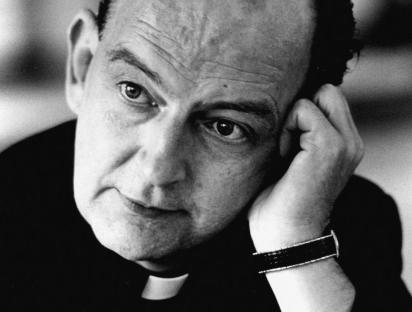
In the music world, combining great individual talents into a “supergroup” may be intriguing in theory, but it has rarely, if ever, yielded a whole greater than the sum of its parts. The same can be said for this pairing of Harvard pro- fessor and social ethicist Robert Coles and rock superstar Bruce Springsteen. Coles’s Bruce Springsteen’s America is well intentioned, but deeply misguided. His attempt to present Springsteen as an authentic voice of the American people suc- ceeds only in resurrecting reverential cliches that mix fact with fantasy, confusing Springsteen the brilliant song-writer with St. Bruce, the patron saint of all that is good and real in America.
Certainly, in Springsteen, Coles has chosen a subject who is among the greatest songwriters rock ‘n’ roll has ever produced, but there is a nagging sense that the author is attempting to apply an unnecessary academic gloss to a body of work that is more than able to speak for itself. Chronicling various people’s re-actions to Springsteen’s music actually has the curious and unintended effect of alienating rather than enlightening us. The power of rock ‘n’ roll in general, and much of Springsteen’s work in particular, depends on a sense of immediacy that is somehow diminished when it is intellectualized.
Structured as a series of interviews with ordinary Americans, the book rambles and repeats itself as those who are interviewed—a grandmother, a globe-trotting businessman, and a truck driver, to name a few—hold forth at length on what Springsteen has meant to them. Most surprising is how such a wide variety of people all sound remarkably the same. The wife of a busy executive sounds like an extra from The Grapes of Wrath: “[Springsteen] could give us, we womenfolks, a few good ‘roles’ [in his songs]—it’d help the menfolks out a whole lot, to hear it from the other side of the street.” It’s as if Coles assembled a cast of Gabby Hayes sound-alikes: simple but honest Americans who can’t but “tell it like it is.”
This artificial folksiness permeates Bruce Springsteen’s America, but it is most notable when Coles is reflecting on the advice of his mentor, the poet/physician and Garden State native William Carlos Williams. Coles recounts at length and with remarkable detail how, over four decades ago, Williams would try to understand his patients’ hopes and dreams through another New Jersey pop icon, Frank Sinatra. As David Hajdu pointed out in the New Republic (“Tramps like Who?” December 15, 2003), Williams’s remarks are so “neatly suited” to the Coles argument—and so similar in style to the other quotes in the book—it is hard to believe they are accurate.
In defense of Coles, he is hardly the first to wax rhapsodic about the legend of Springsteen. There are few artists who inspire as much utter devotion and mythologizing as “The Boss,” and none for whom the disconnect between artistic vision and audience perception is so stark. The unfortunate byproduct of this is that a talented songwriter is lost amid the many competing identities that have been projected onto him: populist, patriot, guy next door, Roman Catholic—to name just a few.
In Springsteen’s most powerful work, there is delicate mastery of character and detail that is novelistic and cinematic at the same time. “Now, my ma, she fingers her wedding band / And watches the salesman stare at my old man’s hands / He’s telling us all about the break he’d give us if he could, but he just can’t / Well if I could, I swear I know just what I’d do / Now, mister, the day the lottery I win I ain’t ever gonna ride in no used car again,” he sings in “Used Cars” from his album Nebraska (1982), beautifully capturing a child’s-eye view of an awkward, ambivalent moment in a working-class family’s life.
Since Nebraska, Springsteen’s songs have become more overtly political. The most famous example is “Born in the USA,” (1984) about a Vietnam vet who returns home to find he’s been abandoned by the country he risked his life for. But there have been many other examples of songs that contain a similar critique, including more recently “Streets of Philadelphia” from the movie about a gay, HIV-positive lawyer looking for justice, and “41 Shots” about the killing of an innocent West African immigrant in the Bronx by New York City police officers. It is interesting that Springsteen still enjoys tremendous popularity over-seas. Rather than dismiss him as a flag-waving patriot, European audiences seem to recognize the nuance and irony in his songs and embrace him as representing America’s best qualities.
Sadly, much of that nuance seems lost on his American audience. Near the end of a September 2002 concert I attended in Philadelphia, Springsteen took a few moments to make some relatively benign comments to the audience. He spoke very briefly about protecting our civil liberties in post-9/11 America and making sure we think long and hard before we send our sons and daughters over-seas to fight a war in Iraq. As Springsteen was speaking, the thirty-something man standing next to me, who had been on his feet cheering the entire concert, started to mutter “Shut up, shut up, Bruce, shut up.” This was the same man who had sung along with gusto all evening long. It was as if he didn’t want to break the spell Springsteen’s excel-lent live show had produced and acknowledge what his songs were actually about. My experience that night was hardly unique. Toward the end of Springsteen’s tour, his comments about the war in Iraq were met with “noticeable jeers and even booing,” according to one report. Coles subtitled his book “The People Listening, a Poet Singing” but I wonder if there is any truth to the first half of that statement: Are the people listening? Maybe the instinct to see and hear only what we choose is a more faithful reflection of America than I care to admit. It certainly gets closer to the truth than Robert Coles does.
Bruce Springsteen’s America
The People Listening, a Poet Singing
Robert Coles
Random House
$23.95 | 244 pp.