No, Cardinal Kasper is not a racist. (UPDATED)

(Cardinal Kasper now denies that anyone from Zenit asked for an interview, and that he "never spoke this way about Africans." Zenit has pulled the interview. And the interviewer has published his response, complete with a full transcript and audio. Scroll to the end of this post for more.)
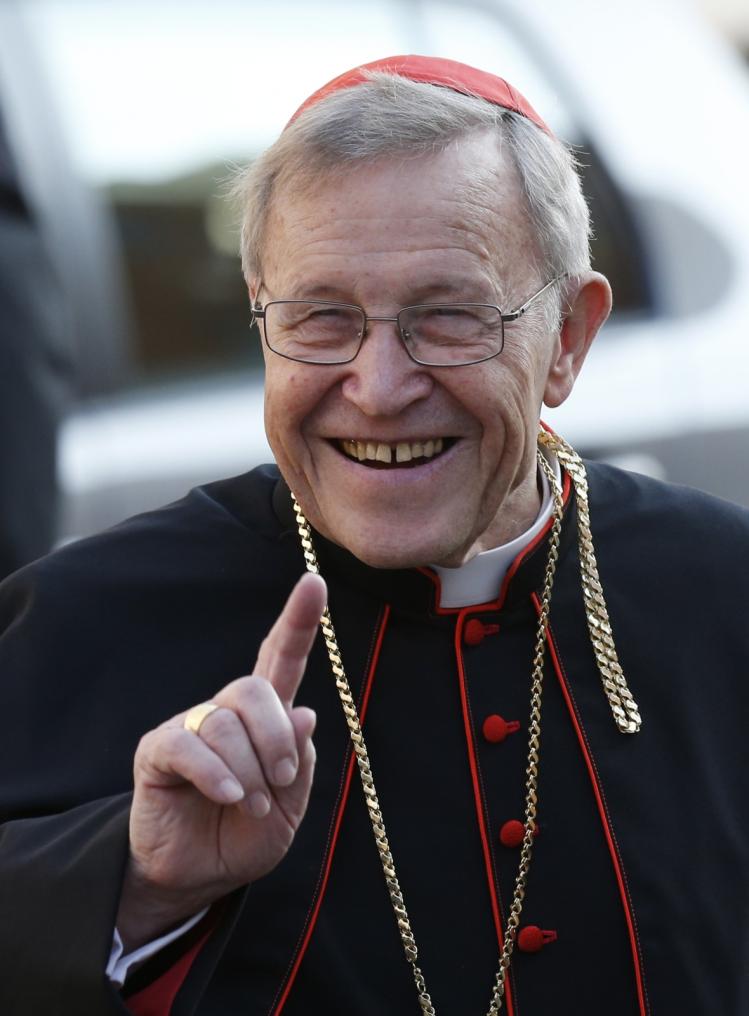
Yesterday, Edward Pentin, who sometimes identifies himself as a representative of the National Catholic Register, sometimes the Catholic Herald, published a brief interview with Cardinal Walter Kasper. Apparently Pentin got hold of Kasper as the cardinal was leaving the synod hall, and asked the obvious questions about his proposal to allow some divorced and remarried Catholics to receive Communion. Kasper said he believes support for that position is growing among the synod fathers.
Then Pentin--who claims he has seen "evidence of an engineered synod"--asked about the five people Pope Francis asked to help write the interim report on the discussions, and whether the pontiff was "trying to push things through according to his wishes." Kasper denied that the pope was manipulating the process, and then he elaborated on the difficulty of writing a summary document that accounts for the many cultures represented at the synod:
The problem, as well, is that there are different problems of different continents and different cultures. Africa is totally different from the West. Also Asian and Muslim countries, they’re very different, especially about gays. You can’t speak about this with Africans and people of Muslim countries. It’s not possible. It’s a taboo. For us, we say we ought not to discriminate, we don’t want to discriminate in certain respects.
Pentin had some follow up questions, naturally.
But are African participants listened to in this regard?
No, the majority of them [who hold these views won’t speak about them].
They’re not listened to?
In Africa of course [their views are listened to], where it’s a taboo.
What has changed for you, regarding the methodology of this synod?
I think in the end there must be a general line in the Church, general criteria, but then the questions of Africa we cannot solve. There must be space also for the local bishops’ conferences to solve their problems but I’d say with Africa it’s impossible [for us to solve]. But they should not tell us too much what we have to do.
Those comments, even though they do little more than state the obvious truth that a one-size-fits-all pastoral approach doesn't work in a global church, have occasioned much flouncery.
According to one critic, his remarks indicate a "stunning" insensitivity toward the African church. Others claim his remarks prove that he is "xenophobic" and "discriminatory." Maybe he should take a vow of silence, another suggested. "Master Kasper likes only one kind of African:
muzzled, submissive, and silent, and who knows his own place," a fringy traditionalist blog declared. One person went further.
Heil Kasper?: Irony lost on German Cardinal when he speaks like Euro prelates are the African bishops' masters http://t.co/NfEB1B8qQC
— Francis J. Beckwith (@fbeckwith) October 15, 2014
(Tenure can be so freeing, don't you think?)
Of course, there is nothing condescending, or xenophobic, or discriminatory, or--and let's just use the word that the most strident critics want us to think of--racist about Kasper's remarks. Look at what he said: Africa is not like the West when it comes to homosexuality. Neither are Islamic and Asian countries. In some places it's a taboo subject. Is that news?
Yes, he said "you can't speak about this with Africans and people from Muslim countries." But he didn't mean that it's a waste of time, or they're impossible. When I interviewed Kasper, with my colleague Matthew Boudway, it became clear that he had a kind of verbal tic when he was trying to describe a difficult situation: "It is not possible." That didn't surprise us because he's not a native English speaker. In fact, before we got started, the cardinal apologized because "my English is not so good." Indeed, his fluency made editing the interview a bit challenging.
But what about Pentin's follow-up questions?
"Are African participants listened to in this regard?" Kasper: "No, the majority of them [who hold these views won’t speak about them]." We have no idea where Pentin interviewed Kasper. Was it noisy? Is that why brackets appear? perhaps Pentin's paraphrasing is accurate. Kasper's view may be that African bishops just haven't said much on the subject of homosexuality. You can't listen to someone who isn't talking.
But Pentin wants more. So he presses, "They're not listened to?" And Kasper says, "Yes, in Africa, of course"--then Pentin fills in--"where it's a taboo." Again, are we supposed to be shocked to see a Western European cardinal explaining that in Africa homosexuality is a taboo subject? This is common knowledge.
But when Kasper says "in Africa," he is signaling his approach to the question. Have another look at the final passage we're supposed to find offensive.
I think in the end there must be a general line in the Church, general criteria, but then the questions of Africa we cannot solve. There must be space also for the local bishops conferences to solve their problems but I’d say with Africa it’s impossible [for us to solve]. But they should not tell us too much what we have to do.
The context of this response is the question of how a local church addresses its own pastoral challenges. (This is, after all, an issue to which he's given some attention.) "The questions of Africa we cannot solve." He means the German church. (Or perhaps the Western European church.) That's why, he continues, "there must be space also for the local bishops conferences to solve their problems but I’d say with Africa it’s impossible [for us to solve]." The "us" Pentin supplies, but again Kasper is saying that one local church cannot solve the problems of another. He doesn't mean we the synod, or we the rest of the church. He means we the Germans, we the Europeans, we the West. In other words, it's up to the churches of Africa to handle their own pastoral challenges. Just as "they should not tell us too much what we have to do." That's hardly dismissive, or xenophobic, or worse. It's just good theological sense.
Update: Today Cardinal Kasper reportedly said, “I am appalled. I have never spoken this way about Africans and I never would. I assure you that in these days and weeks...nobody from Zenit has introduced themselves to me and no one has asked for an interview. Nobody from Zenit has had an interview from me.” (Thanks to Austen Ivereigh for the rough translation.) Zenit has removed the piece from its website.
This may raise more questions than it answers. First, when Kasper says that he hasn't spoken "this way about Africans," does he mean that he literally did not say the words attributed to him buy Edward Pentin? Or does he mean that he did not mean to suggest, as some alleged, that he was dismissive of the concerns of the African church?
My hunch: Kasper is reacting to the critics who have alleged he couldn't give a fig about the experience of the African church--especially those who suggested his comments were basically racist. It was never Kasper's intention to dismiss his brother bishops' concerns. He was making a point about subsidiarity--that is, at what level should pastoral questions be addressed? Who is best equipped to deal with the pastoral problems of a local church? For Africa, Africans. For Europe, Europeans.
So do I think Pentin made the whole thing up? No. The responses sound too much like Kasper. So why did Kasper say no one from Zenit ever asked for an interview? Maybe Pentin neglected to mention where the interview would run. Or maybe the venue was so loud that Kasper couldn't hear Pentin identify the organization he was representing at the time. After all, Pentin is writing from Rome for a bunch of outlets: the National Catholic Register, the Catholic Herald, and Zenit (there may be others). Perhaps he doesn't decide what to do with his material until after the fact.
I suppose we'll have to wait for Pentin to clarify. For now, he's staying mum.
Update 2 (Thursday, 2:15 p.m.): Pentin has published a statement on his website responding to Kasper's latest comments, in which he more or less confirms my speculation. (Pentin also posted his recording of the interview. It's about as noisy as I expected.) He identified himself to Kasper as a representative of the National Catholic Register, not Zenit. That's why Kasper said no one from Zenit asked him for an interview. The cardinal did not deny that he gave the interview at all. He didn't dfeny saying the words Zenit published, as Pentin now suggests. Kasper just said no one from Zenit interviewed him. That's what happens when you don't properly identify the publication you represent.
Update 3 (Thursday, 4:30 p.m.): Thanks to Claire in the comboxes for pointing out this 2010 interview with Cardinal Peter Turkson of Ghana, who stated the following obvious truth about homosexuality in Africa:
Of course, as cultures are changing, this view will be challenged. But in a traditional African society, people wouldn’t even tolerate or listen to talk about homosexuality.
(...)
As the world is becoming increasingly global and the news from around the world is reaching every corner, traditional families are going to find out that what they consider to be taboo is not considered so elsewhere.
Does he have to apologize too?
Update 4 (Friday, 12:15 p.m.): Today Cardinal Kasper claims not that he did not say what Pentin said he said, but that he did not realize he was giving an on-the-record interview. (Apparently my speculation that recording devices were obviously displayed was mistaken.)
I will not comment on and much less authorize a secretly recorded, private conversation, which was not an interview, with two other journalists and a third whom I do not know at all and who also never personally introduced himself to me.
On Pentin's audio recording, you can hear him introduce himself and his publication as, "Edward Pentin, Register." It sounds as though he does so while Kasper is already speaking to the other people with whom he's talking. So what's the confusion? Perhaps Kasper didn't hear Pentin (the conversation took place on a noisy street) identify himself as a reporter. Maybe the conversation Kasper was having before Pentin joined was on background. (Strange that the accounts of the other reporters, or whatever they are, have not yet surfaced.) Whatever the case, Kasper said what he said--and nothing he said was racist.
- All
- Editor Featured
Of course, Cardinal Kasper is not racist. He is just affirming the extreme hostility that Africans (Christians and Muslims) have about homosexuality. You cant' reason with taboos.
Looks like the anti-Pope Francis group are playing hardball.
Tenure can be so freeing, don't you think?
Except at Fordham where Doran Ben-Atar has been shamefully harrassed.
I suspect that there are people who are not Catholics, but possibly have been thinking about it, who have been somewhat following the reports of this Synod. What they are seeing and hearing from current Catholics ... the squabbling, back-stabbing and overall nastiness ... will do little to convince them to give it a go.
And then there are fence-sitting Catholics who must be shaking their heads with disbelief and asking where the back door is.
The truth shall make you free, but no one said that it would be pretty.
Kasper should apologise but I doubt he will, he has form - recall his condescending remark about the UK when he said it was like landing in a "third world country" . He clearly believes the opinions of what he views as "backward" africans are not welcome in the world of his "enlightened" Germany. Does he not believe the africans are part of the universal Church and have a valid contribution to make? What would he say in the event of an african Pope - should an african Pope not comment on these matters. The Synod does not need the white supremacist views of Herr Kasper!
Grant - do you believe that Pentin's bracketed fill-ins accurately reflect what Kasper meant to say? It seems to me that some of Kasper's responses are, to say the least, ambiguous (understandably, as this was a spur-of-the-moment conversation), and he might have meant something quite different than what Pentin attributes to him.
Hmmmm - this reminds me of when B16 went to the UK. Kasper made some "Third World" remarks that were considered by some to be questionable ... http://www.bbc.co.uk/news/uk-11317441
Heil Kasper? That is simply vile.
Just to mention, I know that Kasper is liked by liberals now in part because of his take on divorced/remarrieds, but I remember a different him from earlier, when he went to the Lambeth Conference in the UK to dissuade the Anglican Communion from allowing women bishops (he said this ... http://rowanwilliams.archbishopofcanterbury.org/articles.php/1485/cardin... and NT Wright wrote this in response ... http://www.fulcrum-anglican.org.uk/articles/women-bishops-a-response-to-...). I don't really see him as a liberal, I guess.
There is obviously no reason whatsoever to accuse Card. Kasper of racism. However, I generally find the use of the term "taboo" disrespectful. It implies that other people's cultures are just driven by irrational factors, while "we" are so much more enlightened than they are.
It would appear that Mr. Pentin (of whom I've never heard) is trying to make a mountain out of a non-existent molehill. In religious studies, I think it's known as *eisegesis*, i.e., reading something into a text that is not in said text. Shall we move on to the next topic?
Heil Kasper
Godwin's law (or Godwin's Rule of Nazi Analogies), proven right:
If an online discussion (regardless of topic or scope) goes on long enough, sooner or later someone will compare someone or something to Hitler or Nazism.
Setting aside the tendencious nature of the interview, this addresses one thing I had been wondering about. How did that open tone towards gays make it past a group of people from the entire world, when statistics revealed widespread and strong homophobic sentiment in large parts of Africa, for example?
I vaguely remember someone being sentenced to death because he was gay, and some questions raised about whether and to what extent the representatives of the Catholic church would speak up. Didn't it end up being something like - yes, they eventually spoke up to protest the death sentence, but their argument was that they were against the death penalty in general, and once it was commuted to like in prison, that was fine with them? It seemed very, very minimal defense of gays. I had the impression that for much of Africa, homosexuality was simply outside the set of things that they were willing to consider. Maybe like pedophilia in the West. Maybe they read the relation and react to its stance towards gays in the same way that we would if the word "homosexual" was replaced by "pedophile" - then I can imagine why Cdl Napier would be aghast.
But then, what to do, when the attitude towards homosexuals is so different across the world? And how has the synod handled those differences so far? I had wondered about that. If I read Cardinal Kasper's answers correctly, the cardinals from African countries are so set against homosexuality that there is no way they can engage in a discussion of how to be more welcoming of people who are gay (just as we would have untold trouble engaging in a discussion of how to be more welcoming of people who are pedophiles...), and the other cardinals found that block convenient since it permitted them to hold those discussions uninterrupted by people who disagreed; and they chose to ignore the ones who were maybe speechless with shock. Do you understand it in the same way?
I am not sure that it's a good way to proceed. I am also not sure what would be a good way to proceed. Apparently it's a question where our differences cannot be bridged. Our cultures are too far apart and we cannot consider each other's positions with respect. We think they're condoning discrimination and criminal prejudice, they think we're condoning sin and crime.
Don't worry, Professor Beckwith has explained that he was making a theological observation but nobody got the joke:
Literally in German, "Salvation through Kasper." Layers of meaning in 140 characters, if you can believe it.
https://twitter.com/fbeckwith/status/522560454845927424
I mean, why would ANYONE think he was making a Nazi reference when he wrote "Heil Kasper" about a German cardinal? You all are terrible exegetes.
Maybe pope Francis, by his insistence that people refrain from judgment and condemnation in those discussions, has reduced African participants to silence during discussions about homosexuals.
I don't think that's good. (Unless their silence signals a change of heart, but I would be surprised and do not see any signs of it so far.)
Maybe they can counter by asking that, in the same way that homosexuals are being welcomed, the document ought to also include words welcoming bigamists, priests with common-law wives, etc. In fact I think I read that bigamy, as well as priests in common-law marriage, are common and culturally accepted in parts of Africa. If you really believe that the synod is about adopting a pastoral attitude and not about changing doctrine, then I am not sure that what is written about gays could not be written in exactly the same way about bigamists or maybe about priests in common-law marriage. They must be welcomed, they do good in lots of ways, they sometimes show examplary sacrificial love - I bet all that might be said about them too.
Would that be a way to open a true discussion?
But I can foresee that trying to imagine what goes on inside the head of a homophobic person, and to speak on their behalf, is going to get me into trouble.
Still, in summary, I am troubled by the notion that the bishops who stay silent because they are completely alienated by the subject of discussion may be simply ignored by the other participants.
Claire,
That *has* been the case in the Global South that the church is more conservative about gay issues .... http://www.religionnews.com/2014/02/13/rare-public-split-catholic-bishop... ... This has played out in the Anglican Communion as well, where those most conservative have broken away ... GAFCON ... http://en.wikipedia.org/wiki/Global_Anglican_Future_Conference
Claire:
"How did that open tone towards gays make it past a group of people from the entire world,"
It did not. It was added by our own Neapolitan politician extraordinaire, Archbishop Bruno Forte, next nuncio in Teheran. Erdo said as much during the press briefing two days ago when they asked him about those paragraphs. It was absolutely hilarious, but most non-Italian cannot appreciate the joke.
Frank Gibbons:
I know Doron Ben-Atar. He's a bully. He finally has a turn to play the victim. I'm unconvinced.
I think neither Pentin, nor we, have a correct account of what Cardinal Kasper either said or meant to convey by what he said. Pentin is doing journalism by inference. The bracketed material is puzzling and inconclusive. Where did he get it? It's his inference. The question of who "we" are, which Grant discusses, adds a layer of complexity. The transfer of thought from German to English is evidently incomplete and this material was published in an effort to discredit the Cardinal. The fact that blogs are running with this as if it were true is a totally disgusting ad hominem attack dressed up as offended virtue.
Claire @ 9:51, there was a raising of the issue of polygamy by an African bishop in a video interview at Salt and Light -- but it has since disappeared from the site! I just tried to find it and couldn't.
Rita, is this the video? ... http://youtu.be/fKSU-sUupkk
Yes, Crystal! That's the one. Thanks.
Thank you!
Very clear. The Relatio mentions polygamy once in the beginning among the challenges, then it disappears from the discussion. It could easily have a place elsewhere as well.
JC,
Well, if you can't use your full name, your claim to know him is useless and your evaluation of him is worthless. Your accusation of him is right in line with despicable treatment he has received from the idealogical bullies of the thought police.
I think neither Pentin, nor we, have a correct account of what Cardinal Kasper either said or meant to convey by what he said. Pentin is doing journalism by inference. The bracketed material is puzzling and inconclusive. Where did he get it? It's his inference.
Rita, many thanks - I attempted to raise the same questions, but you've done a much better job of it here.
I would just add that we should be cautious in attriubuting a monolithic contempt for homosexuality to the African prelates. It's possible that attitudes vary considerably among church leaders in that geographic bloc; and if people can learn and grow in the First World, I don't know why the same possibility wouldn't apply to leaders in the developing world.
Jim P., you're right of course, but the statistics according to countries show a scary divide. http://www.pewglobal.org/2013/06/04/the-global-divide-on-homosexuality/ It's not clear how one can bring together men from a culture (Germany) where 87% of the population think society should accept homosexuality, and men from a country such as Uganda, where 96% of the population think the opposite.
Thirty-seven countries in Africa criminalize homoesexuality. Of course, individual African prelates have no reason not to be different, but the few I've heard of - Cdl Arinze, Cdl Sarah... seem to be completely in line with their culture on that subject.
The most moderate among them might be Cdl Turkson, who went so far as to say that homosexuals do not deserve to be in prison for the rest of their lives, but who also said that homosexuality is taboo in traditional African culture, and that the Western world needs to respect African culture - which sounds to me as though he's open to the idea of changing their stance, but only if and when his people are ready. http://www.uscatholic.org/culture/social-justice/2010/07/we-are-world-interview-cardinal-peter-turkson
How to write a document mentioning homosexuality and that might be acceptable by all, I don't know.
Claire - woudln't it be wonderful if the church can help transform attitudes in Africa? The church's social teaching with regard to human rights and love can and must be proclaimed to those who would jail (or do worse) to homosexuals. It sounds as though there is an opportunity to proclaim the truth in love.
Naturally, African leaders rightly would be leery of anything that smacks of attempts by the developed world to impose its culture. At the same time, though, the church (including church leaders in Africa) must reject any suggestion that support for basic human rights is somehow limited by cultural tradition.
Just my views.
Am I failing to use the internet properly, or is Pentin's alleged interview with Cardinal Kasper now missing from Zenit?
Abe Delnore, I clicked on the link in the post and I too got an error message rather than the alleged interview.
Thank you, Zenit. Better late than never. They took it down, no doubt, because the report contained flagrant misrepresentations.
Is Zenit still owned by the Legionaries of Christ? Is the National Catholic Register still owned by the Legion? I didn't think so, but maybe the change was in name only.
His Eminence's denial appears to be untrue. Although some of the recording is difficult to understand, you can hear what he said here: http://edwardpentin.co.uk/statement-on-cardinal-kasper-interview/
After listening to the audio, I think the passive voice in the question may be at the root of a misunderstanding. "Are they listened to?" seems to have been meant by Pentin as "are they listened to in the Synod discussion" but taken by Kasper not as a question of whether African bishops are listened to in the Synod Hall but whether Africans are able to bring home tolerant and welcoming messages to homosexuals and receive a receptive hearing for such ideas in their home country. Kasper dismisses this question because they don't speak about this subject in their home countries, where it is taboo.
This would make sense of what Kasper said, because he initiated the topic by talking about the home countries and challenges there.
Kasper did not deny speaking the words attributed to him. He denied speaking them to Zenit--
Except that he did deny speaking the words attributed to them. You own post says:
"Cardinal Kasper [says] that he "never spoke this way about Africans."
Sorry, but he did deny speaking the words attributed to him. In your "updates," you argue your "hunch" that he didn't mean anything negative about Africans when he discussed them, but in the German original (www.kath.net%2Fnews%2F47956), he clearly denied ever "talking about Africans."
Is the National Catholic Register still owned by the Legion?
The National Catholic Register was purchased by EWTN in 2011.
Grant, I don't think you can get Kasper off the hook that easily, although I would say it is a case of "neocolonialism" rather than "racism," which means something specific. Here are three reasons:
1. As Carlo already said in an earlier comment, Kasper does not just dismiss African concerns as an issue for their local church, he dismisses them as based on "taboo."
2. If, as you are proposing, he is simply saying they have pastoral issues that need to be attended to by the local church in Africa, why is the same not true for the European and North American church? Why are those issues worthy of consideration by a universal synod of the church? That is classic neocolonialism, to attribute universal significance to the European perspective while dismissing the African (or Asian or whatever) perspective as local or parochial.
3. What local African issue is he even addressing? It is clear from the conversation that the topic is respect and sensitivity towards gays and lesbians, but he clearly thinks that is a topic of universal concern, since it is a major topic for the synod. So it seems more probable he is in fact dismissing the African perspective on this issue, and not referring to some issue distinct to the African continent.
4. It is also problematic that he speaks in such a general way about "the Africans." That in itself is a typical form of neocolonialism, to think of an extremely diverse continent as a uniform place. The same is true in this case, since in Africa a diversity of views have been expressed on this issue. For example, back in January the Southern African Catholic Bishops Conference issued a strong condemnation of anti-gay laws and said Catholics should be in solidarity with gays and lesbians.
No. I don't think he's stupid. I think he's been talking to anyone and everyone, and he was caught giving an unguarded, candid answer. And if, as you say, it wasn't disclosed to Cardinal Kasper that he was talking to reporters, that would explain why he may have felt at liberty to say what he really thought. You do not have to look far at all to find progressives broadly trashing African culture and moral values in fairly shocking language.
My hunch is that religion and sexuality are intertwined deep in our unconscious. As is a lot of powerful shadow energy. Cultures deal with this "dark" energy with taboos. I can remember the days before the pill when the primary way that we dealt with teenage pregnancy was through social shunning. Fear of pregnancy (and the accompanying social ostracizing) was enough to keep you chaste.
Shining a light on all of this will help all of us, but there really is very little "religious" light (at least as far as I can see). Psychology (especially Jung) has done more digging than theologians.
Grant:
at least to this European who grew up in a culture strongly influenced by Freudo-Marxism, "taboo" conveys a strong sense of an antiquated, repressive attitude based on irrational fear (typically, fear of sexuality etc).
Cardinal Turkson himself used the word "taboo". http://www.uscatholic.org/culture/social-justice/2010/07/we-are-world-interview-cardinal-peter-turkson
Traditionally, it’s of utmost importance for African societies to ensure growth for survival. Therefore, when people say that traditional African societies consider homosexuality taboo, for instance, it’s because any lifestyle that does not lead to the growth of the community is seen as dysfunctional.
...
As the world is becoming increasingly global and the news from around the world is reaching every corner, traditional families are going to find out that what they consider to be taboo is not considered so elsewhere. They will read that other countries now have a legal structure that allows two men to get married. Invariably tension will be created, and people will be forced to ask themselves how to handle these issues.
I don't know the nuances of "taboo" in English, but in French it's neutral. Doesn't it mean something that you are not willing to consider for any reason? Yes, cultures have taboos, for example incest in my culture; is that necessarily so bad? And if my culture does have a taboo, is it wrong to say it?
Grant, I think it is entirely possible that "we" and "us" here refers to his own local church, but then that still leaves unaddressed why he thinks those local church issues should be discussed at the synod, but the African concerns are better addressed in Africa. And for point 3, yes, he is making the point that the situation is very different in Africa, but he is using that as an excuse to disregard the African perspective on an issue of universal concern, the treatment of gays and lesbians, since that is the issue he is discussing. He is not discussing an actual issue particular to Africa that needs to be discussed there.
And your point about the hermeneutic of charity is well taken, but Kasper himself has a history of uncharitably dismissing those he disagrees with . For example, in his interview in America before the synod he suggests that those who disagree with him do so out of fear and "fundamentalism," without addressing their legitimate criticisms of his position.
No, I am proposing a "hermeneutic of continuity." If the meaning of someone's behavior is ambiguous, it makes sense to interpret it in light of past behavior unless there is compelling evidence otherwise.
Yes, I am familiar with Kasper's work. The universal church is a communion of local churches. That is actually why I find his stance here problematic.
Although he says that the African bishops cannot solve the problems of his own local church, it is still a fact that many of the issues being considered by the synod are primarily the concern of only some of the local churches, such as Kasper's and ours. And in fact Kasper has advocated that these issues, in particular divorce/remarriage, be considered by the synod. So if it is true that each local church should solve its own problems, then why did they call together Africans and Asians to discuss North Atlantic problems?
So faced with that problem, I think there are two options. First, Kasper could realize the problem here and just wish the Africans and Asians would shut up about these issues, which is how most of the critics are reading it.
Or, consistent with some of Kasper's words you quote, he could see the task of the synod as looking at thes issues in a general way which the bishops could then take back and apply to their local church in ways relevant to their issues. But then if that is the case, to be consistent with his ecclesiology, at the synod the bishops would still have to be able to express the perspectives and concerns of their local churches, even if it is distinct to their church, in order for the synod to come up with those general directives. But that seems to be what he does not want from the African bishops.
Thanks for listening for Pentin's transcript. There is a line that warmed my Eurocentric heart, where Kasper says:
"I can only speak of Germany where the great majority wants an opening about divorce and remarriage. It’s the same in Great Britain, it’s everywhere."
That inference from Germany and Britain to "everywhere" made me laugh!
I know what the hermeneutic of continuity is, I was just trying to make a theological play on words but I guess it failed.
Anyway, I am not begging the question. Kasper did not, apropos of nothing, just start giving a disquisition on subsidiarity in the church, he made his comments in response to questions about the progress of the synod. He had been talking about how in general the proposals he supports are making progress at the synod.
And then he continues, "the problem is..." and there begin his comments on Africa and local churches. The reason he launches into his comments on the local church and Africa is that he thinks that issue is an obstacle, although a surmountable one, to progress at the synod.
So what other plausible explanation is there for why he sees this as a problem, other than that he thinks the African bishops have inappropriately brought their local concerns to the synod?
I think Carlo's citation just reinforces my point, that he can conceptually leap from Germany and Great Britain to "everywhere" on the issue of divorce/remarriage shows he is falsely universalizing the experience of his own local church. It is a failure to realize his perspective is just as "local" as that of the Africans.
I rather marvel at how avidly some American Catholics are championing the right of Africans to stigmatize and reject gay people.
Indeed, it seems to be a priority for them to assure that any and all objections to any softening of Church's stand on homosexuality be given a full hearing. They are suddenly zealous that other participants in the Synod listen to voices from Africa -- but, mark well, only on this subject!
I have not detected any similar championship from Rorate Coeli or First Things or the Catholic Herald when it comes to giving Africans a hearing on, say, economic issues, or the AIDS pandemic, or liturgical dance. Who has shown little respect for Africa and Africans? Cardinal Kasper? Or those who simply wish to use them as a tool in this fight against gay rights in the global north?
Grant:
"Do you really think he meant "everywhere" and not "elsewhere"? He is not an idiot."
Often even very intelligent people can say not very intelligent things, especially out of desire to advance some cause. It's called a Freudian slip.
Grant:
but, as an experiment, let me try your version:
""I can only speak of Germany where the great majority wants an opening about divorce and remarriage. It’s the same in Great Britain, it’s elsewhere."
mmmh, suddenly the grammar of the sentence falls apart. I think you are underestimating Card. Kasper proficiency with English. He is an extremely well-educated German, and his English is usually excellent. I think he meant "everywhere" (and not because he is stupid. He is not).
Grant, I read the paragraph where Kasper introduces “the problem” a couple of times with your interpretation in mind, and I will agree that it is plausible, although I have to correct you that they are not talking about the relatio (it is not mentioned at all in the interview), they are talking about the progress of the synod in general, and whether Pope Francis is trying to influence it. So I think we could agree that in the paragraph in question, his point is that cultural differences are making the work of the synod difficult, and then he gives as an example the different attitudes toward sexuality, especially homosexuality, of Africa and Muslim nations, on the one hand, and European nations on the other.
However, even reading it that way, there are some problems. First, he says that African and Muslim bishops bring an attitude where issues of sexuality are taboo, whereas “we,” being presumably European or German bishops, bring a concern for avoiding discrimination. But the fact is that the perspective he is claiming the European bishops bring to the synod is embodied in the proposals the acceptance of which he identifies as “progress” at the synod. This is analogous to the politician who complains about the partisanship in Washington, but really means they’re annoyed that the other party bothered to show up. He has so identified his own cultural perspective with the agenda of the synod that there is a lack of self-awareness of how his own cultural assumptions might also be impeding the work of the synod; it is only those from different cultures who do so.
Second, and a related point, even if your interpretation is right, you still have to link the point about cultural differences with his later point of leaving local issues to the local churches. So I think it is logical to conclude that he is saying that cultural differences are making the work difficult, and it would ease things if we could more clearly distinguish local concerns from the more general concerns of the synod. But then if that is the case, why is he insisting that the things that he admits are concerns of his own local church should be on the agenda of the synod?
Third, that is why your point about his comment on Germany, Great Britain, etc. is implausible. If he was really limiting the geographical scope of the comment, then by his own logic the topic of divorce should not be discussed at the synod, it should be discussed by the local church of Europe. But I don’t think he is limiting the geographical scope (and note later in the same paragraph he adds that “the great majority” of “the laity” agree). This is my point, when he is speaking of European or North Atlantic concerns, he goes back and forth between the universal and the local as it suits his purposes, whereas African concerns are only treated as local concerns. And I think Carlo is right, I don’t think he is aware that is what he is doing. That doesn’t mean he is an idiot, it just means he is human. We all have the tendency to not see the limitations of our own perspective, while seeing quite clearly the limitations of others.
And this is more of a question than a point, but the meaning of the section on the Africans being silent or not listened to still eludes me. A straightforward reading seems to be that because sexuality is a taboo topic in their culture, the African bishops are not saying much at the synod. But then if that is the case, why are cultural differences a problem at the synod? If one side isn’t talking, that would seem to make it easier, not harder. Second, it seems he immediately contradicts this point by saying that, in their own countries where these topics are taboo, they do talk about them, so I am not sure why at the synod this means they are silent or not listened to.
My good bishop said to me 35 years ago, "We can't talk about homosexuality, it's a taboo subject, people would think the church had gone off the deep end." This was in Ireland, not Africa. It is really silly of the pharisees to try to outdo radical PC-folks in their vetting of innocent language.
Matthew Shadle, you do agree, do you not, that African leaders, both religious and political, have shown a stark misunderstanding of their gay brothers and sisters, that has shocked the entire world -- just think of the Uganda anti-gay legislation, for example?
And you do agree that the entire world is correct to be concerned with issues of persecution and human rights wherever these arise?
And that the entire church, likewise, should be concerned about human rights when infringed by local churches?
I'm confused. You quote Cardinal Kasper in your first Update as responding, "I have never spoken this way about Africans and I never would. I assure you that in these days and weeks... Nobody from Zenit has had an interview from me.”
Then in your "Update 2" you state, "The cardinal did not deny that he gave the interview at all. He didn't deny saying the words Zenit published, as Pentin now suggests. Kasper just said no one from Zenit interviewed him."
Please explain how you understand Cardinal Kasper's statement, "I have never spoken this way about Africans and I never would" equates to "he didn't deny saying the words Zenit published."
Grant:
then I stand corrected on that particular aspect, thank you.
I remain convinced that intelligent people can (and do) have preconceptions and make unwise statements because of their preconceptions.
Rather than being dismissive and condescending to their Third World brethren, First World Cardinals should display appropriate humility before them. While the First World may be ahead of the Third World in wealth, science and technology, it is embarrassingly decadent and can hardly be held up as an example of a morally healthy society. We in the West have a lot to learn from ourr pous ndmoral cousins in te Third World.
This Synod appears to be a bllying poweplay by First Worlders to ram their trendy notions down the throats of the rest of the church. In their view, it is only compassionate to pretend that hosexuality is orml. (This is an example of what GK. Cheerton aptly called "the modern and morbid habit of always sacrificing the ormal to te abnrmal." believe that it was Bishop Sheen who said that the truth should never be a casualty of compassion.
The recent focus on homosexualty has tended to obscure the Church's full teaching on sexuality, most recently summarized by Cardinal Dolan in h September 18th column in Cathholic New York, as follows:
"Catholic teaching is clear: "being Gay" is not sinful, nor contrary to God's revealed morals. Homosexual act are - as are any sexual relations outside of the lifelong, faithful, loving, lifegiving bond of a man and a woman in marriage - a moral teaching gounded in the Bible, reflected in nature,and faithully taught by the Church."
In short, the decadent West has a lot more to worry about than just homosexuality
I think it borderd on deceptive for Pentin to identify himself as a writer for the NC Register when he contemplated submitting something to ZENIT.
I think many people --potential interviewees--would not trust anything or any one associated with the Legion of Chrst any further than they can throw them.
So a reasonable person might decide not to give an interview with a writer associated with them-or who was contemplating stringing to them.
Pentin published the recording and a full transcript of what Kasper said at his webiste ...
http://edwardpentin.co.uk/statement-on-cardinal-kasper-interview/
I'm late to this, but when I initially read this, I immediately thought that Kasper's words were inartful to say the least, but expressed something important, along with Archbishop Kaigama. I immediately thought of the Anglican Church's experience with the same issue of the difficulty of reconciling very different perspectives within a global church. Of how because of their economic poverty, Africans are very often put in a position of having changes imposed on them--whether it is birth control or neoliberal economic policies.
When the Episcopal Church in the US elected and consecrated openly-gay Gene Robinson bishop, this caused huge strife still continuing to this day with the African Anglican community. Africans at this time felt that their voices were not being heard. Many conservative Episcopal parishes split from ECUSA and sought to come under the jurisdiction of African Anglican bishops. ECUSA has fewer than 3 million members, and in Africa there are over 30 million Anglicans, but it seemed like it was using its priviledge to ram through a change. In the Anglican Communion there is some controversy around the way that the Episcopal Church so quickly moved forward with its actions. Many who are very supportive of full equality of LGBT people in the Church and believe that same-sex sexual relationships is a good and on par with heterosexual marriages, still have raised questions about how the Africans were being dismissed from the conversation and policies were being imposed upon them. Some progressive Episcopalians wondered whether it would have been better to have much more open dialogue and conversation.
I wonder if Kasper, inartfully, had this experience in his mind, and wanted to somehow keep articulating the growing German consensus for much more development of the Church's understanding of homosexuality, and not shying away from it or apologizing for it, with realizing that it is ok for the African Church to have a different way of proceeding on these issues. Again, really inartfully said, but the questions and responses were hardly clear.
I know what I heard & read. "He who ears ought to hear."
You seem too kind to the cardinal.
He has been on a nine month media tour promoting his vision of how the church should treat the family. He is no media innocent.
If he thought he could say what he said and not be quoted because he was conspiring with friends, that is duplicitous.
To deny saying what he said and then to use threats to get the reporter's story removed from Zenit, is the sort of high handed clericalism the church has suffered from too long.
We have had enough cover-ups!
More from Matthew Schmitz (don't think I saw this embedded among the various comments and updates):
http://www.firstthings.com/blogs/firstthoughts/2014/10/cardinal-is-appal...
Culture is no excuse. If there is anything about the values of a particular culture I find morally reprehensible then I am under no obligation to respect that culture at all. There is all this emphasis on cultural differences but when someone points out what is obviously a real cultural difference he gets branded as a racist. That is ridiculous. If things like putting homosexuals to death or in prison, female genital mutilation, stoning women to death, honor killings, etc. are wrong, then they are wrong - period. I could care less about culture. I tend to judge - and yes judge - a culture on the circumstances in which it justifies violence against other people. This is not some abstract sociological concept - people are being hurt. How we have gone from moral outrage to moral relativism is beyond me but if this keeps up nobody is going to feel comfortable speaking up, and that solves nothing. I am just as critical of my own morally bankrupt American culture in many ways as well. But that is not the point. The guy had no reason to backpedal on anything he said. He was telling the truth. I don't care what his motivations were.