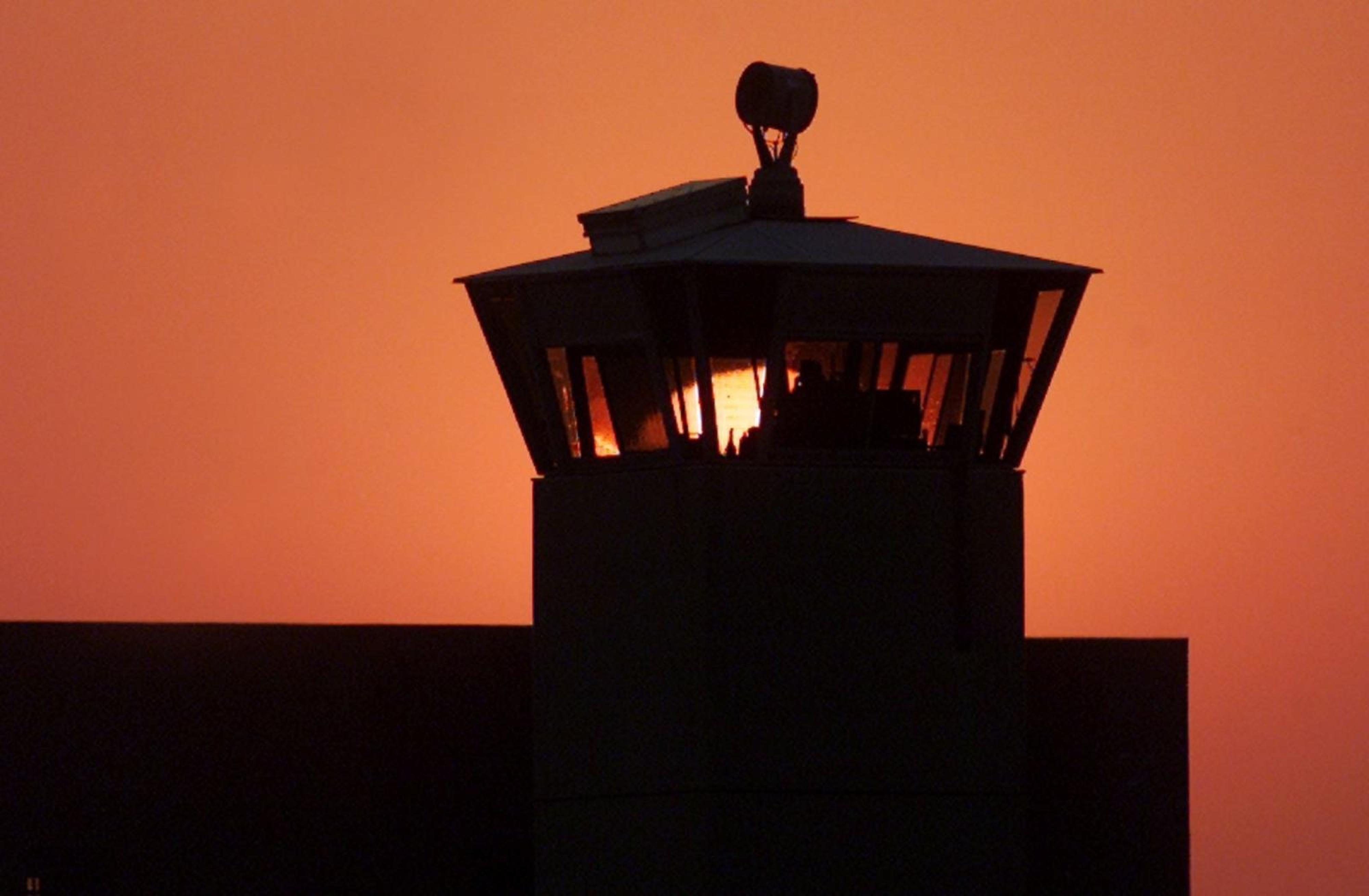
Randy Gardner hardly remembers anything about the day in 1985 when his brother Ronnie Lee Gardner was sentenced to die. Maybe he prefers not to. “I wasn’t too worried,” Randy tells me. He knew the appeals process would probably take decades—and it did. But twenty-five years of failed appeals did eventually yield to an execution date: June 18, 2010.
Gardner’s family had to say goodbye in advance after he requested they not be present. Instead, they held a vigil outside the Utah state prison in Draper. They blasted the rollicking Lynyrd Skynyrd classic “Free Bird” while inside the concrete walls, guards asked Gardner if he had any last words. He did not. The prison’s warden placed a black hood over his head and exited the death chamber. A white square with a circle in the middle already hung by Velcro over the left side of Gardner’s chest. About thirty seconds later, gunfire echoed out from the prison walls.
The Salt Lake Tribune’s designated witness conceded that killing a man via firing squad “is, by definition, violent.” Yet, “if it can also be clinical and sterile,” he wrote, then it had been. It was nonetheless shocking: Gardner was the first person executed by firing squad in the United States since 1996, and only the third person since 1976. He chose that fate over lethal injection. Randy still isn’t sure why—maybe something about living by the gun and dying by the gun. Outside, news reached the vigil. The group released twenty-four balloons, each decorated with messages of hope.
Ronnie Lee Gardner was the kind of repeat offender for whom few would feel much sympathy, regardless of mitigating circumstances. In 1981, serving time for armed robbery, he managed to escape. Two weeks later, he picked a fight, got shot, and ended up back in prison. In 1984, during a hospital visit, he stole a guard’s gun and escaped again. Three months later, he killed a Salt Lake City bartender, which earned him a second-degree murder charge and a stay in Utah state prison on $1.5 million bail. On April 2, he was transferred to downtown Salt Lake for a pretrial hearing, where an accomplice managed to smuggle him a gun. Attempting to escape yet again, Gardner was immediately shot in the shoulder by a guard but managed to run into a basement records room. There, he came upon Michael Burdell, a pacifist attorney known for defending criminals no one else would; he was there doing pro-bono work for his church. Gardner shot him in the eye. He managed to shoot a bailiff and take another bystander hostage before he was finally surrounded and captured.
Utah assistant attorney general Tom Brunker called Gardner “the poster child for the death penalty.” On the eve of Gardner’s 2010 execution, David Muhlhausen wrote for the Heritage Foundation, “Some crimes are so heinous and inherently wrongful that legislatures have the moral responsibility to establish sentencing floors that include life sentences and the death penalty. The majority of Americans recognize this principle as just.”
According to Gallup, American support for executing murderers peaked in 1994, with 80 percent in favor and just 13 percent against. But by 2010, support had steadily trended down to 64–29, and Gallup’s most recent data, for 2025, shows 52 percent in favor, 44 percent against—the nation’s lowest level of support for capital punishment since the early 1970s. Muhlhausen was technically right, then—the majority of Americans support execution in certain cases—but it might not stay that way much longer.
When Randy last spoke to his brother a few days before his death, the condemned man defended the guards who, for twenty-five years, had made it impossible for them to hug each other and thrown him into solitary confinement. “Randy, they’re just doing their job,” he’d said. “You can’t be mad at them.” He didn’t say so, but inside, Randy thought, Yeah, I can be. Twenty-five years of waiting bred indignation and rage. “I was very angry at everybody that had anything to do with it.” In the sixteen years that followed, Randy traveled a long road to try to escape that anger. Along the way, he reckoned with a world where so much about capital punishment is changing, even while his pain stays the same.
You might like: David Bentley Hart on Christians and the death penalty
It would be fifteen years before a U.S. state would execute another prisoner by firing squad, this time in South Carolina in 2025. As lethal injections have fallen from the nation’s good graces, the states still committed to executions are experimenting with alternatives, from suffocation to firing squads. Randy flew to South Carolina and tried to persuade the governor to stop it. Instead, the Palmetto State would end up killing three men by firing squad last year alone, including one man, Mikal Mahdi, who cried out when he was shot and groaned, still alive, forty-five seconds later. Beginning July 1, Idaho has made the firing squad its default method of execution. For a while, rather than burden human volunteers with the weight of shooting someone to death, the state had planned to fully automate the firing squad, but developing such a system has not yet proved feasible.
The United States inherited legal execution from Great Britain, which started sentencing people to hang in the tenth century. Public hanging was by far the most common method of execution in the New World colonies, but the first recorded execution in British North America was not a hanging. In 1608, officials from Jamestown, Virginia, executed a man named George Kendall by firing squad. Since then, per the Associated Press, at least 144 people have been executed by firing squad in the United States—most of them in Utah and most of them before the 1970s. Many more, before the twentieth century, were executed by hanging. Those were the options until 1890, when the state of New York came up with a novel method: the electric chair.
The chair, says Fordham University’s Deborah Denno, the country’s leading scholar of execution methods, was supposed to be a more humane alternative. “People were really horrified by hangings,” she says. “They were slow, they were torturous, and the feeling was, this isn’t bringing out the best in society.” Legislators feared that the spectacular brutality of hangings would turn public sentiment against the death penalty itself. “That’s been an ongoing theme,” says Denno: the search for a “humane” method of execution to make capital punishment broadly acceptable.
But in that regard, the electric chair was an unmitigated failure. It sometimes lit prisoners’ heads on fire, and it always left their bodies scarred and deformed. But alternatives were hard to find. Firing squads were fading from fashion for the same reasons. Nevada experimented with poison gas starting in 1921, with similarly gruesome results.
By the 1960s, public sentiment had soured on the death penalty. Gallup’s data pinpoints 1966 as the only year in recorded history that more Americans opposed the death penalty than supported it. This sentiment took on legal force in 1972, when the Supreme Court placed a moratorium on executions. The death penalty was too arbitrary, the majority wrote, and state statutes needed to be rewritten.
Just a year later, in 1973, then–California governor Ronald Reagan led his state to do just that. Reagan questioned the existing methods of execution and compared the old days of shooting injured horses with the reality of 1973, in which veterinarians could simply euthanize a horse with an injection. He wanted to move away from gruesome spectacles toward something that felt clinical and medical. “I myself have wondered if maybe this isn’t part of our problem,” Reagan said then, “if maybe we should review and see if there aren’t even more humane methods now.”
Reagan was onto something. Executions resumed in 1977, when Utah once more killed a prisoner via firing squad, but that same year, Oklahoma spearheaded the development of “lethal injections,” with the first one administered in 1982. The new method offered, in theory, what hangings, the electric chair, and firing squads could not: an execution without visible brutality. “On the one hand, people did look like they were going to sleep,” Denno says. “But other people had horrible executions. They would vomit. They would yell out. The execution would take a very long time. It was clear the person wasn’t dying.”
The promise of lethal injections did not match the reality. With more exposure in the internet age, that became very hard to ignore. Medical professionals, bound by their Hippocratic oaths, had never participated in lethal injections to begin with. And drug companies soon started refusing to provide the typical chemical cocktail. The result has been a series of botched lethal injections using questionable drugs and methods. But lethal injections remain the default in most places, and they are still by far this country’s most common method of execution: state governments killed thirty-nine people that way in 2025 alone.
Now, some states have begun experimenting with alternatives. Alabama and Louisiana have carried out executions using “nitrogen hypoxia,” essentially a form of suffocation. South Carolina allows the condemned to choose the firing squad instead, as does Utah for anyone sentenced before 2004. Meanwhile, Mississippi and Oklahoma permit firing squads as secondary methods of execution, should lethal injection become impossible. Thus far, only Idaho has made them the state’s default method of execution.
By March 2023, Randy Gardner had been working for many years with an advocacy group called Death Penalty Action. When the organization’s leaders got wind of an upcoming Idaho Senate hearing where the Judiciary and Rules Committee would consider firing squads as an option in capital-punishment cases, they asked Randy to testify. He was one of very few who could speak personally to the toll of firing squads. “It just ripped my brother’s body apart,” Randy, who has a white beard and a grizzled, Hemingway-like look, told lawmakers. The process was gruesome and “barbaric,” like the “Wild West days.” He accused them of moving backwards. “It’s just not a good thing to be doing as civilized members of society,” Randy said. “I would beg you folks not to pass this through.”
But, by a 5-4 vote, the measure passed the committee and was overwhelmingly adopted in both the House and Senate. A year later, the state passed another bill making firing squads the default method of execution, for the simple reasons that lethal injections had become very expensive, and firing squads—in a stunning reversal from Reagan’s thinking in the 1970s—had reemerged as possibly the most humane execution method available.
Randy wasn’t surprised by the outcome; he was never going to change anyone’s mind, he realizes in hindsight. He’s still glad he showed up. “If I don’t do these things, sometimes I feel worse.” Still, the feeling of futility that comes afterward can be overwhelming and exhausting. The death penalty is inherently immoral, he believes. “Half my life I’ve spent doing this work that I shouldn’t have to be doing,” Randy says. “It’s not a moral thing to do, to kill somebody.”
In 2018, Pope Francis changed the language of the Catechism to define capital punishment as “an attack on the inviolability and dignity of the person” and “inadmissible” in all cases. Before that, the language was more ambiguous, though it still landed squarely against execution, noting that, “the cases in which the execution of the offender is an absolute necessity ‘are very rare, if not practically nonexistent.’”
But Rep. Bruce Skaug, an Idaho Republican who sponsored both of his state’s recent capital-punishment measures, uses his Baptist faith to justify executions. “I have no problem defending it from a Judeo-Christian heritage perspective,” says Skaug, “because we value life so much. Life is so precious that if you take a life, an innocent life, you have to give up your own life in the most extreme situations.” Further, he says, he’s doing his job as a voice for his constituents: the people of Idaho want executions. He’s just translating the popular will into policy.
To Randy, that’s only possible because most people can ignore executions. Unless botched, they rarely generate much news coverage these days. But if people were to see what actually happens—to take in the process and sit with it—he thinks capital punishment would lose popular support. So would firing squads, which are usually quick but always bloody and violent. In his 2023 testimony, Randy urged lawmakers to consider not just the condemned, but the secondary trauma inflicted by executions: the people who have to fire the guns, clean up the blood, remove the bodies, and live with it all.
Skaug resembles a younger Colonel Sanders with a fuller goatee. Before joining the legislature in Boise, he was a prosecutor. But even back then, the death penalty, he says, was “not something that had been on my mind.” That changed because of his state’s issues with lethal injections. Aside from the necessary drugs becoming much harder to source, the method allowed for new kinds of appeals; it was prone to botches; and, Skaug admits, the injections sometimes “just simply fail.”
He started looking into more reliable, more humane alternatives, which led him to firing squads. He found an unlikely ally in Supreme Court Justice Sonia Sotomayor, who Skaug eagerly identifies as a liberal. A reliable dissenter from the Court’s pro-death-penalty conservative majority, Sotomayor nonetheless wrote in 2015 that a firing squad is “significantly more reliable than other methods.” She admitted that the process is gruesome, which could open the possibility of litigation alleging “cruel and unusual punishment.” But, as an alternative to lethal injection, the “relatively painless violence may be vastly preferable to an excruciatingly painful death hidden behind a veneer of medication.” In 2017, she reiterated those points, adding that “historically, the firing squad has yielded significantly fewer botched executions.” Skaug found more allies in academia, including Denno, the Fordham scholar. “As long as we have a death penalty,” she says, “we should be using the method that’s the least inhumane, and that is definitely the firing squad.”
It wasn’t Skaug’s idea to try to automate the process. That, he says, came from leaders at the state’s Department of Corrections, who wanted to limit staff involvement as much as possible to minimize secondary trauma. Skaug was concerned about what would happen if the automated system malfunctioned, so he made sure a secondary squad bearing traditional rifles would always be on hand as a backup. As for how the automated system was supposed to work, details were never made public, but earlier this year, Skaug summed it up like this: “There’ll be one button to push.” Is it concerning to shift the burden of executions from people to machines? Is that responsibility really something that should be outsourced? “I have not worried about that one bit,” Skaug says. After the recent legislation passed, many people volunteered to join traditional firing squads, he adds, and a Florida company proudly sent ammunition free of charge. There’s no shortage of people willing to bear the burden. But, Denno says, why make them if we don’t have to?
Then in June, the Idaho Statesman reported that Idaho had stepped back from its automation plans, at least for now. Instead, the state will use volunteer police officers. Three of them will fire at the condemned inmate through a one-foot hole in a protective wall. The process is supposedly designed to limit their exposure to the deed as much as possible.
In theory, an automated firing squad could reduce intentional and accidental misfires, making the process even more quick and painless. Idaho is “probably going to be leading the way,” Denno said back when automation was still a possibility. “Whether people think that’s a good thing or bad thing, what I say is, it’s the least inhumane way of executing people. Because any aspect of an execution is psychologically traumatic not only for the inmate, but probably for the people doing it.”
This rationale for firing squads recalls that for the guillotine in revolutionary France. Championed by French doctor Joseph-Ignace Guillotin and put into use in 1792, the device was explicitly intended as a technological, efficient, humane, and “enlightened” alternative to the common execution methods of the era, like hangings and beheadings by sword or axe. But there was no way to get around the brutal reality of what that efficiency enabled: lots of bloody, severed heads. In the American legal tradition, any kind of beheading is widely understood as cruel and unusual. International law similarly categorizes beheading as outside the bounds of human dignity. A firing squad is not a beheading, but the guillotine points to a simple truth: speed and effectiveness do not make executions humane. Efficient killing is brutal, too.
Last November, a group called Worth Rises released emails between Idaho corrections officials and the three companies building its new firing-squad chamber. In one email, an architect discussed the acceptable level of noise from the gunfire. He wondered whether the Department of Corrections would be “open to utilizing suppressors and subsonic ammo with their rifles if helps save cost to achieve acoustic goals?”
Worth Rises advocates against the prison industry by targeting the corporations that enable it. It’s easy, says the group’s Chief Advocacy Officer, Celina Chapin, to blame the state for the resurgence of firing squads, “but it is more than that. It is a project that requires private companies to step in and make these executions physically possible, and kind of sanitize this really archaic practice.”
In another email, sandwiched between a note about plumbing in the witness bathroom and copper pipes in the ceiling, was a bullet point about a request for a floor drain in the execution room. “It’s OK if they have to mop/squeegee liquids to the drain,” the bullet point continued. “Sloping the floor would not be cost effective.” “Liquids,” of course, means blood. Prisoners shot in the heart will bleed out, and that blood needs to go somewhere. Euphemistic language is needed to cover up the reality that employees will have to “mop/squeegee” blood into the drain. “They are trying to…distance people from the horror of it,” Chapin says. “These are things that are incredibly, incredibly, incredibly violent, and they’re just being framed as a regular course of business.”
A similar strategy of naming and shaming the companies who enable executions worked to stop many pharmaceutical companies from selling drugs for lethal injections. “When companies refuse to make those choices, the system breaks down,” Chapin says. “And when they agree to make those choices, and we all look away, then…we’re sanitizing something that’s very, very violent.”
Randy joined Worth Rises in March to protest outside the Boise legislature, carrying a sign that read, “No profiting from executions!” The last thing we need, he argues, is to remove ourselves further. If only people would stare the practice in the face, it would be outlawed overnight.
In one dream, he’d execute his own children. In another, they’d execute him. In another, it would be his mom. “My poor mom’s in a wheelchair,” he explains. “And it’s, you know, ‘No, Randy, no!’ and then it’s me shooting a bullet in her heart.” He’s never really escaped the horror of what happened to his brother, but part of him doesn’t want to. “I’m never going to get closure because of my own choice.”
Randy did his first interview the night before his brother’s death, with his brother’s daughter. He estimates he’s done hundreds since, plus demonstrations and speeches for lawmakers. “I’m not a natural speaker. I’m not really good at this stuff,” he says. But his soul demands that he speak up. Most people he’s met whose loved ones were also executed—by firing squad or otherwise—try to put the horror behind them, to move on and, within reason, achieve some new sense of normalcy. “They just let it die, and their soul dies with it,” Randy says. But “if I don’t [speak] here and there, I feel like I’m not doing my part, because I am maybe one of the chosen few that are able to do it. And it’s sad that I’m in that position where I have to do it.”
Randy wants people to experience through him the wreckage a firing squad leaves behind. Whatever his brother did—whatever other condemned criminals have done—there’s no humane way to kill someone. Much less by putting multiple bullets through a person’s heart. “I’m honestly waiting for someone to say, ‘Hey, let’s bring an automated guillotine here! That’ll be instantaneous!’” he adds. “I’m surprised it hasn’t happened, honestly.”
He partly blames himself—for not convincing enough people, not doing enough to save his brother. “I beat myself up over the years,” he admits. “And I’ve gone through all the emotions and all the everything I could possibly feel.” What he feels now, especially, is frustration over how durable support for the death penalty remains. “I’m definitely getting tired of it.” But, amid his cynicism, he does find reasons to be hopeful. So much of the support, he believes, is based on ignorance. When they find out about his brother, people say, “I didn’t know we still had firing squads!”
Now, the tide of public sentiment is finally turning—at least according to Gallup’s data. Will the new firing squads accelerate the trend? Randy can’t predict the future. He can only make peace with the past. After about eight years of meeting and befriending violence survivors through his advocacy work, he learned to forgive. If he could, he’d hug his brother’s killers. “My whole attitude kind of changed.” Rather than let his advocacy serve as a form of revenge, he started speaking from a place of love. Finally, he listened to what his brother had told him right before the state of Utah killed him: Randy let his anger go.
If that means advocating less, it doesn’t mean stopping. Instead, he picks his battles. He’s gone to therapy and beaten back his nightmares. And he’s found hope. “One day we won’t have the death penalty,” he says. “I do believe that—you know, if this world lasts that long.”
We welcome your comments about this article. Please send your response to [email protected].