In his 1980 postapocalyptic novel Good News, Edward Abbey cuts to the quick with a brief exchange between two friends on the run—a Harvard-educated Hopi named Sam and a weathered white guy named Jack. “That swarm of greedy peasants from the slums of Europe,” says Sam, “made a commercial-industrial slum out of our America.” Jack admits that what once looked like prosperity is over after “the collapse.” But he has no regrets: “What of it? What does that prove? Which is better: a hundred and fifty years of fun, excitement, lots of money—or twenty thousand years of flies, filth, poverty, and stagnation with a mob of ignorant heathen savages?”
Jack puts blunt words to the lived assumption of millions, and it’s an attitude that, as the effects of climate change continue to reveal themselves, is only hardening. Better to have partied hard than never to have partied at all—even if it was at the uncalculable expense of whoever comes next.
Wendell Berry has devoted himself to calling out the Jacks of this country for more than six decades. Three years before Abbey’s novel was published, Berry began The Unsettling of America with a summary of American history only slightly less flattering than Sam’s. The nation’s economy was still, two hundred years in, “substantially that of the fur trade, still based on the same general kinds of commercial items: technology, weapons, ornaments, novelties, and drugs.” He did not let up.
If there is any law that has been consistently operative in American history it is that the members of any established people or group or community sooner or later become ‘redskins’—that is, they become the designated victims of an utterly ruthless, officially sanctioned and subsidized exploitation.
For saying such things, Berry was either dismissed as a crank or tagged with the label “prophet.” In a blurb for Berry’s book, Abbey himself called him “our contemporary Isaiah.” But if the sermonic quality of Berry’s speech is undeniable, it is far from his only mode. Now, in his ninety-second year, he offers a story aiming not to denounce but to exhort.
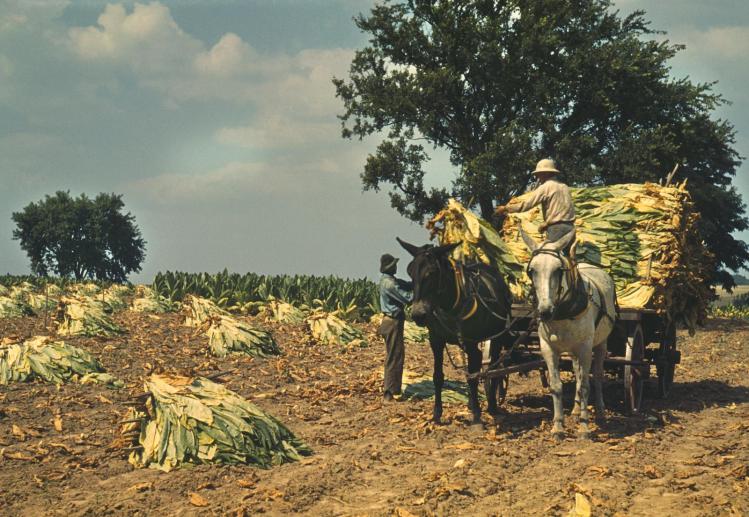
Marce Catlett: The Force of a Story seeks to reclaim an enduring, time-honored notion of prosperity by means of a fictionalized account of real Berry family history—and real American history. It’s a story Berry has often told, most prominently in his 2012 Jefferson Lecture, sponsored by the National Endowment for the Humanities. In the winter of 1907, Berry’s paternal grandfather, Pryor Berry, made the journey from Port Royal, Kentucky, to Louisville to assist in the sale of the family’s annual tobacco crop. There he discovered that James Buchanan Duke’s American Tobacco Company, having cornered the market, was making a sham of fair pricing. Pryor Berry returned home with less money than he needed to get the crop to market—“without a dime,” as his son John M. Berry Sr., six years old at the time, would recall. It was, the narrator says, “a passage through the dark.”
The story here, though, is not common injustice but uncommon resolve. Pryor Berry—the inspiration for the novel’s Marce Catlett, “capably poor and self-sustaining”—continued to farm the family’s four hundred acres according to the ancient dictates of husbandry, the third generation to do so in this particular place. Two decades later, his son John, having earned a law degree in Washington D.C. while serving on the staff of Congressman Virgil Chapman, returned to Henry County determined to put cooperative economic theory into practice. He became the primary force that turned a struggling tobacco co-op—the Burley Tobacco Growers Co-operative Association—into a regional economic force, serving it as president and attorney over many decades.
The New Deal’s Agricultural Adjustment Act provided the framework that helped secure fair pricing for the association’s members, and that stability drew thousands of farmers and dozens of regions into its fold: it covered eight states (it was most dominant in Kentucky, Missouri, Indiana, Ohio, and West Virginia), and as late as 2003 its participants numbered eighty-eight thousand. In 1989, Wendell’s brother John Berry Jr., who followed their father into law and politics—working for the Burley Association and later serving in the state senate—was asked why Kentucky’s small farmers had fared so much better than those in other states. His response: it was largely due to this highly effective program, which “pays the bills, educates the children, and doesn’t cost the government any money. There’s no subsidy in it, although there are people who like to call it a subsidy. It’s not. It doesn’t cost the government anything. It works.”
And it worked, his brother Wendell adds, only because its members dedicated themselves to keeping alive the hope of true prosperity—“an ancient wealth sounder than dollars,” as Berry’s fictional alter ego Andy Catlett, the novel’s narrator, says. Andy describes a world that was “once all astir with the life of closely neighboring farmsteads and fields,” empowered and animated by “work swapping”: “All help was paid for in advance by the knowledge that there would be no end to anybody’s need for help, which would be given to the limit of life and strength.” As Berry’s Port William stories amply show (this is the ninth novel, along with dozens of short stories), not all neighbors were equal in talent or character. But the principle had enough substance to mold a culture, lived out over generations by people with “the customs and refined skills of dwelling at home.”
Of course, under the aegis of Progress this way of life came to be classified as “backward.” In reality, Andy says, it was “a possession of incalculable worth,” the value of which becomes more evident day by day. Pryor Berry and his son and grandsons gave their lives to keeping that culture alive. In the novel, when Andy and Flora Catlett return to Kentucky in the 1960s after sojourning for a time in the centers of Progress, they find there is something to return to. Andy admits that
it took him years, even as a grownup, to understand fully that the widely shared modest prosperity of the farms and small towns of the country he grew up in…was not simply the way of the world. It was an economy deliberately made and fitted to the nature and needs of its regions by the Burley Tobacco Growers Co-operative Association.
Structurally, that culture survived due to the nimble and purposeful actions of the association’s leaders and the federal program that stood behind it. “There is no denying the dependence of local culture upon local economy and local work,” Andy avers. But there was another factor in this vitality, just as crucial, and even more central to this telling of the story: the collective memory of the injustice of the 1907 tobacco sale. “In its time that story was suffered by nearly everybody on the farms and in the country towns,” Andy says. “Because they remembered it, there was an extraordinary mutuality among them.” It provided the “force” that led to the reimagining and maintaining of the Burley Association.
For a time. Andy’s telling—spare, plain, and elegant—makes it clear that the association proved no match for the corporate colossus, with its seductive stories of “technological romance.” And tobacco itself, Andy acknowledges, “has long outlived its economic occasion.” Even so, Marce Catlett’s story remains for any who wish to claim it: a story of historic injustice—the “unwillingness to pay farmers for their work or the land for its yield”—and the structurally effective means by which it was, for a time, combated.
Marce Catlett offers a path forward. At the same time, it reveals a road not taken. As the century moved along, the Democratic Party submitted more and more to the mandate of corporate power, doing its part to engineer what Sheldon Wolin acidly dubbed “Democracy Inc.” This structural submission became easier when, in a cultural sense, Pryor Berry became “backward” and John Berry Sr. a throwback. The party forgot both its story and its storytellers. Now we have Trump to pay.
But the progeny of Pryor and John Berry are still here, helping us remember old stories and see with truer eyes the fables that replaced them. Once upon a time, not so long ago, there was a program whose “effect upon the region was conserving and democratic,” Andy Catlett reminds us. It was brought into being for a people who practiced “an elegant reconciliation of art and nature.” They knew we can’t cheat the earth. They also knew we can still, every day, serve it, and serve one another as well.
Marce Catlett
The Force of a Story
Wendell Berry
Counterpoint
$26 | 176 pp.