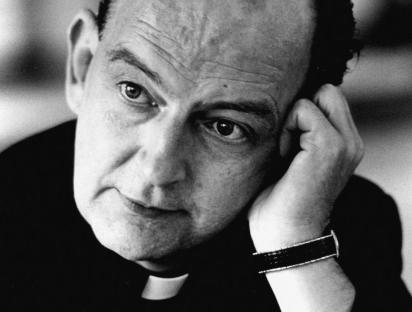
This was Charles Kingsley’s contemptuous question, whose vulgar ribald effrontery was superbly and immortally answered by one of the greatest autobiographies ever written, that is also one of the most brilliant pieces of apologetic in the Enghsh language. Poor Kingsley has not survived the iconoclasm of the twentieth century—his sweetly pretty “Water-Babies” is now known to be full of rabelaisian innuendoes (he re-read Rabelais every year) and the British Museum is prowng a rich mine of wonderfully nasty drawings and writings from his inhibited pen. But we also, now that the tumult and shouting of celebration and centennialization which marked the hundredth anniversary of Newman’s conversion has died down, can ask Kingsley’s question, albeit respectfully.
It was on the dark, rainy, autumnal evening of October 8th, 1845, that the Passionist Father Dominic, a “simple, holy man” as Newman called him, who spoke practically no English, came to Littlemore and received the submission of the au-thor of Tract 90, of the central figure of the Oxford Movement, one of the most eminent and revered of Enghshmen, then as now. But what, today, does, or can, John Henry Newman mean to us?
Perhaps the most outstanding feature of that long, great life, completely spanning the nineteenth century, and broken so neatly into two, rent so completely asunder by his conversion, is the tremendous burden of loneliness, and the magnitude of the intellectual agony. Even before he came into the Church, Newman writes of himself that though he loved friends, they came unsought, and natural beauty he dared not love. Hardly more than a child, he felt certain that God had called him to the single life. And the nineteen years immediately following his abjuration were, of course, particularly mortified and tenebrous, a dark night not of the soul only, but of the completely echpsed mind and personality. Certainly the most famous Oxford professor of his day, certainly the most discussed figure in the Church of England, he fell immediately into an oblivion so blanketed and profound, that the tomb could hardly have swallowed him more completely. Indeed, until Charles Kingsley’s ill-bred review of Froude’s History of England appeared at Christmas, 1863, in Macmillan’s Magazine, and by its personal gibe at Newman’s veracity, and by its impugning of the truthfulness of any and every Cathohc priest, goaded Newman out of the obscurity to which his superiors had consigned him, he was so utterly and entirely forgotten that few people even remembered he was still alive.
His letters are anguished. “You may think how lonely I am,” he cries, and in his private journal wrote that he was treated as “some wild incomprehensible beast, a spectacle for Dr. Wiseman to exhibit to strangers, as himself being the hunter to capture it.” For thirty-two years all Newman saw of Oxford, that he loved above all places earthly, were her spires from the train; yet, as he lamented to a friend, “It was at Oxford, and by my parochial sermons, that I had influence. All that is past.” And, with bitter irony, he concludes, “Alas, that religion, which is so delightful as a vision, should be so distasteful as a reality “
For seven years, has chief work was in exile, attempting to found in Ireland a university which almost nobody wanted, with powers no one would grant hlm, finding nothing but “indifference, misunderstanding, hostility.” His superior, Archbishop Cullen, refused him his confidence, and “has treated me from the first like a scrub, and you will see he will never do otherwise,” as Newman wrote. For Newman found nothing but the coldest comfort from his fellow Cathohcs. Suspected both by the English hierarchy and by the Irish, he was “disappointed, desponding and sore.”
Even after the Apologia Pro Vita Sua had, in a matter of weeks, been recognized as a religious masterpiece, as a work of genius, causing “Newman’s long-forgotten name to leap into national prominence,” members of his own communion thought the book “egotistical and expressive of self-admlration,” and he later composed the Grammar of Assent in “haunting fear” of those Catholics “by whom every word I publish wiIl be malevolently scrutinized, and every expression which can possibly be perverted sent straight to Rome…. I shall be fighting under the lash.”
From his first wrestlings with his own uncompromising integrity, which prevented his taking the Anghcan sacrament beside Archbishop Whately when he had come to disagree with him, until, in sunset scarlet, he became “the poor clothes horse man, senile and decrepit, who, in stone, invites our pity on the Brompton Road,” in spite of “the large draughts of intellectual day” which he continually quaffed, Newman’s life was a long dying alone—to use a phrase of Pascal’s, Newman had applied to himself. So that when he tells us that God still knows what He is about “if I am in perplexity, my perplexity may serve Him, if I am in sorrow, my sorrow may serve Him… He may take away my friends, He may throw me among strangers, He may make me feel desolate, make my spirits sink, hide my future from me—still He knows what He is about” we may believe him.
Nor was it God only, Who, to quote Saint Teresa, treated His friends so badly. Newman intensely disliked himself. Seldom has anyone found himself so dreary, so boring to live with, or life such a long day’s march. Alone in Sicily he wrote, “I seemed to see more and more my utter hollowness, to be nearly hollow, with little love, little self-denial. I believe I have some faith That’s all.” Mercifully, most of us, most of the time, are as unconscious as are swimmers when life saving, of the true weight, not only of our sins, but of our selves. Just sometimes, perhaps only once in a lifetime, the waters recede, and we are left for an instant holding up, and staggering under, the unknown, unimagined, intolerable weight. Then the waters, or of grace, or of our habitual indifference, flood back, return again to support the unendurable burden. But for Newman the full consciousness, the entire awareness, of that weight was almost continual. He experienced it as tangibly as Christian his burden in the Pilgrims Progress, as the Ancient Mariner the dead albatross. It balanced his awareness of his immense intellectual gifts, saving him from spiritual pride, and it gave him a touching humility. So that he could write to Froude, “You and Keble are the philosophers, I am the rhetorician.”
Jacob was always one of Newman’s favorite characters, both for his wresthng, and for his wisdom. Above all, for the concreteness of his vision. And Jacob’s vision, that was also Newman’s, is another part of the meaning he can have for us—his almost palpable, tangible sense of the reality of the unseen world. Nor was he merely certain that “alles Vergaengliche, ist nur ein Gleichniss“—all that passes, is but a parable. For him also the Church herself, and all that we know of the mysteries of revealed religion, are but types of the realities they adumbrate. Realities that are there, not coming, because for Newman the spiritual was not an intrusion. All that it required was perception, recognition. Everywhere, immediate, actual, are always around us “the traces, so faint and broken, of a super impending design.”
As a child, he tells us, he wished the Arabian Tales were true, and thought “life might be a dream, or I an angel, and all this world a deception, my fellow angels by a playful device concealing themselves from me, and deceiving me with the semblance of a material world.” As he grew, Novalis’s saying became true for him “that our life is no dream, but it may and should become one” Newman, adult, viewed the angels “as carrying on, as Scripture also implies, the Economy of the Visual World. I considered them as the real causes of motlon, light and life, and of those elementary principles of the physical universe, which, when offered in their development to our sense, suggest to us the notion of cause and effect, and of what are called the laws of nature.” Turn but a stone, Francis Thompson was to write later, and start a wing. Newman, in his Apologia, quotes from his own Michaelmas Sermon of 1831: “I say of the Angels, ‘Every breath of air and ray of light and heat, every beautiful prospect, is, as it were, the skirts of their garments, the waving of the robes of those whose faces see God’.” And elsewhere, he writes that when people “think that they regret the past, then they are but longing after the future. It is not that they would be children again, but that they would be angels, and see God.” Perhaps his feeling for angels came from his Jewish ancestry. It is fairly well established that, whilst his mother was of Huguenot stock, his father’s origins were Semitic, and the name originally had been spelled Newmann. In our day, the painter, Marc Chagall, gives us a sense of the part played by angels in traditional Jewish life. At all events, Newman never was in the least dismayed by the advance of science, was unshaken by Darwin, and would, no doubt, have been delighted, though not surprised nor exultant, when Heisenberg’s uncertainty principle fluttered the dovecotes of determinism.
All the above quotations are taken from the new, complete edition of Newman’s works that is being published by Longman’s Green at the rate of three volumes a year, and at the price of $3.50 a volume. The first three volumes, the Apologia Pro Vlta Sua, the Idea of a University, and the Grammar of Assent, each prefaced by a masterly introduction by the editor, are the 1947 quota, and are really most excellently well turned out—new type, not merely photographed from the earlier sets. And admirably unobtrusive, but essential notes, combine to make a really scholarly as well as a very handsome production. One might only wish, perhaps, that the pubhshers had not issued first the best known works, readily available in other editions, but rather had given us to start with, say the Sermons, the Verses, or the Meditations? But we need only be patient, for all are promised, and meanwhile, it would indeed be a poor heart that was not rejoiced by Doctor Harrold’s three first volumes.
Newman, undeniably the greatest figure in English religious life in the nineteenth century, is easily also the most sympathetic. Manning, bringing his fist down with a mighty thump upon the table at a private dinner party so that the glasses all shook, and thundering, “I declare that I would light again all the fires of Smithfield tomorrow, if thereby I could but save one heretic soul,” or Wiseman, dryly writing prim, unread-ble, dusty tales about early Christians, are hardly rivals. Only Keble, whom Newman himself so loved and venerated, can challenge him.
Yet, for all Newman’s gentleness, all his simplicity, he has never been exactly popular, nor has he ever been the object of popular devotion. No one, it is said, has ever been able to squeeze a miracle out of him, but how many have tried. Aubrey de Vere gives a wonderful description of Newman’s coming into the room, “with a kind of balance, like a very great lady, absolutely without noise.” Blennerhassett, who knew him well, says he never heard him say a harsh thing of Father Loisy, an apostate priest, for example. He only said, “How much he must have suffered! How must he still suffer.” Yet Gerard Manley Hopkins, going on pilgrimage to Birmingham in the throes of his own converslon, relates that he found the great Cardinal as chilly as Saint Augustine, on a similar occasion, complained he found Saint Ambrose.
Seldom has one man been as indispensable as John Henry Newman. Whilst he remained an Anglican, he was the center, the life of the Oxford Movement. With his removal, that movement languished. Instead of a leaven that might have renewed the whole Church of England, it merely crystallized into yet another denomination, a flavor chosen by some, rejected by others, vanilla or chocolate. Newman brought with him to Catholicism in England not only a first class mind, but a style and language which rehabilitated Catholic writing, too long associated with treacley translations of insipid devotional manuals. Henri Bremond has said that Newman did for Catholicism in England what Butler’s Analogy had done for the Established Church. It Is certain that there is a close connection between the Analogy and the Grammar of Assent, which it is said to have prompted
Dr. Harrold, in his delightful comment on the Apologia, points out the elasticity and multiformity of Newman’s style, its colloquialism, as in “I was sore with the great Anglican divines, as if they had taken me in”; its dry wit, as “I was in a humor, certainly, to bite off their ears”; its withering contempt, as in such phrases as “our national form of rehglon professes httle more than reading the Bible and living a correct life,” or “it were well if none remained boys all their lives,” or the whole savage passage on secular education, where he discovers to his unfeigned horror that according to the Minutes of a Committee of the Council of Education, Religion is included not under signs, as language, facts, as history, relations and laws, as science and mathematics, but under sent,ment, as poetry and music. What has Truth to do with sentiment? he asks scornfully, anticipating Don Chapman’s delightful “beware of feelings, Protestants have them.” Again, Newman’s power of sarcasm is evident in that passage where he foreshadows Father D’Arcy’s admirable condemnatlon of the current “ideas of Godhead, Ground, Brahman, Clear Light of the Void,” etc. Thus Newman, “The Almighty is something infinitely different from a principle, or a center of action, or a quality or a generalization of phenomena. If by the word (God) you do but mean a Being who keeps the world in order… but only an the way of general Providence… such a God is not difficult for any one to conceive, not difficult for anyone to endure.” Such a creed, that “of shallow men in every age” was anathema to Newman, who, from the age of fifteen, was conscious of an inward conversion of which he could write over twenty years later, “I am still more certain [of it] than that I have hands and feet.”
This first conversion made him “rest forever after in the thought of two, and two only, absolute and luminously self-evident beings, myself and my Creator.” This apprehension caused him continually to realize, as he bluntly put it, that “religion is for practice, and that immediate.” And he sledge-hammers the weaknesses of our feeble and superficial assents. “We are what we are,” he declares, “and we use, not trust, our faculties. Our consciousness of self is prior to all questions of trust or assent we do not confront or bargain with ourselves.” Nor is his certainty of God less emphatic than his certainty of himself. God, he writes “is an Individual, Self-dependent, All-Perfect, Unchangeable Being, intelligent, living, personal and present. He is One, Who is sovereign over, operative amidst, independent of, the appointments which He has made. One in whose hands are all things, Who has a purpose in every event and a standard for every deed. Who has, with an adorable never ceasing energy implicated Himself in all the history of creation, the constitution of nature, the course of the world, the origin of society, the fortunes of nations, the action of the human mind.”
What, then, does Dr. Newman mean?
He can mean for us a weaning from our attachment to those sweets with which Saint John of the Cross says God feeds us infants in the interior life, a more immediate perception of the drift of pinions at our clay shuttered doors, and a graduation from the puppy biscuit, of woolly and sentiment clouded thought and faith, to those theological bare bones upon which we may cut our teeth, but still must be careful not to break them.