After eleven years of sobriety are followed by a year of secret drinking, Meghan O’Gieblyn copies a line from Simone Weil on an index card and tapes it above her desk: “We have to try to cure our faults by attention and not by will.” This mantra launches an extraordinary memoir that is as much philosophical and theological exploration as it is a narrative of personal struggle. Maybe the most remarkable thing about Will and Attention, in fact, is that psychological and emotional resolution do not seem possible at all for O’Gieblyn without some kind of accompanying philosophical breakthrough. To borrow an image of her own, this book is a winding sermon, not a triumphant TED Talk.
It’s an urgent sermon as well. Through her uneven journey, O’Gieblyn manages to cast a different light on an issue that continues to dominate our time: the matter of attention. Her memoir does not pose a technical question about how attention spans are being hijacked and hobbled by algorithms and screens. Nor is it a cultural assessment of the broader attention economy. O’Gieblyn’s question is moral and existential: “What must I pay attention to?” Candid about her failures, refusing easy answers, and engaging with thinkers ranging from Augustine, Schopenhauer, the Desert Fathers, and medieval mystics to Simone Weil and Iris Murdoch, O’Gieblyn participates in a long conversation about how we should understand ourselves and what we should attend to in light of that understanding. The result is a book that reads like something from an older era, one in which it was assumed that our inner worlds participated in the meaning of a cosmos. Against a backdrop of technology’s sprint toward humanlike intelligence (a topic O’Gieblyn explored in her book God, Human, Animal, Machine), this memoir’s depiction of anguish, unwieldy desire, and wonder is especially resonant.
The heart of the book is the author’s midlife return to the two forces that shaped her young-adult years: religion and alcohol. The return to religion comes first. O’Gieblyn grew up Evangelical and attended Moody Bible Institute (identified in this book simply as Bible school). There she encountered a Calvinism whose uncompromising explanations for suffering and what she called in her previous book a “totalizing logic” ultimately pushed her away from Christianity. Having considered becoming a missionary, she left school and church altogether—and began drinking heavily.
This new memoir is not about those early years, however. Nor is it really about a decade of recovery involving AA meetings, career stability, marriage, and writing success (her first book, the essay collection Interior States, won The Believer Book Award for nonfiction). Will and Attention is instead about O’Gieblyn’s almost incidental decision in her late thirties to start slipping into a Catholic Church to observe midday services, and then, soon after, when she is disillusioned for a second time by religion, to start drinking again. She does both of those things in secret. She doesn’t do either of them because her life is in shambles. She does them, she decides, for no neat reasons she can access or understand. The arc of her life itself, the arc of conversion and deconversion, of addiction and recovery, is shattered by this regression. Instead of making progress on a journey, she is caught in a loop. She experiences what writers from Montaigne to Marilynne Robinson have described as being a mystery to oneself. Augustine, whose Confessions sits at this book’s shoulder, describes the mystery poetically: “I had taken leave of myself, and could not find myself.” O’Gieblyn quotes Julian of Norwich: “For we are double by God’s making.” Will and Attention honors the long line of exploration of the mystery of that doubleness.
“Being a mystery to oneself” can almost sound like an enviable predicament, a kind of artistic ennobling. But O’Gieblyn is not ennobled by her clandestine drinking. Chasing that bliss (she insists that it is bliss) is also a pursuit of oblivion. This marks the connection between religion and alcohol. O’Gieblyn describes the “profound longing to lose myself in the rituals of Mass or the stupefied void of a blackout.” Her mind is restless and contradictory. She wants to escape her uncontrolled thinking, which she describes as “always leading me astray.” She wants something to lose herself inside. Leslie Jamison’s memoir of addiction, The Recovering, describes a similar desire for escape and oblivion: “I wanted nothing more than to be absent from my own life.”
In her first struggle with addiction in her twenties, O’Gieblyn experienced the power of recovery rituals and recovery communities, but the experience of circling back to alcohol makes her wonder about the pragmatic practices she trusted before. She challenges the whole idea that a gesture of faith can “work” without “metaphysical beliefs to support it,” that you benefit from going through the motions of prayer and recitation regardless of what you actually believe. What she calls the “infinite regress” of will and desire needs to be understood and accounted for. Faith requires some kind of theology.
One of the interesting things about this book is that it encompasses so much of the American religious spectrum. Steeped in Evangelicalism, a one-time student of Calvinism, and a seeker who almost joins the Catholic Church, O’Gieblyn also knows the therapeutic version of religious life associated with, but not exclusive to, recovery groups like AA. It is now conventional to refer to all these groups as “people of faith,” but O’Gieblyn’s earnestness makes that phrase seem shallow. Lapsed believers are often the harshest critics of lukewarm versions of what they previously believed. James Wood once observed that the child of Evangelicalism who abandons that framework remains, nonetheless, “always evangelical.” Wood elaborates: “He respects the logical claustrophobia of Christian commitment, the little cell of belief. This is the only kind of belief that makes sense, the revolutionary kind. Nominal belief is insufficiently serious; nominal unbelief seems almost a blasphemy against earnest atheism.”
O’Gieblyn’s earnestness feels Evangelical in exactly that way, although it never quite feels atheistic. It just feels exiled, homeless. She still believes in truth. She believes in finding an ideal with which to orient yourself that is more than self-expression or therapeutic self-acceptance. She acknowledges that the Desert Fathers’ descriptions of our inner world as an arena of spiritual combat feels truer to her experience than the pragmatic suggestions of modern psychotherapy. “So much of the therapy I’d experienced in the past,” she writes, “was devoted to recognizing ‘cognitive biases,’ which were like glitches in a computer system. But temptation had never felt to me like a glitch. It felt like being seduced by some dark force that was cunning and supremely intelligent and wanted me dead.” The shape of her inner world remains old-school religious, despite the loss of its theology. The scaffolding is intact, but inside the building has fallen.
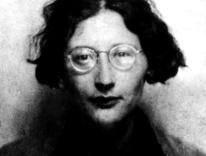
The philosopher with whom O’Gieblyn remains in dialogue throughout the book is Simone Weil, whose interest in Buddhism influenced her unique Christian mysticism. For Weil, attention is not a self-focused act of resolve or concentration. Instead, it is “a form of directed receptivity.” O’Gieblyn has tried and failed to summon the right effort to stop drinking. Weil inspires her to think differently about the problem of the will, even as Weil herself remains a mystery to her:
She calls attention an “indirect method,” a way to achieve ends that resist the brute force of will, but she does not say much about how to cultivate it. Her spiritual writing is runic and aphoristic. I don’t really understand it, and I think this is also part of its appeal, the sense that it conceals truths that might, if they were fully comprehended, annihilate me.
Weil helps O’Gieblyn understand her inner world differently, but she also teaches her that she doesn’t have to account for all the suffering in the world. She doesn’t need an answer for Job, or for Bible school’s Calvin, or Wood’s forever-Evangelical. Crucial to Weil’s posture of receptivity is taking the world as it comes and loving it unconditionally.
Yet for all her wisdom, the ascetic, self-punishing Weil remains distant from O’Gieblyn’s experience. Weil’s thinking lifts the burden O’Gieblyn has carried, but it doesn’t really set her on her way. It takes Iris Murdoch, another thinker influenced by Weil, to do that. Murdoch also experiences the self as a “divided thing,” but her diagnosis is more specific. There is for Murdoch “an egocentric system of quasi-mechanical energy” operating inside us. The will, O’Gieblyn elaborates, “is clearly no match for this mechanical ego-feed.” We are, by default, overstimulated and outmatched. Jonathan Lear called this “the deepest form of human helplessness: helplessness in the face of too much energy.” Murdoch’s remedy is not to subdue the feed with willpower but to counter it with attention to the good and the beautiful. Summarizing Weil and Murdoch, O’Gieblyn writes that “we must reprogram ourselves, through attention, to be automatons of the good.” She goes on:
This is what it means to be free. It is, granted, a very different kind of freedom from the sort that’s often celebrated—having as many choices as possible. It is very nearly the opposite. “If I attend properly,” Murdoch writes, “I will have no choices, and this is the ultimate condition to be aimed at.”
Murdoch’s claim that goodness is a form of beauty and that moral beauty is an end in itself lets O’Gieblyn reframe resistance to alcohol and addiction. Looking back, it wasn’t so much that the drinking and lying were wrong, she decides, as that they were ugly. Why choose the good now? Murdoch has given her language and inspiration: “Because it is more beautiful. Because drinking is fantasy and delusion and hiding from the sun. That way of living is selfish and ugly and I don’t want to add more ugliness to the world that I love so much.”
Toward the end of the memoir, O’Gieblyn visits the chapel where St. Francis knelt to pray and where Simone Weil did the same for the first time. O’Gieblyn kneels there too. After so many pages of psychological, spiritual, and philosophical struggle, her simple commentary is poignant: “I wanted so badly to be saved.”
The book closes on a note of humility. No amount of attention can overcome the tensions of being what we are, the doubleness we experience. O’Gieblyn has not resolved that dividedness. Instead, she decides, “Humility is a willingness to live with doubt, tolerance, uncertainty, and compromise.” But this middle-ground thinking is not the book’s climax or ultimate gift. The achievement of this memoir is its hard-won apprehension of beauty and its wonder at the sheer existence of the world. O’Gieblyn finally settles her biggest theological problem. She’s been looking, she realizes, through the wrong end of the scope. “It was as though the theodicies that had preoccupied me for years suddenly inverted themselves,” she writes. “The riddle was not the problem of evil; it was the problem of good. Beauty and goodness and order—this was the truly shocking fact of existence. It was not that life was full of rocks and whirlpools; it was the sheer wonder that our vast universe had managed to produce anything but rocks.” The right launching point of our wondering is not “teleology or purpose, not how or why but that. That the world existed, that beauty existed. It was an undeniable fact, and it was a miracle.”
Will and Attention
Meghan O’Gieblyn
Doubleday
$30 | 288 pp.
We welcome your comments about this article. Please send your response to [email protected].