The ways of Sion do mourn, because none come to the solemn feasts; all her gates are desolate; her priests sigh, her virgins are afflicted, and she is in bitterness. —The Lamentations of Jeremiah
He is not here: for he is risen, as he said. Come, see the place where the Lord lay. —Matthew 28:6
Jerusalem was not, at first, a geographic place on my map; it existed for me only as metaphor, and to think of it otherwise seemed even a little gauche, like asking for a chemical analysis of the Communion wine. I had never thought of it as a place I might visit until I was offered the trip, the chance to attend an international book fair. Even then, I hesitated. My vague sense of a “real” place called Jerusalem was infused with danger.
“Oh, but you can walk the stations of the cross!” a friend of mine said.
“I can do that here,” I said.
“No,” she said, “these are the real stations, where Jesus actually walked.” With those words she made the spiritual Jerusalem geographical to me, and I was not at all sure that was what I wanted it to become.
Still, the thought of achieving some as-yet-unimagined depth of religious experience started to sneak in and take its hold. People started telling me about Jerusalem syndrome, where a devout seeker actually goes mad and ends up standing outside the gates in sackcloth and ashes, calling the people to repentance, claiming to be Moses or Jeremiah or John the Baptist or Mary Magdalene. This gave me a shiver; I could imagine it happening to me. I began to set aside the books I would take in my luggage: Augustine’s Confessions, Bernanos’s La Joie, Merton’s The Seven Storey Mountain which I was ashamed not to have yet read. I might be going for work, but I would make it a pilgrimage. These were books to read in silent spaces, of which there would be none.
This was 1993, and the First Intifada was in full swing. But I hadn’t absorbed much more sense of the conflict than the general American understanding that people are all a little crazy over there in the Middle East. At a gathering given by the organizers for all the people going to the book fair, I stood in a small group of neophytes listening to a veteran prepare us for the city.
“Jerusalem is such a tremendous place for Jews,” he said. “If you’re Jewish, it’s tremendously powerful to see that city. It doesn’t matter if you’ve never been religious before.”
“Yes,” I said enthusiastically, joining in the spirit, “I imagine it must be powerful for Christians too, from everything I’ve heard….” I was thinking of “the real stations,” where Jesus walked, and the penitent Mary Magdalene at the city gate, but the Jerusalem veteran didn’t seem to hear me.
“Really, for any Jew, it’s an overwhelming thing, you can’t help but feel the connection,” he went on. When he finished, and everyone had nodded, I tried again.
“You know, as a Catholic, I’m really looking forward to…” He turned his back to me. I stood, embarrassed in the way one is when there is half a sentence hanging out and no way either to finish it or to pull it back in, wondering how it could be possible he really had not heard me.
It had not yet occurred to me how much of life and politics is in what one hears, and what one chooses not to hear; and the meaning one finds, the interpretation one gives, to the words that get through. It has taken some time to begin to understand that this man might have been talking about the feeling of encountering a community that wraps itself around you like a warm robe, of not being an outsider. Of finding that the calendar is your calendar, the holidays are your holidays, not someone else’s. Of feeling that the powers-that-be are already on your side (rather than against you) because of a shared tradition, that no one who matters is making assumptions that exclude you. For me to interject my vision of Jerusalem—transcendent, holy to all faiths–into such a discussion was a big boo-boo, from the acknowledgment of which my back-turning colleague was no doubt only trying to spare me. Or perhaps he simply could not explain what he felt to an outsider.
At the same time, I thought I was relating to what he was saying. I’d been casting about for a while for some clue as to what it meant to be Catholic, some sense of being part of a living tradition. I was open to the possibility that Jerusalem could tie us all closer to our faiths, why not?
I was completely unprepared for the physical and the political nature of the place, the smell of orange blossoms and dry heat when I left the airport in Tel Aviv, relieved to have been allowed to enter the country at all after the forty-five-minute interrogation I had had by three El Al security people at Kennedy. (“The last guy just asked me that same question!” I had kept proclaiming in exasperation, not understanding the technique.)
Once in Israel, I was shocked to see, on the wall of a religious school outside Jerusalem, a sign with an American flag thanking “the people of the United States” for support in building it—wasn’t it illegal to use government funds to build religious schools in our own country? I was astonished to see teenage kids everywhere, sauntering and chatting and drinking Coca-Cola, as one might expect, gorgeous tresses of long black curls trailing down the backs of many of the girls; but in uniform and with machine guns casually slung under their arms or across their backs. As I say, I was completely unprepared.
We arrived, without knowing it, on the Eastern Orthodox Good Friday. (Easter Sunday was also Holocaust Memorial Day, an impossible conjunction for someone who might want to recognize both.) The following night, a British journalist—our British companions, with their national memory of having once run the place, didn’t shy away from the Arab quarters, as many of the Americans did—led a small group of us to dinner in East Jerusalem, at an old hotel “known” to be a “secret” meeting place of diplomats and the PLO: The American Colony, an exotic place richly decorated with carpets and tiles, with a courtyard of lemon and orange trees. In the balmy courtyard we drank excellent wine from Galilee and inside, ate from dozens of delicious tiny dishes, plates appearing and disappearing at the hands of four gracious waiters—British colonialism suddenly understandable as quite a good idea, from the colonialist point of view. But having discovered the Eastern Orthodox calendar, I was determined to find a way to the midnight Easter vigil at the Church of the Holy Sepulcher, the holiest place in Christendom, deep in the Muslim quarter of the Old City. I was afraid to go alone, so the only option was to persuade my dinner companions—a group from many backgrounds, to go with me. Our waiters pointed the way, only a short walk, they said, to the Damascus Gate.
Holy city, eternal city, city of light, whereof Jeremiah spoke, “For lo, I will call all the families of the kingdoms of the north, saith the Lord; and they shall come, and they shall set every one his throne at the entering of the gates of Jerusalem, and against all the walls thereof round about….”
City of stones. The feel of them, ancient and worn, under thin-soled shoes, has a charismatic effect on the whole body. In the dark, they are companions, absorbing fear, on the way from the Damascus Gate toward the Church of the Holy Sepulcher. The streets are far from empty. To the side, the shuttered market stalls reveal their presence by smell: of pepper, of hard cheese and animal blood, of cumin and coriander and especially the strong scent of cardamom, a cacophony of spices, of olives and vinegar, of dusty wool and oiled new wood, of coffee and sweet hot mint tea. Some of them are still open to serve the crowd of people flowing from doors and arches and alleys, down stairs, some carrying candles or folding chairs or a wooden stool, into the main artery toward the church that Saint Helena, mother of Constantine, built to mark the sites she identified through legend and inner vision as those of the crucifixion and burial of Jesus.
The crowd thickens and slows. Some stalls are open to sell candles, rosary beads, holy water from the River Jordan, small vials of blessed earth from this sacred land itself. There is a heavy resonating report against the stones, a striking sound of wood against rock; and again, vibrating through the crowd and parting it; and again, as the black-cloaked and mitered Greek Orthodox priest, with a long gray beard stretching to his waist, lifts his gilded staff and brings it down sharply. He is at the head of a swaying robed procession of priests, all with ornate heavy staffs, with which, every few steps, they strike the stones. There is a burst of chanting; and another, somewhere else in the dark. Inside the vast church, the crowd of hundreds mills about—Armenians, Palestinians, Greeks, Africans, women in embroidered dress and white headscarves, men smoking, hundreds holding candles, dripping hot wax, chanting, waiting. The church is cavernous. Near the empty Roman Catholic chapel, in a little-used part of the church, there are building materials on the floor, and a smell of urine. In the center, the Orthodox vigil is going on: all the candles are lit; small gold-tasseled tapestries, hung high on staffs, twisted and swung over the heads of the crowd, which chants, stops, waits, chants again.
The smell of incense is overpowering, stinging my throat and mouth, already dry from having drunk too much Galilean red wine. Around the sides of the church, people mill about, talking. Behind the tiny shrine, which one bends to enter, built around Jesus’ tomb, a group of men huddle around a prayerbook, singing and chanting, while the women sit at the sides, watching, praying, resting, waiting. They are Coptic, an ancient Egyptian Christian rite. Upstairs, in a chapel hung with gold lamps with a large Byzantine crucifix, someone tells me to put my hand through a gold-rimmed hole in the floor, under the altar. I do, and feel cool, smooth, flat rock. The rock of Golgotha.
I stand up, and see an old woman, her face finely lined and serene, in a chair with her stockinged feet tucked under her, fast asleep. A bearded Orthodox priest is teaching something to a small boy, who is writing something on a pad; he shows it to the priest, who nods and smiles. I fret about how to cross myself and pray without being seen by my colleagues, and manage to position myself behind a pillar. Three Israeli security police saunter through in their tan uniforms, rifles slung over their shoulders.
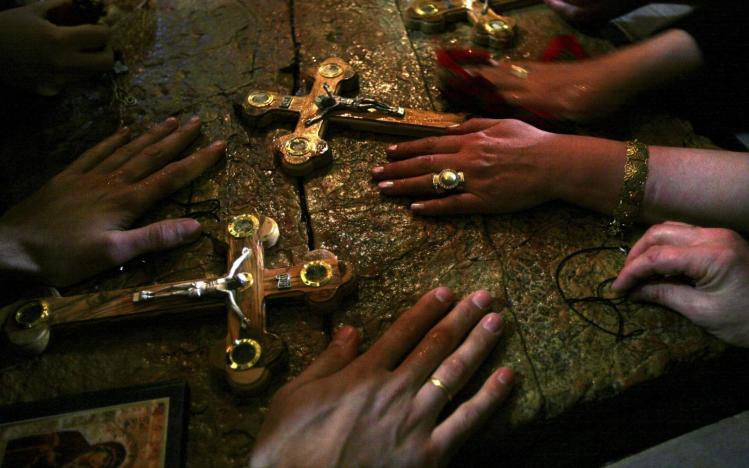
Downstairs, old women are strewing rose petals over the marble slab representing the place where Jesus’ body was washed before burial. The slab is wet with pools of water which seems to have appeared miraculously, while the women kiss the stone, dampen their rosary beads in the water, bathe and stroke their own worn faces with it, praying. It seems that the stone will be bathed eternally, that it has never been dry since Jesus’ body was washed on the spot.
From another upstairs room there is a stairway to an Ethiopian monastery, an African village of mud-walled cells on the roof of the church, near the pillar marking the ninth station, where Jesus falls for the third time. Down in the courtyard, light spills from a crowded chapel of Ethiopians quietly singing, wrapped head-to-toe in dazzling white cloth, their smooth dark faces radiantly beautiful in a wash of light from oil lamps and candles, the mood more solemn and still than in the main church.
The next morning, in West Jerusalem, those of us who had ventured down the Damascus Road from the orange-and-lemon-scented courtyard of the American Colony Hotel into the Old City at night were roundly condemned for our foolishness. One of my companions, recounting what he’d seen, commented in awestruck tones, “You could see, right there, the source of everything that’s wrong with the world, all that fanaticism.”
She weepeth sore in the night, and her tears are on her cheeks; among all her lovers she hath none to comfort her; all her friends have dealt treacherously with her; they are become her enemies.
I wonder how European medieval pilgrims felt when they reached the Holy City after months and months of difficult, dangerous travel. Were they disappointed to find a city made of earth and stones, like other cities? Did the physical sites of their belief seem real, or hollow? Did they always believe that their relics were indeed fragments of the True Cross? Or were they conscious of the sediment put down by centuries, layers of meaning and sensibility, on any one of which they might be allowing themselves to be conned, or ridiculous? Or were they hooligans, rowdies, adventurers along for the ride? Were they spellbound by the landscape, its gorgeous hills spotted with white stone, its sudden shifts in terrain from one hill to another; confused by its accretions of time and meaning; frightened by its politics; entranced by its suggestions of the presence of the invisible and frustrated by its invisibility, as I was? Were they all of the above?
Jerusalem asks more questions than it answers. Its literalness, the flesh of its existence in history, its churches with their layers of Franciscan stucco over Ottoman embellishment of Crusader castle built on Byzantine ruins of Herodian stone—the flesh of its existence in history is fascinating, and embarrassing.
I met a young Jewish man who had “made aliyah,” returned to Israel out of religious devotion, and had been living in Jerusalem. Jerusalem, he said, was another Disneyland, a religious theme park. It had made him lose his faith.
The Friday after Orthodox Easter, I followed the procession along the Via Dolorosa, with the “real stations, where Jesus walked.” The procession was led by a young Roman priest with a microphone; the familiar chants were overpowered by the Muslim call to prayer at the nearby Dome of the Rock, broadcast over loudspeakers. The mass of yellow sun hats worn by a large group of tourists trying to stay together was distracting to any devotional mood; many held video cameras over the heads of the crowd while brown-frocked friars, looking bored, grimly ignoring the flashbulbs, tried to herd the edges of the crowd in the right direction. The Muslims had a much better sound system, while the Franciscans had only one small amplifier that a lead friar carried on a shoulder strap while he and his brethren read and sang into the microphone. At, perhaps, the second or third station, he read the only lines I could hear clearly, “We live in an earthly city; yet we look for a heavenly one.” No kidding, I thought.
Then as at each station, he led the prayers. Our Father. Hail Mary. Glory Be. The Fourth Station, Veronica wipes the face of our Lord. I had seen two rooms of the Last Supper, one over a Syrian Orthodox convent with few visitors.
I had also seen two sites of Jesus’ burial; the Anglican one in a garden—full of cheerful Britishers photographing each other before the cave—had been established by those who dissented from Saint Helena’s view, on which the Church of the Holy Sepulcher had been built. The overgrown place had its own sweet romance, and seemed more true than the gilded shrines of the Holy Sepulcher; a painted sign fixed to the gate of the Tomb reminded visitors: “He is not here, he is risen.”
At the end of the procession of the stations of the cross, I was back in the Holy Sepulcher, and after the last station, where Christ is laid in his tomb, I peered in at a Coptic priest with his yellowed beard trailing over his belly, guarding the shrine behind the tomb. He allowed me to take his picture and to kiss his cheek in thanks. He reached to the altar beside him and pressed something into my palm: a small wooden cross with a tin figure of Christ. I wasn’t sure at first that he meant me to keep it; I thought it was some ritual and I was supposed to stand there, the cross in the center of my palm, and say a prayer or perhaps a confession—the priest seemed to be waiting for me to do something, I didn’t know what. Then he jostled my hand, indicating that the cross was mine to keep. It somehow seemed an answer to a question I hadn’t even realized I’d asked, a communication I didn’t even know I was thirsty for, and I clutched it, overwrought with emotion. All this time, I realized, I had been waiting for some kind of sign, and this one seemed so generous and concrete that on a stone step nearby, I sat and cried. Then I went to sit and pray in a silent ancient catacomb housing Joseph of Arimathea’s tomb.
When I came out again the Coptic priest was still there, his yellow beard a streak across his vestments. He brought an extra stool into his shrine and made me sit beside him, while we tried to communicate in his very few words of English and my even fewer words of Arabic. He seemed delighted for my company, apologetic that he didn’t have more English words to share with me, that the words he had were like unruly marbles in his snaggletoothed mouth. He pressed two more crosses into my hand from a box by his side I hadn’t seen before—along with candles, intended to be given in return for donations. That had been what he had been waiting for before, but now that he’d seen the impression the cheap little cross had had on me, he wanted me to have more, gratis. I think he might have showered me with crosses if I’d wanted. He smiled hugely in his beard.
If the first cross had seemed a sign, the other two seemed a divine wink of uncertain meaning, both joke and affirmation. I clutched them in my sweaty hand. Three crosses, like the three lighted ones I had seen from a train near Washington a few months before, after an intense weekend with two friends where deep discussion of Catholicism had alternated with sweaty dancing in gay discos. Kitsch, like the three homemade triptychs of the Virgin Mary my friend P. had found at a yard sale, dividing them up among the three of us. Now three cheap wood-and-tin souvenirs, or signs of grace, to be divided the same way. I had spent much of my time in the holy city wishing my friends were there, to witness and grapple with its strange alloys of sacred and secular. Three months after my return from Jerusalem, both would test positive for HIV; one would live, one would die.
I took the three crosses to dip them in the water on top of the marble slab of the Stone of Unction, as I had seen the old Greek ladies do; but the slab was by now almost entirely dry, scattered with withered rose petals, and I could only rub them in a few remaining spots of dampness.