Holocaust memory is proceeding to a new stage. Soon, we will no longer have unmediated access to living survivor testimony, which has been so crucial to our understanding of these horrific events. It is less often acknowledged that we will also lose the living testimony of others who were involved in the Shoah: Nazi perpetrators, bystanders, enablers, liberators, and those in the resistance. Telling the story from all angles and about all aspects of Holocaust memory is thus urgent work. Moreover, recent distortions of Holocaust memory after October 7, 2023, and the pursuant war on Gaza render a new focus on the many histories of the Holocaust even more pertinent.
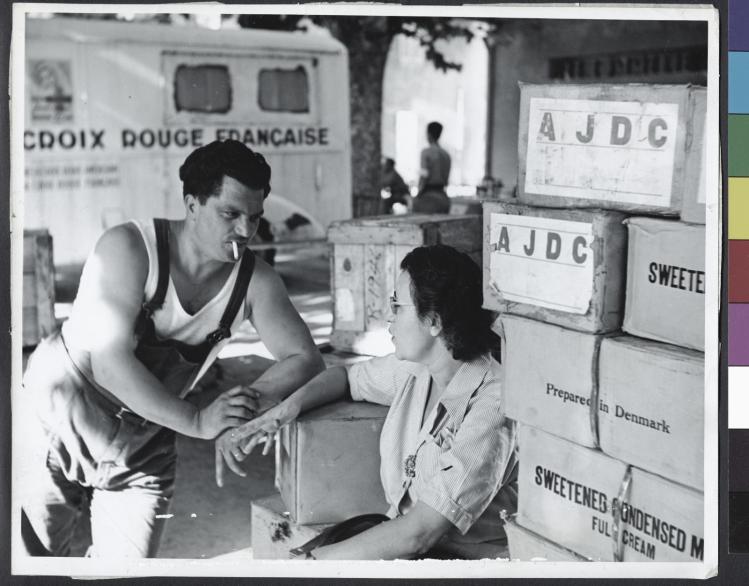
Enter Debórah Dwork’s captivating history of American relief workers during the Holocaust. Through organizations such as the American Jewish Joint Distribution Committee (JDC) or the American Friends Service Committee (AFSC), Americans put their lives on hold to save Jews and other groups targeted by the Nazis. The book is divided into five chapters, each telling the detailed story of one location and one relief worker or relief-worker couple over the course of roughly one year. We travel from Prague (in 1939) to Vilna, then to Shanghai, Marseille, and finally to Lisbon (in 1943). For each of the five settings, we are given an in-depth snapshot of the liberators, the different kinds of relief work they engaged in, and their challenges on the ground. This topographical history, combined with an analysis of tangible material culture, lets us dive into the particularities of one place and culture at a time while also situating each in the larger history of diverse relief efforts.
Dwork’s new book is remarkable not only because it provides a compelling story of Americans who became heroes by saving Jewish (and other) refugees, although it does that. The history of staggering American self-sacrifice is a story that we seem to need today especially, in times of crumbling national cohesion and resurgent ethnonationalism. Yet the brilliance of Dwork’s study is that it uncovers the emotional reasons, the incidental allegiances, the seemingly accidental happenings that helped and sometimes profoundly hindered those brave individuals in their endeavors. For example, after numerous policy changes, only “French children with relatives in America and foreign refugee children” could obtain visas to exit Nazi-occupied France. This meant that relief workers like Martha Sharp had to be extraordinarily resourceful and adaptable to save lives. When the Ministry of Foreign Affairs refused to let French children go to America, Sharp was quick to pivot. “She shifted her sights,” and the group now included “French, German, Austrian, Czech, Hungarian, and Russian children.” She was able to include the French children in other groups of immigrants that had already been cleared. Tragically, this very contingency and randomness could also work against people in need. Dwork describes the fate of a Jewish refugee couple who had been selected for Unitarian Commission support out of Prague. Even though they already had passports, “Mr. Weller’s middle initial D had been incorrectly recorded as O, and that discrepancy prompted the British government to deny him entry.” Dwork does not dwell on the fate of someone who could not be saved, but we can easily surmise what it meant to be left behind.
In this way, the book records a history of big personal ambitions as they intersect with miniscule chance occurrences. As a result, the title Saints and Liars is perhaps more sensationalist than the stories require. It is of course true that in many cases, the liberators profiled here had to “lie” or make difficult moral choices for the sake of saving lives. But the very fact that they had to bend the truth or be resourceful while doing good is not in the first place what makes this a compelling read. Even though the relief workers were often sent by religious organizations, invoking religiosity or “sainthood” is not necessary. The book highlights that it was the relief workers’ personal qualities, such as perseverance and endless sacrifice, rather than their adherence to a specific religious belief, that made their aid successful. The most captivating aspects of the book are the often unexpected ways that relief efforts were thwarted or succeeded, sometimes against great odds. Remarkably, the relief workers were from different religious backgrounds, many of them Christians ranging from Unitarians to Quakers. It is especially heartening to read about people who sacrificed so much for refugees of different religious persuasions.
Dwork’s book also stands out for its portrayal of women relief workers in particular: although they were sometimes not properly remunerated, they were heroic and undeterred in their work. In 1939, Unitarians Martha and Waitstill Sharp worked in Prague to rescue Jews and other dissidents. Time and again, it was Martha who took more risks than Waitstill and who was ultimately more successful at saving lives, especially children’s lives, during her time as an unpaid minister’s wife. Her extraordinary sacrifice is heightened by the fact that the Sharps left their own children behind in the United States with family friends.
Or consider Laura Margolis, a woman employed by the JDC in Shanghai. Trained and tested by previous relief work in Cuba, she called out the glaringly dysfunctional mismanagement of the existing relief regime in Shanghai. Even after she had proved her effectiveness, her stubborn, power-hungry (male) coworkers resisted her efforts to deliver emigration documents to deserving refugees. The leadership of the Committee for the Assistance of European Jewish Refugees (who were often not on the ground) disagreed with her approach, but she nevertheless managed to bring considerable relief to fourteen thousand Jewish refugees. Even though her work ended up being stalled by the Japanese attack on Pearl Harbor, she succeeded in establishing structures and institutions in Shanghai that outlasted her stay there. Margolis’s work highlights the extent to which women really were the unsung heroes of the relief effort.
The story of the Quaker couple Marjorie and Roswell McClelland, who were not specifically trained as social workers and had done no prior relief work, was one of a steep learning curve that they successfully summited. They went from almost total inexperience upon their arrival in Rome in 1941 to savvy leadership in the Marseille office, which tasked Marjorie with “correspondence with Philadelphia on all the emigration, money transfer, and welfare inquiry cases,” among other things. As the situation in France for refugees and for Quaker relief workers deteriorated, Marjorie was forced to decide which children to choose for emigration. Dwork meticulously describes how Marjorie’s decisions were often guided by emotion, empathy, and a curious form of antisemitic philosemitism.
The last chapter focuses on the Unitarians Elisabeth and Robert Dexter, who worked for Jewish organizations in Lisbon in 1943 and helped political activists who had become Gestapo targets. After the Nazis’ fateful decision to pursue the “Final Solution” in 1942, the Dexters often had to make decisions about relief initiatives versus rescue actions—and again, Dwork admirably details the individual emotions, interpersonal differences between aid workers, or incidental circumstances that explained those decisions.
When telling the story of liberators, the danger is that the victims, including “the saved,” remain eclipsed. Yet in this book, we get an appropriate sense of their fates, even if told through the lenses of the liberators. The five richly detailed case studies show through archival materials, diaries, and other documented sources how earlier tidy, linear postwar narratives of relief and rescue work were incomplete. The work of these individuals was mired in internal politics, gender prejudice, personal ambitions, clashes between leadership offices in the United States and workers on the ground, and myriad other circumstances that contributed to the refugees’ uneven fates. A deep sense of loneliness befell many of the workers in their endeavors, especially those who were not able to share their burden with a partner. Debórah Dwork’s book shows us how they nevertheless prevailed, even in the face of overwhelming adversity. Her work is a must-read for anyone even slightly interested in history, and especially for those discouraged by current events.
Saints and Liars
The Story of Americans Who Saved Refugees from the Nazis
Debórah Dwork
W. W. Norton & Company
$27.89 | 256 pp.