Now and then, a martyr gets off a really good line. There’s the famous tale of St. Lawrence’s quip as he was being burned at the stake: “Turn me over—I’m done on this side!” Acacius I, bishop of Melitene or maybe Antioch, uses his interrogation by pagans as an excuse to dunk on a series of pagan gods, starting with calling out Apollo for being an incel loser who killed his catamite by accident. “Sanctus,” martyred under Marcus Aurelius, spoke by his silence, refusing to give his name, origin, or even whether he was a free man or enslaved. There’s something here that goes beyond panache in the face of death. To show up in court, to refuse to fight or flee, and then to refuse to answer the state’s question or accusations—this is an unexpected combination of the highest boldness and the most complete surrender.
Sarah Ruden was struck by the boldness of St. Perpetua, “the first female prose author in Western history whose work we still possess.” Ruden is captivated by the refinement and wit with which Perpetua expressed herself, the individuality and assertiveness with which she went to the spectacle of her own death in the arena. In her new book, Perpetua: The Woman, the Martyr, Ruden depicts Perpetua as smart, highly imaginative—but also attention-hungry, spoiled, irresponsible, callous, and probably duped by older men. She seems less awed by Perpetua than indignant on her behalf.
Ruden is a poet and translator. She has translated everybody from Aristophanes to the Gospel authors, and crafted a jolting, fascinating translation of Augustine’s Confessions. I would not recommend this translation to someone who had never read the Confessions before (Thomas Williams’s 2019 translation is far more student-friendly), but there are both thrills and insights to be had in turning from the harpsichord of F. J. Sheed’s Confessions to the electric guitar of Ruden’s. Thrills: Who wouldn’t prefer, instead of Sheed’s “I went away from You in fornication,” Ruden’s “I cheated on you like a true slut”? And insights: for example, her insistence on translating Augustine’s Dominus as “Master” rather than “Lord.” Everybody else avoids this move in English, because it feels too redolent of slavery. Ruden is the only one who will make you ask what it might be like to worship Christ in a slave society—and what it might mean to call God “Master” more often than “Redeemer.”
Ruden’s Augustine felt foreign and alive: an ancient mind making contact with the contemporary world. And so I’m sorry to report that her Perpetua feels flimsy, as if she is not imaginatively inhabiting the saint but merely projecting contemporary interpretations and concerns onto the screen of an ancient text. Ruden criticizes scholars for “insist[ing] that Perpetua stood for a Christianity like their own”—but just a few pages earlier she writes that Perpetua “died for the right to be herself…to get into a lot of trouble and stay there.” This is a saint who can fit on a coffee mug.
The book is loosely structured, more a series of riffs than a sustained argument. Some riffs are persuasive and intriguing, like Ruden’s attention to the nursery tenderness of Perpetua’s dream of heaven. Ruden’s guesswork about Perpetua’s education, piecing together bits of her backstory from the evidence of her prose style, is also fascinating and fun. The chapter exploring specific features of Perpetua’s masterful “intimate literary voice” illuminates both Perpetua’s style and, occasionally, her faith.
But Ruden has axes to grind. She wants the reader to know that not only Roman tyrants but Christians used the spectacle of the arena as propaganda; that some men who praised martyrs died in their beds; that Perpetua was caught between a society that saw no value in her living mind and a Church that saw infinite value in her dead body. These are all ideas and interpretations worth exploring, and a highly personal, essayistic book might be the ideal way to explore them—but exploration isn’t quite what happens here. Ruden is more interested in intellectual conquest than in exploration.
This short book is stuffed with pushy phrases, cynical assessments, whole paragraphs of rhetorical questions, and flat-out victim-blaming. Perpetua “relishes the prospect of her martyrdom as a pageant of self-fulfillment”; she “sounds like an immature recruit to self-sacrifice” and is “preoccupied with…material matters.” That’s all on one page! Perpetua is “nudged and flattered” into her dream-visions. She speaks “coldly” and is “preachy” toward her father. (By contrast, author Virginia Burrus, in her Saving Shame, describes Perpetua’s “consistently compassionate response” to her father’s pleas for her to apostasize.) Again and again, Ruden insinuates that pagans and Christians collaborated to produce the mutually glorifying spectacles of martyrdom, that Christians connived at their own or their comrades’ murder. In martyrdom, Ruden writes, Perpetua “had chosen to detonate herself” and was “first seen starving [her baby] in jail.” I am not convinced this is the correct attribution of responsibility for the suffering of a child born to a woman jailed for resisting religious persecution. But then, Ruden makes no real effort to convince me.
Of course, martyrs do serve as propaganda for both sides. In the past few months, my social-media feeds have shown me the exact same videos of detentions, assaults, and murders posted by both the administration committing them and the brave people opposing them. This does not make the two sides equivalent, or cooperators. The mother of a young child faces danger by rebelling against a repressive regime. She’s slain in spectacular fashion, her child’s custody is thrown into question, and her death inspires far more people to join her cause. Is that a description of Perpetua, or Renée Good?
Many voices within and outside the Catholic Church are calling Church leaders to account for the ways they have pressured vulnerable young people into sacrificing far too much for the sake of a distorted Gospel. Teens and young adults can be pressured into sex, into conversion therapy, into making excuses for those who harm others in the name of Christ. This doesn’t happen only in the Church, but it does happen in the Church. And Perpetua might seem like a prism through which light might be shed on these issues. After all, her story includes troubling elements, such as her child’s unknown fate and the moment when “on her own she moved the wavering right hand of the novice gladiator to her throat,” making her an active participant in the act that ended her life.
But reading Perpetua left me thinking that its heroine’s life is explained more fully by elements Ruden didn’t explore than by these contemporary parallels. Ruden treats Perpetua as primarily Roman in her psychology. Joyce E. Salisbury’s Perpetua’s Passion: The Death and Memory of a Young Roman Woman, by contrast, places Perpetua in a specifically Carthaginian context, including Carthage’s tradition of honorable female suicide. Salisbury suggests that Perpetua may have been, even without acknowledging it, following models her culture named as heroic.
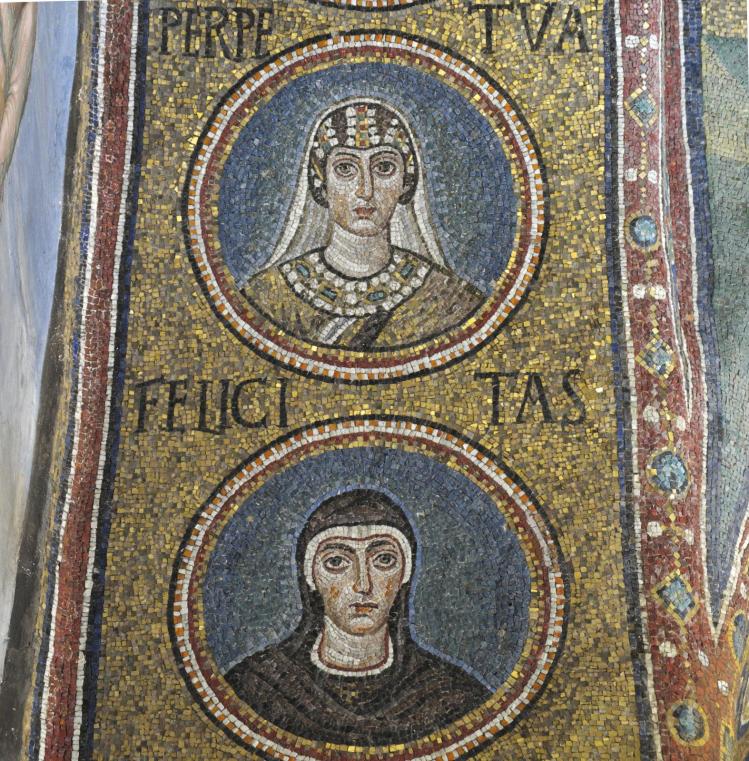
Neither Salisbury nor Ruden do much with an aspect of Perpetua’s story that has always resonated with me. From the Mass to mosaics, from Augustine down to the present day, this Roman matron’s name has been linked with the other woman who died with her: Felicitas (Felicity in English), an enslaved woman. Perpetua and Felicitas were both mothers. Felicitas prayed that she would be delivered of her child more quickly, so that she could be martyred—and she managed to get her child raised by a Christian, in freedom. If Perpetua’s narrative leaves us with as many questions as answers, Felicitas is even more of an unknown. While some enslaved martyrs like Blandina had their witness to Christ described in detail, Felicitas’s story takes place in the margins of Perpetua’s. Ruden suggests that the two women are twinned in Christians’ imaginations by a simple matter of wordplay: Augustine loved the ring of Perpetua felicitas, “eternal blessedness.” Maybe Felicitas’s main role in the story is to turn heaven into a pun.
I am not so sure. For me, Perpetua is so compelling not because she was so bright, not even because she was a literary genius. Perpetua may have been spoiled, precocious, impulsive, even thoughtless. Her hunger for glory may have blurred into hunger for celebrity, or approval, or specialness. But she is remembered, and her name rings down through the ages, because she chose to take the same place as a slave. She is not singled out. Perpetua and Felicity are now what they always were: eternally equal.
Perpetua
The Woman, the Martyr
Sarah Ruden
Yale University Press
$28 | 208 pp.
We welcome your comments about this article. Please send your response to [email protected].