Introibo ad altare Dei: “I will go in to the altar of God.” Ad deum, qui laetificat juventutem meam: “To God, who gives joy to my youth.” So began the prayers at the foot of the altar in the preconciliar Tridentine Mass, with an exchange between priest and altar server adapted from Psalm 42:4. I belong to the last generation of servers who relied for our share of the Latin verses and responses on those laminated, two-sided sheets you can still buy online from certain retro Catholic websites.
We had learned it was an altar (not a table), on which the priest offered the sacrifice of the Mass. The consumption of the sacrificial offering took place behind us at the altar rail, which separated us (temporary ministerial inductees, dressed in cassock and surplice) from the laypeople in the nave. It was a bloodless repetition of the sacrificial death of Christ on the cross. We had learned that the ritual reenactment of that sacrificial death earned vicarious merit for those for whom the Mass was offered—and for us as well if we received the sacrificed body of Christ in the sacramental form of the host. Those acts were key moments in the supernatural economy that linked us horizontally with the living and vertically with the deceased, whether in heaven or purgatory.
But we were only vaguely aware of the nearly two thousand years of ritual and doctrinal growth that connected what we were doing with the once-and-for-all sacrificial death of Christ in Jerusalem in first-century Roman Judaea. On the Altar, the new history of sacrifice by Jonathan Sheehan, the Sidney Hellman Ehrman Professor of European History at the University of California, Berkeley, won’t leave readers much better informed about that development than we were in our naïve assumption of an unchanging ritual permanence. That’s because he explicitly leaves out the thousand years of development from about 400 to 1400, “during which [occurred] the luxurious growth of sacrifice in the bosom of the medieval Church—the sacrificial priesthood, the sacrificial Eucharist, the cult of the holy blood, the cult of the saints, the development of sophisticated doctrines of the Atonement.” He intentionally jumps over the era that shaped much of the Catholic ritual practice with which we grew up and which we believed must always have existed in roughly the same form.
In other words, On the Altar is not a general history of sacrifice in Christianity in the era of its cultural dominance or in its afterlife in a post-Christian secular modernity. The rich worlds of Eastern Christianity are left out altogether. It is, as the author says, not just a book of history but a book about history: a methodologically sophisticated study of how what was said and believed about sacrifice in the past was remembered, understood, and reappropriated in the present. It is thus an ambitious and creative exercise in reception history. The focus on critical reception explains why two of the book’s four parts concentrate on the early modern period, the fifteenth through the seventeenth centuries, when debates over sacrifice were so central in public discourse. Those are the centuries that the Western-civilization textbooks of two generations ago tidily encapsulated as Renaissance and Reformation, movements deeply marked by critical, creative, and often adversarial engagement with received religious, political, and cultural traditions from the Bible and from Christian and classical antiquity. During those years, debates about sacrifice were enriched by the vast trove of new data from the European encounter with the Western hemisphere.
The chronological terminus of the book is “ca. 1915,” in the middle of World War I. We will turn to that in a moment. Sheehan’s treatment of how thought about sacrifice changed in the modern period is very selective. Here I note only the role of what he calls the human sciences that emerged in the nineteenth century. The critical study of the Bible, for example, made comparative work on sacrifice easier but also opened the door for hostile critics like Nietzsche, who denounced the entire notion of sacrifice as the fruit of an inhuman and “denaturalized” religion.
Though the book ranges over nearly two millennia, that timespan is a bit misleading. Part I treats those aspects of sacrifice in the first five hundred years that will draw special attention in later centuries. Parts II and III, treating the period between 1450 and 1685, are the heart of the book, with overlapping discussion of writers, books, and artwork. Always, Sheehan’s theme is “heteronomy,” a term he borrows from Immanuel Kant. In Kant’s moral philosophy, true moral autonomy means not depending on some source outside ourselves, such as history, nature, or God, to legislate our moral life. To depend on any of these is to fall into “heteronomy”—subordination to forces we cannot control. In Sheehan’s adaptation of the term, it means the diversity and pluralism that escape the epistemic or practical control of any would-be normative authority. To this reviewer, Sheehan’s version of heteronomy appears to function pretty much like historicity. Whether we are talking about the dogmatic uniformity of the early Christian Church or about secular modernity’s claim to have escaped the irrationality of religious sacrifice in the name of civil order and amity, there is always more to history than the official story. “Heteronomy” thus names whatever we want to deny or refuse to acknowledge.
Sheehan’s method is well expressed in the long opening section of Part IV, which recaps past developments and introduces the turn of ideas about sacrifice toward the secular and the affairs of this world, not the next:
Sacrifice…but not like that. From the deep Christian past, the challenge had always been to work out the terms of this difficult thought. From this thought grew the archives of Christian sacrifice from the Reformation onward, as generations of writers grappled with that essential but imposing question: what belongs to Christianity and what does not? What I have called the heteronomy of Christianity—the way it incorporated and sedimented within itself the world of its opponents—was put on full display as Christians, and especially Protestants, in Europe discovered that what they had thought was Christianity was, surprisingly, nothing of the sort. Sacrifice thus split the churches apart, each seeking to delimit which sacrifice belongs and which does not, which should be preserved and which eliminated. Like the history of Christianity itself, sacrifice was simply too important to lose. How to save it was the problem.
Over time these archives grew, swollen with material first about the early church and its ultimately failed efforts to patrol the boundaries of the new faith. Early conflicts about the Eucharist, liturgical reforms, and eventually the blood of the martyred pulled Christianity into its own deep time. Theology joined forces first with history, antiquarianism, and then anthropology, a dynamic that only accelerated in the seventeenth century. New problems, confessional and otherwise, made new questions urgent: why is sacrifice apparently universal? Is sacrifice a human invention or a divine one? Are the sacrifices of the ancient Mediterranean, the New World, and the sacrifices of Christ all part of one story? If so, what story is this? Comparative histories of idolatry, anthropologies of worship from the ancient Mediterranean to the New World, problems of sovereignty and sacrality: the archives of sacrifice were endlessly pressed into new political, religious, and intellectual service.
However various the questions, problems, and materials, what knit them together were the sinews of Christianity’s sacrificed deity. By the later seventeenth century, these began to fray.
Every important feature of Sheehan’s approach is evident here. First, there is the theme of identity and difference: the death of Christ on the cross was acclaimed as a sacrifice that ended all sacrifice—both the sacrifice practiced in the temple in Jerusalem and later pagan sacrifice as well. But, somehow, that did not render superfluous the sacrificial blood of the martyrs. Retaining the Hebrew Scriptures as the Old Testament required incorporating blood sacrifice alongside the supersession of temple sacrifice in the Letter to the Hebrews. Then there is the concept of an “archive,” a literary corpus of texts created either by design or coincidence that is retrieved, or crafted, by later ages and weaponized in service of new forms of contestation. Next, there is the genesis of ever new methods for interpreting those archives and sustaining a single normative story—e.g., the antiquarian investigations of Renaissance humanists or the ethnographic compilations of Spanish missionaries in the New World—which in turn must yield to new data.
Finally, there is the quasi-Hegelian idea that superseded notions of sacrifice do not disappear but are “sedimented” into the ongoing tradition, as if a thesis has generated its antithesis and the resolution of the conflict produces a new synthesis. But Sheehan’s heteronomy differs from Hegel in at least one important respect: it does not constitute a progress toward greater rationality, for there is no telos in history as Sheehan understands it. The modern turn toward the secular does not necessarily constitute progress. “By the late eighteenth century, then, a new secular sacrificial imagination had expanded throughout the political sphere…. Whether we call this patriotism or nationalism, it wove citizenship and sacrifice permanently into the fabric of modern political life.”
That last sentence points to a fundamental question. When I agreed to review On the Altar, I expected that Sheehan might treat sacrifice in modernity as an unmasking of secularization, in which the state appropriates the sacrality formerly claimed by the Church. Theologian William Cavanaugh, well known to Commonweal readers, has written of the seventeenth century’s “migration of the holy” from the Church to the state. A century ago, Carl Schmitt’s resuscitation of ancient political theology saw the same logic at work in law and government when he proposed that all modern concepts of the state and of sovereignty were secularized theological concepts. The liberal state lived under the illusion that it needed no religious legitimation, even though the same state claimed it could compel its citizens to sacrifice their lives to protect the state when it was existentially threatened. Yale law professor Paul Kahn adapted Schmitt’s critique in asking how the so-called limited liberal state could rely on the well-nigh eschatological threat of nuclear weapons in its strategy of defense.
Sheehan is of course keenly aware of this “transfer of sacrality” and discusses it at length, especially in chapter ten, “The Death of Cato,” with poignant quotes from Rousseau on a civil religion as “political therapy for Christianity.” Sheehan ends his book with a response to views like Kahn’s. The conventional modern hallmark of the secular, he says, is its claim to autonomy from the hierarchical and the religious. Genealogical arguments like Schmitt’s unmask that claim as an illusion. Sheehan agrees that it’s an illusion, but he does not share the implied moral superiority of Schmitt’s critique, for he writes as a historian and not as a jurist. Even the secular, he shows, retains “the intimacies—uncomfortable, strained, even violent”—of its origin, just as Christianity itself had done. By this he seems to mean not only the bloody cost at which the secular originally freed itself from the constraints of religious authority but also the price it continues to pay to maintain its freedom. Rather than suppress or deny that cost, Sheehan concludes by suggesting that we might appreciate it because of the artistic and imaginative creativity that it has inspired. He begins his book with an evocative quotation of Wallace Stevens’s 1915 poem “Sunday Morning.” He ends it with T. S. Eliot’s “Little Gidding,” written in 1942 “under a hail of German bombs…. A poem on sacrifice and resurrection, history and memory, death and renewal. The history of the imagination is the history of this renewal, transfiguration in other patterns.”
Sheehan is not suggesting that cultural creativity is an adequate compensation for the damage done by the nation-state, the “free” market, and colonialism, which have all been historic corollaries of the secular. Again, impartiality is the historian’s appropriate posture. But it is still somewhat surprising that he chose to conclude his book with Eliot—an unapologetic royalist—rather than with what is possibly the most famous antiwar poem ever written, Wilfred Owen’s bitter “Dulce et Decorum Est,” which ends with a condemnation of “the old Lie: Dulce et decorum est / pro patria mori.” Owen is nowhere named or quoted in this book. But that damning Latin line, borrowed from the Roman poet Horace, does show up in Sheehan’s brilliant account of how the Enlightenment reimagined the history of sacrifice, both Christian and pagan, and freed sacrifice for new secular and political ends. I suspect most of his readers are more likely to know Horace’s tag through Owen than from the original Latin poem. Those of my generation who thought the American war in Vietnam was unjust treasured Owen’s poem. Sheehan does cite Voltaire, Goethe, and Nietzsche at length for their eloquent and savage denunciations of biblical and Christian sacrifice. But the secular critique not only failed to neutralize sacrifice’s bloody legacy; it recycled, deepened, and democratized it.
I have given disproportionate attention to Part IV of On the Altar because it touches on matters of immediate concern to us in the United States as we witness an upsurge in Christian nationalism. The political expropriation of religion in the name of ethnonationalism is also evident in Russia, Israel, Hungary, and elsewhere. Religion and ethnicity are not supposed to be conditions of citizenship in the liberal secular state. Perhaps we are witnessing not the return of the religiopolitical models of earlier eras but disturbing demonstrations of the modern state’s inability to shed its blood claims.
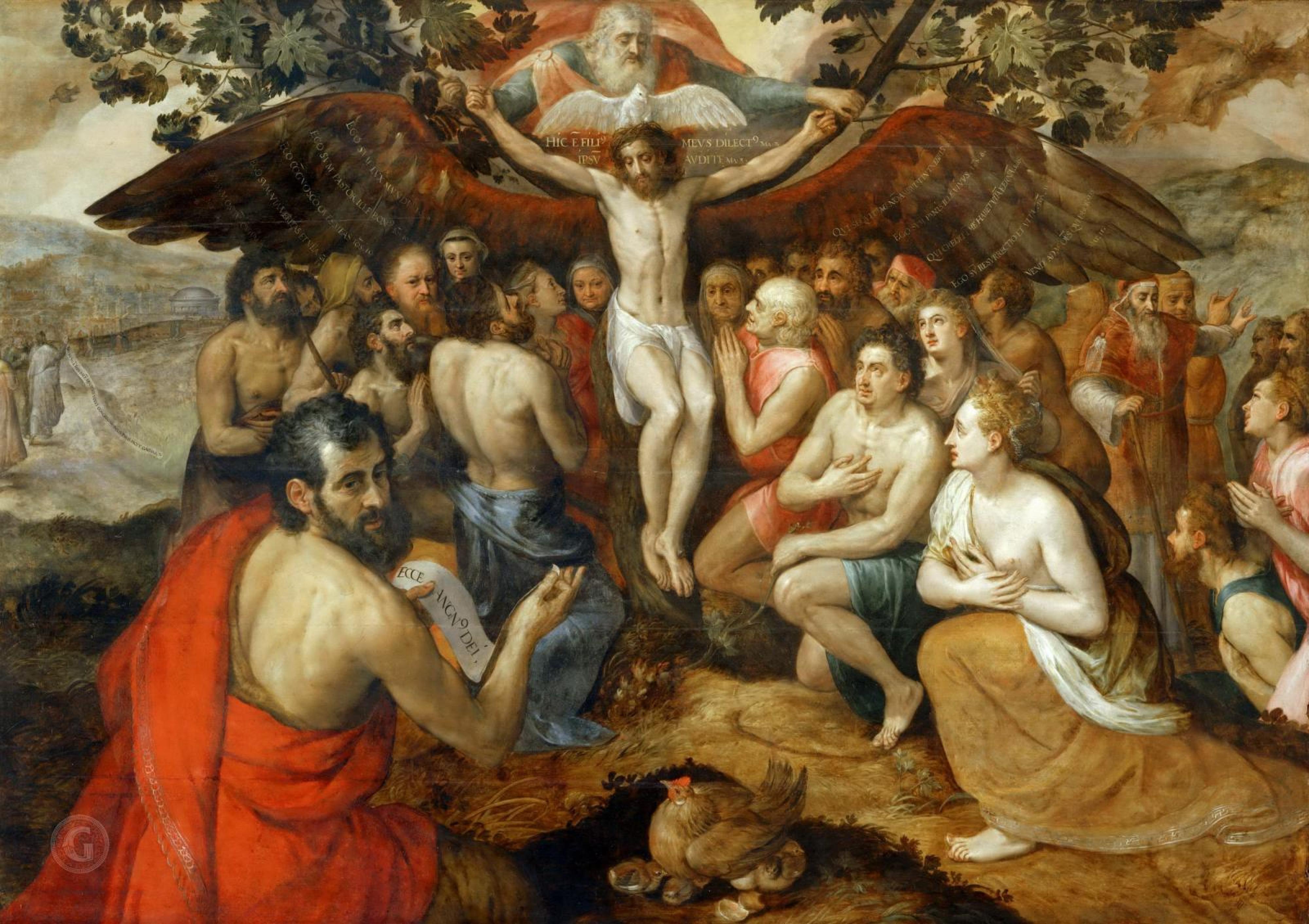
There is so much else of note in this rich and demanding book. Eamon Duffy had written about the popularity of the Mass of Saint Gregory in The Stripping of the Altars. Based on an eighth-century legend about Pope Gregory the Great and a miraculously bleeding Eucharistic host, late medieval paintings showed Gregory saying the canon of the Mass as a life-sized Christ appeared after his crucifixion and dripped his salvific blood on the altar. Sheehan offers an extended discussion, accompanied by four colored plates, of how the painting offered a visual meditation on the sacrificial blood of Christ. Around 1400, an indulgence was attached to prayers said in front of that image.
In a fine demonstration of his heteronomy theme, Sheehan shows how “a new and robust sacrificial imagination flourished” among the early Reformers, who repudiated the sacrifice of the Mass and a sacrificing priesthood yet retained the powerful visual and homiletic motifs of the sacrificial blood. His main point about the Reformation’s sacrificial imagination is how the Eucharistic sacrifice that had once been “an integrative concept and practice…[that] bonded the Christian community with the blood of sacrifice” later divided Western Christianity into warring communities bonded by competing understandings of Christ’s sacrifice and of their respective confessional martyrs. The heteronomy of sacrifice would continue to trouble and inspire Protestantism for the next two hundred years until Enlightenment rationalism finally worked its solvent effects. And even then, Pietism would creatively rework sacrificial themes “unchained from doctrinal and confessional controversies.”
Two other sections of the book deserve special mention. In chapter six, “The Gods of Paste: Anthropology and the Sacrifices of New Spain,” Sheehan recounts the various ways in which European Christians absorbed the sometimes shocking rites of previously unknown peoples and tried to fit them into the narratives, hermeneutics, and sacramental categories that they brought with them from across the ocean. “In this city of priests [Tenochtitlan], blood ran everywhere all the time”—so Sheehan begins his long quotation of Cortés’s description of the Aztec capital that he sent back to the Emperor Charles V. The resulting encounter, Sheehan writes, would be “a catalyst for broad transformations in the European sacramental imagination.”
Chapter seven, “Kings and Martyrs: Sacrifice and the Seventeenth Century Political Imagination,” is even more interesting. The century was split in two by the execution of King Charles I in 1649, “the first judicial execution of a king in European history,” a controversial event that evoked radically different reactions. Sheehan first presents readers with the anonymous royalist pamphlet Eikon Basilike (“Royal Icon”), which portrays Charles as a suffering Christus Rex in an altered medieval political theology. He then gives us John Milton’s Eikonoklastes (the title speaks for itself), in which Milton portrays the scaffold not as the cross of a suffering Christ but as an altar of propitiation for the blood shed by a tyrant, not a king. And then in an ideological whiplash, we meet Thomas Hobbes’s disdain for both views and for all manner of armed prophets in his great work Leviathan, which would build rulership not from heaven above but from below, in a social contract against mutual fear. That, together with John Locke’s social contract based on commerce, will form the bridge to the secular in Part IV of On the Altar.
Sheehan’s book is a strenuous but engaging read for anyone who wants to think hard about the origin and purposes of sacrifice. Its subject matter bears on politics, war, liturgy, prayer, interreligious dialogue, gender relations, and much more. Sacrifice, especially blood sacrifice, makes most of us uneasy. I finished reading On the Altar during Holy Week, when the office is filled with texts on sin, guilt, and redemption. The reading of the Akedah, the sacrifice of Isaac, in the Easter Vigil, is unsettling, not least for parents. We are too aware of the misuse not just of the act but of the very language of sacrifice. I challenge readers to turn to pages 414–5 of Sheehan’s book and not be chilled by the account of the performance of Rites of Spring in 1913. Historians are generally not fond of the work of the literary theorist and armchair anthropologist René Girard and his ideas about sacrifice, and you will not find his name in this long book. But his case for the end of sacrifice in the one sacrifice of the Son of God is still worth considering. Girard’s warning many years ago in the pages of First Things about a nuclear apocalypse reminded this reader of the angry voice of Ha Shem in Walter Miller Jr.’s classic science fiction work A Canticle for Leibowitz after a second nuclear war: “You have made a holocaust of my sons!” Let’s hope that sacrifice never gets made.
On the Altar
A History of Sacrifice from the Sacred to the Secular
Jonathan Sheehan
Princeton University Press
$39.95 | 608 pp.
We welcome your comments about this article. Please send your response to [email protected].