The Eucharist, in the eyes of the Church, is the “source and summit of the Christian life.” In recent years, though, it’s become increasingly difficult to square that belief with the lived reality of Catholicism in the United States. For all the headlines touting a boom in adult conversions, the data tell a different story: declining Mass attendance, parish closures, and surveys that suggest widespread disbelief in traditional Eucharistic doctrines. For many, our individual experience of Mass feels rote, unenriching, or even disturbing and hostile.
Then there’s the Church’s uneven witness in the public sphere. Some American bishops praise the beauty of the Catholic intellectual and artistic tradition and champion “pro-life” causes while aligning themselves with the Trump administration’s illegal warmongering and racist immigration policies. From Memorial Day through the Fourth of July, the National Eucharistic Revival has undertaken a pilgrimage titled “One Nation Under God,” with the goal of offering 250,000 holy hours “for the renewal and blessing of America.” Overlapping with the national prayer service “Rededicate 250,” at which Bishop Robert Barron and Cardinal Timothy Dolan spoke, the pilgrimage—however sincere the intentions of the Catholics who will participate—is likely to be interpreted by many as an alignment of Catholicism with Christian nationalism.
Partly to blame for this dissonance between what the Church proclaims and how it plays out on the ground is an overemphasis on the Eucharist as the “summit” of our faith. Bishop Michael Olson of Fort Worth, Texas, writing thoughtfully in America from his perspective as a priest, notes that one of the problems with the U.S. bishops’ recent three-year National Eucharistic Revival is how the initiative frames the sacraments and Mass-going as the most important elements of Catholicism. Participants in the “Walk With One” program were tasked with inviting and accompanying someone to Mass, as if that were not just the high point, but the whole point of being Catholic.
For all the ways that the gift of the Eucharist uniquely nourishes, sustains, and empowers us to love God and our neighbors, problems arise when sacramental devotion becomes the measure of our Christian faith. It can lead to a self-centered, exclusive Church that forgets this world as it contemplates and journeys to the next one. Consider the resistance, in some quarters, to Pope Francis’s and Pope Leo’s advocacy for peace, justice for migrants and refugees, care for the earth, and dialogue with other religions, especially Islam. Rhetoric of “spiritual warfare” and “culture wars” often overemphasizes adherence to doctrine and devotional practices rather than attention to the real economic, political, and social injustices affecting the most vulnerable people in our world. Within these ways of thinking, the Church is presented as a shelter against the secular world.
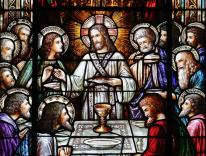
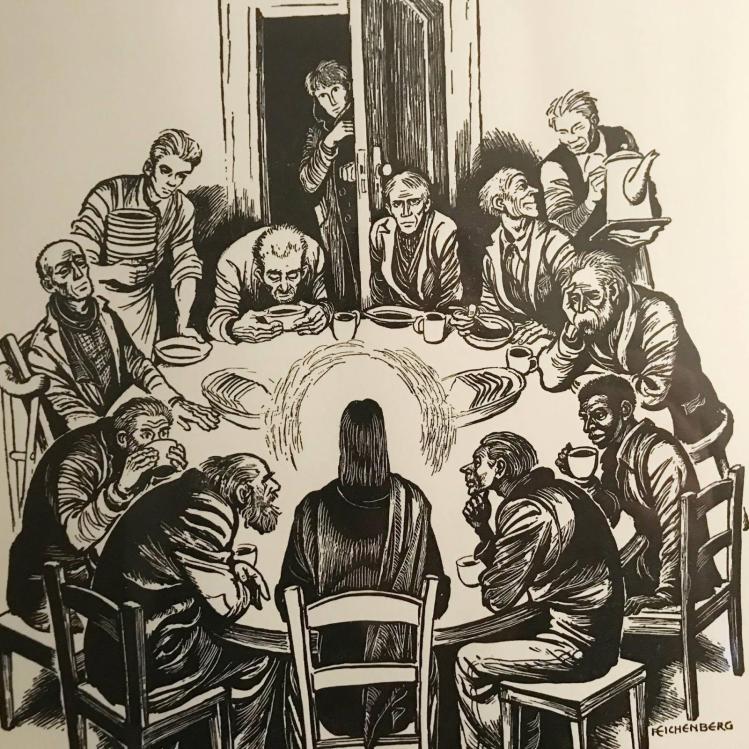
At the Last Supper, Jesus broke bread and said, “Take, eat; this is my body, given for you.” If we wish to follow him, we must go and do likewise, giving ourselves wholly to others. After the meal, the gospels tell us, the disciples struggled to remain with their teacher and friend as he was arrested, tortured, and executed. When we go forth from Mass, do we remain with Jesus, who is present not only in our friends and family, but also, even primarily, in those who are poor, suffering, despised, and belittled?
Like Jesus’ earliest disciples, we fail again and again. That’s why we need to keep going back to Jesus present to us in our neighbors, keeping watch with them and not shutting our eyes to their needs. It’s not enough to experience the “summit” of Eucharistic devotion—when we consume and become the Body of Christ—powerful as those moments are. We also need to come down from those spiritual heights and allow the sacrament to become the transforming “source” for our ordinary lives outside the liturgy. That’s where the work of Christian discipleship really begins.
The Eucharistic source and summit is not a prize we attain through our piety, but a dialogue between the Church and the world, between members of the visible Body of Christ and Christ who lives in every human being—in fact in every creature, particularly in the seemingly lowliest. Some of the earliest abuses of the Eucharist appear to have been failures of dialogue. We see this in 1 Corinthians, where we have the earliest biblical Eucharistic formula, as Paul decries a serious division in the community:
When you come together, it is not really to eat the Lord’s supper. For when the time comes to eat, each of you proceeds to eat your own supper, and one goes hungry and another becomes drunk. What! Do you not have households to eat and drink in? Or do you show contempt for the church of God and humiliate those who have nothing? What should I say to you? Should I commend you? In this matter I do not commend you!
Paul recounts the tradition of the Lord’s Supper that he has received and handed down to the Corinthian community, followed by a stern warning: “Examine yourselves, and only then eat of the bread and drink of the cup. For all who eat and drink without discerning the body eat and drink judgment against themselves.” For Paul, self-examination, discernment, and potential for unworthiness refer not to sin generally, but specifically to sins committed by the rich against the poor. Paul saw that the rich Corinthians didn’t view poorer believers as equal members of the community, and thus fractured the communion table—the place where, especially given the early Eucharistic practice of sharing an ordinary meal, real dialogue could occur.
American Catholics are similarly divided today, and dialogue is often seen as one potential remedy. But the dialogue the Church needs is not bipartisan, or a matter of compromise between rich and poor, sacred and secular. Christians are called to much more than compromise. We must, like Jesus, give ourselves totally to the world, in all its suffering and violence and instability. Perhaps, through our own witness, others will be drawn to our faith.
Or, maybe they won’t. Our evangelism hasn’t failed if we don’t bring someone else into the Church. We have failed in our mission, however, if we cannot show what is “good news” about a Catholic Christian way of life. Jesus persuaded those who would follow him through their own reasoning and sense of goodness, offering them something that answered the desires of their hearts. To those who were comfortable in their possessions or their piety, he offered the challenge of the God who demands justice, not empty words and gestures. To those who were downtrodden by society, suffering in body or mind, or labeled as sinners, he offered God’s unconditional love, welcome, and healing. Following Jesus’ example, we should seek first to live out our faith in a way that responds to the needs of the world and to each person we encounter.
Following Paul’s instructions, we need to examine ourselves before participating in the Eucharist, lest we be found unworthy. First, we should continually remind ourselves that the Eucharist is a person, not a thing. People draw us out of ourselves, make demands on us, and fundamentally transform us as a result. Jesus’ parables—take the Good Samaritan, or the Prodigal Son—teach us that our neighbor is the person, whether friend or enemy or stranger, who demands our attention and love. We all experience moments when we’re the one hurt and stranded, just as we all encounter situations where we must decide whether to pass by or stop and help. Who among us hasn’t needed forgiveness or held a grudge? Do we always welcome back with open arms those who’ve left us?
Frequent participation in Mass and other devotions doesn’t necessarily prepare us to notice the many demands others make on us. We might receive the Eucharist in a more “reverent” way or spend hours in adoration, then look away when we meet families down the street who can’t afford health care or housing. How much attention do we pay to immigrants terrorized by ICE, or innocent Palestinians and Iranians whose lives our government has destroyed? Can we say that our environmentally destructive consumption and transportation habits show reverence for creation? Hymns sung during Mass mean nothing if we then return to our comfortable, insular lives. All these summit-focused Eucharistic theologies keep us contained in the Church—the rich having a feast before the poor even arrive—rather than where God calls us to be, in communion with our neighbors and our world.
Summit-centered Eucharistic devotion often leads to clericalism. The idea that the priest alone acts in persona Christi during the Mass has created an understanding that the consecration is a miracle performed through priestly authority on behalf of members of the congregation, who merely observe. But it’s really a communal celebration among friends, who gather to remember what God has done for us in Jesus Christ, and who then become the presence of Christ in the world. While many priests, liturgical ministers, and communities of faith do wonderful work to facilitate more active, inclusive celebrations of the Mass, it remains difficult to see past the priest’s typical front-and-center position and his singular authority to preach before the Eucharist.
Yet, the biblical Eucharistic narratives themselves challenge us to reconsider the role of the priest and the laity in the celebration of the sacraments. Jesus didn’t say, “This is my body, as long as you say the right words and believe the right things,” or, “This is my body; only a few of you are worthy to touch me.” Let’s remember how many sick and ritually unclean people, like the hemorrhaging woman, clamored to touch Jesus and be healed! Nor did he say, “Do this in memory of me, as long as you’re a man who’s received the proper rites.” It’s scandalous—and unbelievable—to think that no woman in history ever has or ever will be able to bring Jesus’ Eucharistic presence to the world. At the Last Supper and in his death that would follow, Jesus freely and fully gave himself to his friends, even knowing that many of them wouldn’t remain with him through the unimaginable suffering that awaited him. (Several women, of course, did.)
Beyond our own Church, Catholics can pursue a more dialogical Eucharistic faith by changing the ways we consider and interact with people of other Christian denominations. Too often, our Eucharistic theology has been defined polemically against that of other Christians, as though Catholics “have” what others “have not.” While anti-Protestant (and anti-Catholic) Eucharistic rhetoric emerges from centuries of Christian reformation and counterreformation, many of us now have more beliefs in common regarding the Church’s sacramental life than we typically acknowledge. Besides, polemical thinking keeps us from appreciating and learning from others’ sincerely held beliefs. Christian churches that focus deeply on the Lord’s Supper as the community’s meal of remembrance or that worship in house churches correctly intuit the communal origin of the Eucharist in a way that many Catholics fail to appreciate. Similarly, Christians who do not spell out doctrinally exactly how the sacramental bread and wine are transformed through consecration remind us of the insufficiency of philosophical categories like “substance” and “accident” in defining God’s self-gift. They also invite us to recognize the limits of human understanding.
Ignoring those and other lessons that might be shared and learned, exclusivist Catholic discourse on the Eucharist—whether online, in university classrooms, or in school- and parish-level formation—effectively reifies and claims ownership over the presence of Jesus, as though the Catholic Church produces something through the priest’s words and actions that others cannot access in their own Christian traditions. Clericalism appears again, this time with disparaging effects for ministers of other faiths, whose own celebrations of the Lord’s Supper are deemed invalid and therefore stripped of meaning.
Further, overemphasizing the doctrine of transubstantiation in its specific traditional formulation, which depends on medieval theologians’ interpretation of ancient Greek metaphysics, can imply that Jesus Christ is absent from the congregation until he is made present by the words and gestures of a priest. In a blog on the National Eucharistic Revival website that explains parts of the Mass, one priest anticipates the Eucharistic prayer, writing: “Here we go! For those longing for the true presence of Jesus, the time is drawing near!” On the words of consecration, he writes, “Let’s pause for a moment and think about what just happened in the Mass: Jesus himself, Almighty God, Second Person of the Trinity, through the hands and voice of the priest, is now truly, really, and substantially present on the altar!” (emphasis mine). Comments like these, on a blog published by the U.S. bishops and targeted towards a general audience interested in learning more about the Mass, reveal an exaggerated emphasis on what we could call a “miracle” that occurs by the power of the priest acting in persona Christi. Laypeople become simply spectators of that miracle, and Protestant Christians have no access to this form of Real Presence in their worship at all.
The Catholic Church is right to proclaim its own doctrine of Real Presence. But we should also acknowledge that this doctrine developed over time, and was not simply given to us from heaven in Thomas Aquinas’s formulation. The Church is right also in believing that the Eucharist is an irreplaceable gift from God, just as it is right to invite others to share in that gift. On the other hand, the Catholic assertion that Christ is present in body, blood, soul, and divinity only in the Eucharist of certain rites—and the insistence by some Catholics that the doctrine of transubstantiation definitively separates the Catholic Church from others—borders on idolatry. We risk worshiping not Jesus Christ in himself and for us, but merely Jesus Christ as he is present in our own Church’s sacrament. Claiming a monopoly on Jesus’ sacramental presence effectively puts our faith in the authority of the Church and in the words and gestures of priests, rather than in God, who throughout history has made Godself present in unpredictable and even offensive ways. When Jesus has come for the salvation of the whole world, do we imagine that he would limit his presence and his radical self-gift only to specific rites? At the very least, it is not for us to judge.
This is not to disregard important differences between diverse denominations’ sacramental theologies. There are genuine and sometimes irreconcilable differences between various Christian communities about the meaning of the Lord’s Supper, and disagreements arise on all sides from strong feelings that others have desecrated the original meaning of the sacrament. For myself, I find that for all the challenges inherent in remaining a member of such a flawed institution, I cannot leave the Catholic Eucharist; the Eucharist is my home, my food for the journey, and my sure path to growing in love of both God and neighbor.
At the same time, as people who believe that Jesus gives himself to us truly and substantially under the appearances of bread and wine, Catholics would do better to hold it in our hearts and minds that Jesus is present everywhere the Lord’s Supper is celebrated in sincerity of heart. Even while believing (or striving to believe) that the Catholic Church offers the fullest and richest vision of the sacrament, we must acknowledge, respect, and allow ourselves to learn from other Christians’ strongly held and earnestly practiced faiths. We all fall short in our understanding and appreciation of Jesus’ gift, so that each of us can say in the same breath, with the father of a sick child remembered in Mark’s Gospel, “I believe; help my unbelief!”
We can then begin to see more clearly that the Eucharist is, as Pope Francis wrote in Evangelii gaudium, “not a prize for the perfect”—nor, I would add, a prize just for Catholics—“but a powerful medicine and nourishment for the weak.” This medicine and nourishment is a person: Jesus the healer and liberator, God with us. We do not earn Jesus’ presence by being born and raised as Catholics or by converting to Catholic faith; Jesus’ presence is not something we can earn at all. Even so, celebrating in a Eucharistic community that holds such a profound, serious, and joyful view of the sacrament can enable us to gather more strength from that medicine—strength to climb to the summit of our faith, return to ground ourselves in the needs of the world, and press on to new summits in our neighbors’ lives.
Considering our fellow Christians with greater respect and charity, though necessary, is just a first step in the Catholic Church’s development of a posture of greater openness to the world. We have much to learn from the sincere beliefs of our Christian siblings, and likewise, we have much to learn from all peoples in which the Church lives, moves, and has its being throughout the world. Through the Eucharist, we are called to a dialogue that meets others where they are, welcomes them, learns from them, and offers them something of ours. And through the Eucharist—God willing—we will see that our neighbors are, for us, the Real Presence of Jesus Christ.
We welcome your comments about this article. Please send your response to [email protected].