Despite the open corruption and commercialism of FIFA, this year’s World Cup has been a hit. The soccer has, by and large, outshone the many distractions and intrusions. And the atmosphere of the tournament may even have given exhausted liberals reason to hope that—despite the nativism and witless imperial ambition of the country’s present leadership—American patriotism can coexist with a welcoming internationalism. But a series of infuriating controversies has also shown that the beautiful game can become ugly when it is put under microscopic scrutiny.
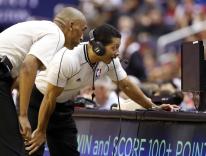
Advances in technology—including something called a Snickometer in the ball that can detect whether it has been touched—mean it’s now possible to determine in retrospect exactly what has happened on the field. In theory, these technological tools should help eliminate controversy and make things fairer. In practice, they’ve only exacerbated controversy, angered fans, and interrupted the flow of the game.
But justifications for the technology are very persuasive, and those who complain are often calling for more tech-assisted reviews, not fewer. Of course, nobody wants a bad decision made by a referee who didn’t have a good angle to affect the outcome of the game, especially when everyone watching at home has the benefit of high-definition replays. So why not do everything possible to get it right?
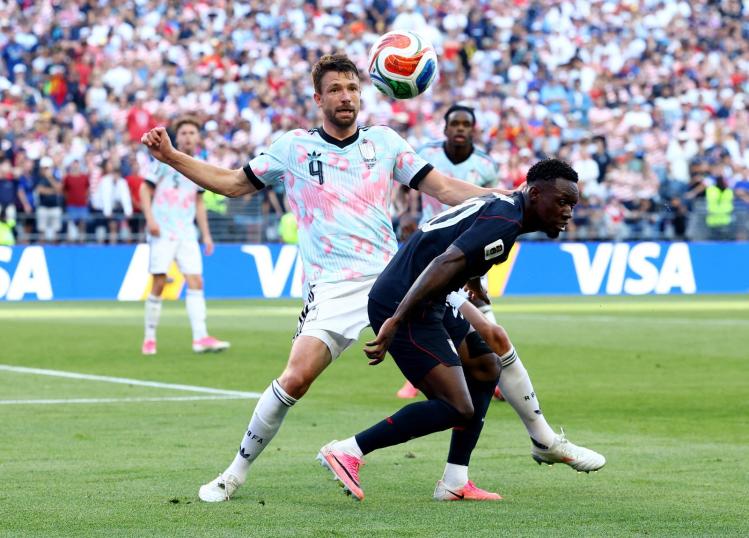
We now have glimpses of where this logic is leading: our sports are being overwhelmed by lengthy high-tech reviews whose selective and overcomplicated implementation itself becomes the subject of endless controversy. Our awe and enjoyment of athletic achievement is deflated by the kind of frustration and dread we experience when a speed-camera ticket or medical bill arrives in the mail, or when we’re trying to get through airport security. Did the American player’s step on a Bosnian player’s ankle constitute a malicious and dangerous act worthy of a red card? Did the ball brush against a Croatian player’s hair before it went through to his teammate, rendering him offside? Did a Paraguayan player deserve to be thrown out of the game because he covered his mouth during a heated discussion with the Turkish player? While the referees review the footage, the game grinds to a halt.
But those who would resist the encroachment of technology have few argumentative resources at their disposal. Against the obvious justifications for tech-enabled reviews, critics offer little more than feeble appeals to the “spirit of the game.” After his team was denied a goal that would have extended an excellent game against Portugal into extra time, the Croatian coach Zlatko Dalić groaned that the video-assisted review (VAR) system “kills the emotions, it kills everything within you, it kills what you are experiencing…and it’s not easy to deal with all of this.” A sense of embarrassment also frequently accompanies even the most tempered criticism of things like VAR. It’s usually prefaced with some kind of disclaimer: “I’m not a Luddite but…” There is an implied false dichotomy in these debates: either we return to some pre-technological idyll or we resign ourselves to tech maximalism. Either ban the tech altogether or let it in and watch as it eats the whole game.
We need a more nuanced description of what is being lost by technology’s gradual encroachment. The recently deceased Scottish philosopher Alasdair MacIntyre may be of some help here. MacIntyre famously distinguished between external and internal goods in considering “a practice”—defined as any “human activity,” such as soccer, with certain “standards of excellence” that drive us to extend our “human powers.” A practice’s external goods are those available instrumentally through success in the game—in the case of soccer: the glory of victory, gobs of money, international fame, and exponentially multiplying Instagram followers. Whereas external goods like these can be secured by other means—Killian Mbappé could have won $70 million in the lottery instead of earning it from Real Madrid—internal goods can be found only in the game itself. MacIntyre admits the “meagerness of our vocabulary” for describing such goods. They are “highly particular”—inseparable from the experience of playing soccer at a high level or watching it closely over the course of years. These are the things that make it reasonable to call soccer “the beautiful game”: its intricate passing moves, ferocious strikes, cutting through-balls, heroic saves, delicately chipped finishes, as well as the particular kinds of camaraderie and sportsmanship it fosters. Its particular excellences make a sport something like a craft.
As MacIntyre points out, these “internal goods are…the outcome of the competition to excel”—there would be no point to a swerving free kick or a perfectly timed slide tackle if they didn’t help your team win. But note that these goods are not zero-sum the way external goods are. There is not a finite amount of soccer excellence available: Lionel Messi’s brilliance on the field doesn’t rob Cristiano Ronaldo of his own opportunities to be brilliant. On the other hand, as Ronaldo seems well aware, Messi’s glory (an external good) does somewhat diminish his own. An internal good is “is a good for the whole community who participates in the practice,” MacIntyre writes. It is the existence—and indeed superiority—of this type of good that allows a tennis player to applaud an exquisitely placed drop shot that nonetheless puts him down a break point.
Along with the fact of competition itself, rules are a necessary precondition for the achievement of soccer’s internal goods. Rules and their reasonably reliable enforcement are part of the overall structure of the game and ensure that the competition is fair. When rules aren’t enforced, the competition can’t reliably incentivize the pursuit of internal goods, and the virtues of the game can be lost or degraded.
But what we’ve seen at this World Cup is that a fetish for the perfect enforcement of the rules can swamp those virtues as well. High-tech officiating hinders the achievement of soccer’s internal goods by stopping the flow of the game, arguably one of soccer’s fundamental qualities—especially in contrast to, say, American football’s stop-start rhythm. The soccer referee’s ability to “play advantage”—that is, to decide not to blow the whistle on a clear foul so as to enable the fouled team to continue their attacking move—is the rulebook’s most explicit acknowledgment of this quality.
High-tech enforcement also makes every beautiful goal or exciting move contingent upon a series of checks, to the point that it’s become hard for players or fans to know when it’s safe to celebrate a goal. And it tends to reorient the players away from the internal qualities of the game and toward the optimal enforcement of rules, turning them into aggrieved tattletales appealing to VAR when things don’t go their way. This maniacal pursuit of tech-aided perfection can be just as distorting as the elevation of external goods like profit (also on vivid display at this year’s World Cup, with its disruptive new commercial breaks).
The enforcement of the offside rule is particularly instructive. In the 1990s, the rule was eased to allow for more goals: attackers could be even with, rather than behind, the opposition defender closest to the goal. But of course, it is practically impossible for two people to be precisely even with each other. The new rule was written for human referees to enforce. It has been effectively reversed by VAR, since attackers who are, to the naked eye, “even with” their defenders are frequently technically offside by a toe or shoulder. Such over-enforcement becomes an end in itself rather than a service to the game’s greater goods; rules meant to facilitate soccer’s internal goods become barriers to them instead.
In many cases, tech-aided officiating has failed even by its own lights: it has led to unjust outcomes and ever more accusations of bias. But the MacIntyrean critique doesn’t depend on whether the new system is unfair or inaccurate. Even a system with perfect outcomes would still do damage by making the perfect enforcement of rules more important than the game itself.
This doesn’t mean soccer should try to do without technology altogether. If technology can help referees more accurately enforce the rules without disrupting the game’s flow, it is worth considering. Reversing an egregious and consequential error with a quick intervention might be merited under certain limited circumstances.
But the maximalist enforcement we’re now starting to see in World Cup matches should be rejected. Doing so will require a conservationist approach, prioritizing the sport’s internal goods over its external outcomes—including, yes, wins and losses. This is what early twentieth-century environmental conservationists did: they put nature’s intrinsic value above its instrumental value.
We are still quite far from adopting that position today, in sports and in other facets of human life. We place outcomes—whether it’s the “right call” in soccer or “efficiencies” in the economy or education—far above internal qualities of the practices we’re engaged in, whose virtues we tend to neglect because they are fuzzy, hard to measure, and open to interpretation. Our technology is fast reaching the point where, if we don’t articulate and conserve those qualities, we are fated to lose them.
We welcome your comments about this article. Please send your response to [email protected].