The Modern Art Museum of Fort Worth’s exhibition “Jenny Saville: The Anatomy of Painting,” on view through January 18, 2026, begins dramatically. As I ascended the stairs to the show, I saw two monumental heads rise on the wall ahead of me. One head tips back, the other forward. The portrait is of two young women, cheek to cheek. Their heads seem at first to share a body—but no, one rests her chin on the other’s hunched-up shoulder. The left head looks down through narrowed eyes. The right, almost cherubic, looks off to the side, eyes and mouth open. Their faces are marred with red spots; a piece of flesh beneath an eye appears missing, exposing a smattering of scarlet over crude primer. The painting, Hyphen (1999), is twelve feet by nine feet. I approached it and shuddered.
Widely celebrated for reinventing the reputedly dead genre of figurative painting, Saville portrays bodies and faces—nearly all of them women—on large canvases and without context. The scale of a work like Hyphen permits the image to dissolve and resolve multiple times at various distances. From far off, the two girls’ eyes and hairlines are strikingly realistic. Delicate bluish veins appear on a forehead.
From three feet away, the collision of whole and part overpowered me. Both heads filled my vision. But I could simultaneously see the thickly layered, abstract rhythms that comprised them. It’s not that Hyphen stopped making sense; it suddenly made too much sense, as the small and large scales competed for attention.
A step closer, and the whole vanished. Now I was mesmerized by the parts. I noticed that the red spots on the faces were not where Saville had added a layer of paint, but where she had scraped one away. I could have looked at the mouths forever. Their sensitive rendering is belied on a closer look by the chunky strokes that make them up. One lower lip looks as if Saville had sopped up pink paint with a wide brush and slapped it straight onto the canvas. The blue veins on the forehead, so conspicuous from a distance, are actually a slate gray underpainting showing through a gap between broad patches of white.
We are not used to seeing bodies and faces the way they appear in Saville’s work. As a result, it often provokes a strong reaction. A few years ago, when the Modern showed Saville’s Strategy (South Face, Front Face, North Face) (1994)—a twenty-foot-wide triptych of a woman with knobby knuckles and prodigious rolls of fat, clad only in a bra and a pair of underwear—visitors gathered before the canvas and wept. Some of the force of Saville’s work derives from her effort to upend how women have been represented in Western art. “A large female body has a power, it occupies a physical space,” she told The Guardian in 2005. “Yet there’s an anxiety about it. It has to be hidden.”
Saville defies that anxiety in Propped (1992), one of her earliest notable works. A larger-than-life nude self-portrait, the painting shows Saville sitting on a black pillar, her fingertips digging into her thighs. Every bump and hollow of her knees is exaggerated to topographical majesty. A quote from the feminist author Luce Irigaray is scratched into the paint in reverse.
Propped, which Saville completed while studying at the Glasgow School of Art, launched her career. The collector Charles Saatchi bought the picture, then financed Saville ahead of her first solo show in 1994. (Propped sold at auction in 2018 for $12.4 million, then a record for a living female artist.) Saville was soon numbered among the Young British Artists, in company with Damien Hirst, Tracey Emin, and others known for their daring vision and willingness to shock. By the turn of the century, Saville was a star.
Today, she is nothing short of a modern master. Her talents are on full display in this stunning exhibition of fifty works, from the voluminous nudes that made her name to more recent portraits that make psychedelic use of oil pastels. Virtually every piece in the show, the largest exhibition ever of Saville’s work in the United States, rewards a long look, because whatever one expects these works to be—beautiful, affirming, violent—will likely be unsettled.
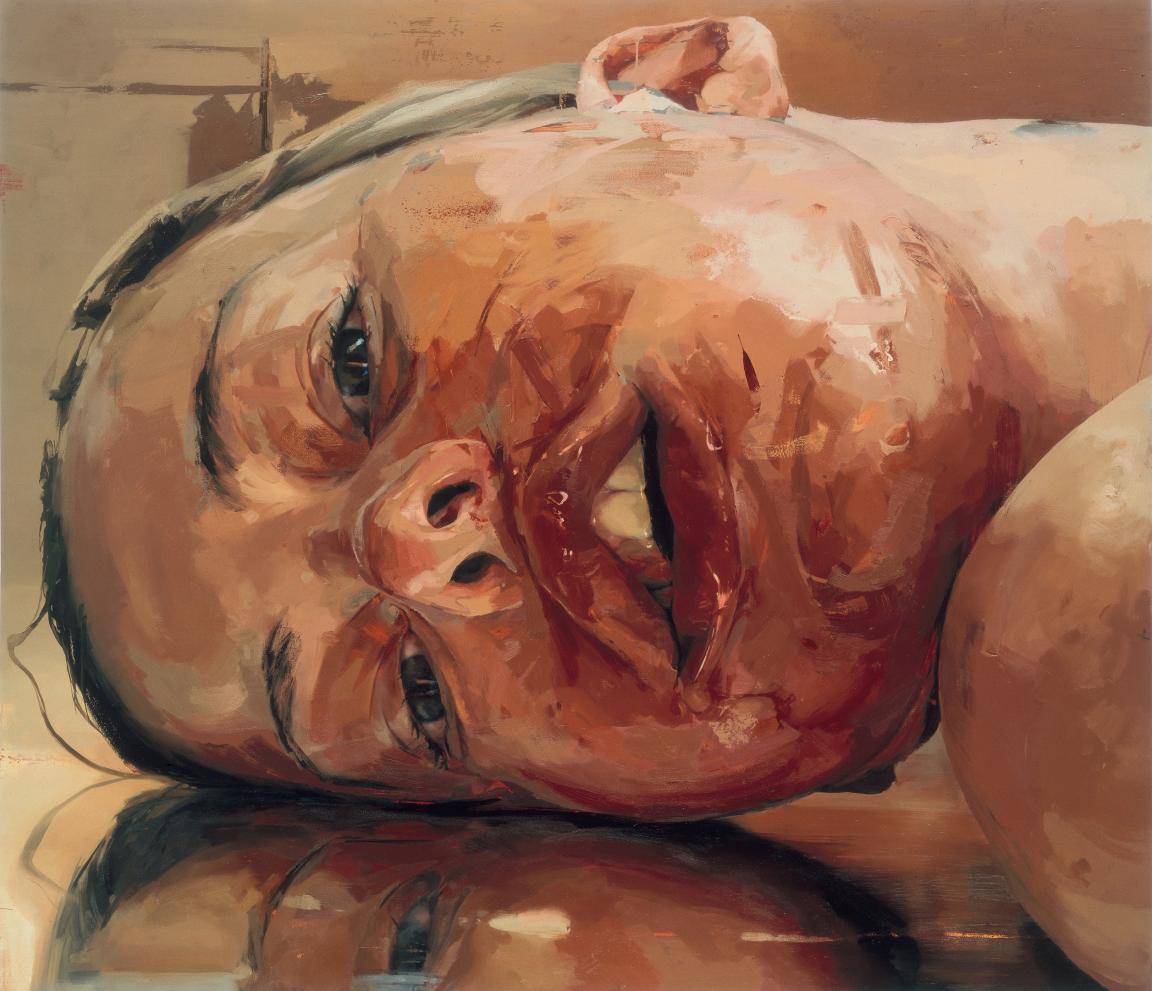
“It’s terrifying being a little girl trying to grow up. That’s what I see,” I overheard one woman say to another during the show’s opening day. They had just seen Trace (1993–4), a seven-foot-high painting of a woman’s back. Her skin still bears the marks of too-tight undergarments. A moment later, facing the horizontal portrait Reverse (2002–3), one of the women asked a man if he thought the portrait was sexy. The question was fair, if a bit forward. A woman’s face, partially reflected in the surface beneath her, fills the eight-foot-wide canvas. Her glistening, bell-shaped lips are parted, showing her upper teeth. She stares straight ahead. Who is she? Why is she lying on her side? And why is her mouth bathed in red?
“That’s not what I’m thinking,” the man replied. He compared the face to Janet Leigh’s in Psycho, pressed against the bathroom floor after her character’s murder. The women in the gallery seemed to agree, then settled on “troubled” as the most apt adjective for the figure’s character.
As I walked the exhibition, questions of character kept arising and being deferred. On the wall behind Reverse is Still (2003), another portrait of a woman on her side, this one in blue and green. Her eyes are swollen shut; there is no discernible separation between their lids. The woman’s mouth is half-open, devoid of intention. She is a cadaver. To get a different perspective, I tried to see Still as a landscape, but its face-ness kept asserting itself. As I took the picture in, a sharp gash of muddy crimson above the left eye arrested me. I couldn’t help wondering how the woman had died.
Stare (2004–5) is a portrait of a young woman with an intense gaze and a curled lip. The right side of the picture, including much of the woman’s face, is spattered with crimson paint. Blood? Is this a picture of abuse? When the band Manic Street Preachers put Stare on the cover of a 2009 album, leading British retailers refused to display it.
I found the ten-foot-high portrait as overwhelming as Hyphen but ultimately not violent. Stare is based on a photo in a medical textbook of a woman with a facial birthmark. Half her face is quite red; the other is as green as the cadaver’s in Still. The irises of her eyes, however, are delicate nebulae, executed in thin layers of blue, black, brown, tan, and plum paint. Two lights are reflected in the pupils.
Stare appears alongside a series of derivative works with the same woman’s face stenciled onto slightly smaller canvases. In the later versions, Saville favors relatively spare (for her) presentations and a limited palette of red, pink, and gray. These differences blunt the sense that Stare tells one person’s definitive story. In Red Stare Collage (2007–9), the woman no longer has thick, dark bangs; instead, her hair is rendered in large-gesture vermilion swipes and curls, her hairline a slab of pink. Gone is the hint of fury on display in Stare. The palpable tension in the woman’s brow is now a blur of abstraction. Beneath a few flicks of peach paint, though, the eyes are still sensitively done.
“I always paint eyeballs first thing in the morning,” Saville said in a 2021 interview, “because I have an incredible level of focus at that time. I’m very risk-taking in the evening, when I get more tired and I don’t care as much.” The care she takes in her morning work shows. The whites of an eye in Hyphen have wedges of tan, gray, and violet and are framed by the elegant lines of the lashes. There is a doubled eye amid the pastel scribbles of Oracle (2019–23); a cloudy, pupil-less blue eye, splashed with primer, in the magnificent Rosetta II (2005–6), the model for which was blind; in the eyes of Chasah (2020), a reflection of the photographer.
Saville’s paintings feature bodies, but that doesn’t mean they make a claim about embodiment, any more than Georgia O’Keeffe’s work says what it’s like to be an orchid or Claude Monet has a thesis about the Rouen Cathedral. Bodies and faces, rather, offer Saville both a surface and visual language within which to explore representation, abstraction, and what one can do with paint. Hands, knees, fat, ears, breasts, wrinkles: these are elements of a human body. Represented in pigmented oil on canvas, they can become elements of a disturbing, elevating, or piercing work of art. But they do not say who we are.
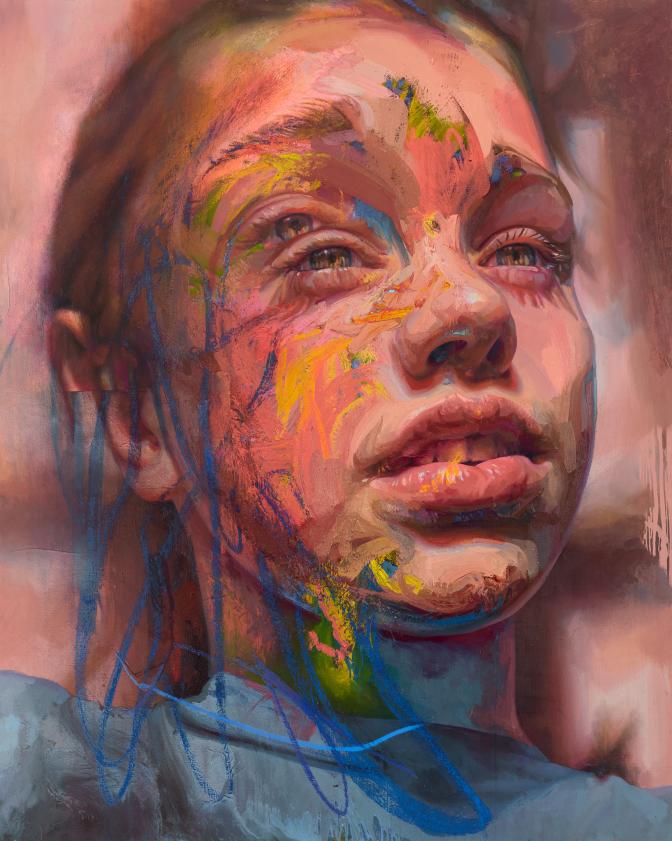
Saville seemingly cannot resist filling a blank patch of canvas. But even as she makes thighs into landscapes and cheeks into abstract expressions, she faithfully preserves the features that painters have for centuries associated with individuality. The technical precision and expressivity of her subjects’ eyes, lips, and hands invite us to reach for a person they might reveal. But the gouges and spatters and whorls lead us away. This tension is what makes her work so captivating. Confronted with Saville’s subjects, we are primed to make judgments about character, but we can’t. The paint resists our attempts.
There is none of this tension in figurative work by, for example, Willem de Kooning, whose remark that “flesh was the reason why oil painting was invented” is often cited in articles on Saville. De Kooning invites no claims about the character of the figures in his Two Women (1954–5), which hangs in an adjacent gallery alongside other modern influences on Saville, including Francis Bacon, Jackson Pollock, and Pablo Picasso. The slashing, bristly strokes of Two Women—not just pink but deep blue, orange, green, yellow, and gray—suggest muscle fibers, as if skin had been peeled back. But the face of one woman is a toothy trapezoid. The face of the other is indiscernible. This painting has surely moved few to tears.
Saville does not always manage the tension effectively. A few pieces in the exhibition draw from Christian iconography, including Blue Pieta (2018), which depicts a man in a sweatshirt and knitted cap carrying a lightly clad adolescent away from a destroyed city block. The child has two heads and four arms, Saville’s technique for suggesting movement. But the man’s body and face are played straight, lending the scene an air of disaster-hero kitsch. The painting would not be out of place in a senator’s office.
At her best, Saville bumps against but ultimately frustrates moralizing cultural scripts about bodies: that they should be celebrated, pitied, or rescued. Saville brilliantly teases the illusion of psychological depth. But she also reminds us that in painting, we only ever see the surface. Beneath this skin is nothing but canvas.