Among the American colonists, it was common knowledge that Germans tended to be rowdy and boozy at Christmas. George Washington counted on this in December 1776 as he and his generals planned to capture Trenton, a once prosperous but by then nearly deserted town at a key point of the Delaware River. It was held by some 1,500 German mercenaries, mostly from the area of Hesse-Kassel, who were in the pay of the British. On Christmas night, Johann Rall, the leader of the Hessian garrison, felt comfortable indulging in some celebration—playing cards and drinking. He had heard from a possible spy from Washington that the upstart Americans were too bedraggled and downtrodden to attack. But he was wrong. Rall was not fully awake at 8 a.m. on December 26 when Washington attacked Trenton, capturing it after a battle that lasted less than sixty minutes. The Americans killed twenty-two Hessians, including Rall, and lost two of their own in combat, plus four or five others from exposure to the cold.
It might be hard for us to imagine, but Christmas was not much celebrated in the thirteen colonies at the time of the Declaration of Independence. Washington couldn’t have known that, about fifty years later, new waves of immigrants from the various German states would bring their own Christmas traditions that would capture the American imagination. Their festivities were brought indoors and domesticated rather than celebrated rowdily in public as they were in Germany. But the Germans would set the hallmarks for Christmas in the United States forever after with their decorated indoor trees and Kris Kringle, the figure that Americans would come to know as Santa Claus. One Protestant German-speaking group brought with them the custom of carved miniature Nativity scenes that included tiny statues of the Virgin Mary and St. Joseph, something other Protestant sects would have found anathema.
But those German touches did not appear in North America until about two centuries after the arrival of the Puritans. That disciplined group of English reformers settled in Massachusetts in 1620 and set up a theocratic government that sought to purify religion of the remnants of Roman Catholicism and eliminate suspicious practices that did not have a basis in the Bible. They insisted that the Sabbath was the only day that Christians were commanded to keep holy and that observances on December 25, which was part of the Catholic calendar, had no Biblical grounding. This is true. Early Christians set the date in the fourth century to distract from the Roman festival of Saturnalia, which often involved unruliness and licentiousness. During the Middle Ages, Christmas became a highlight of the Church year and gathered to itself a collection of songs, plays, legends, and churchly observances. Touches of Saturnalia, particularly the drunken revels, remained.
It was that heritage that the Puritans wanted to shed. Massachusetts governor William Bradford declared from the outset that the settlers had a village to build and that December 25 was a workday like any other. But soon Anglicans, who had not rejected all vestiges of Catholicism, arrived in the colonies, and the two groups clashed over what Christmas would look like in the land that would become the United States of America. Anglicans refused to work and insisted that they would observe Christmas. Bradford allowed time off but forbade all revelry. These conflicts presaged many of the debates in the battle over Christmas: religious solemnity versus good fellowship; private celebration versus public hullabaloo; and the plain meaning of the Bible versus interpretations by the Fathers of the Catholic Church.
The Puritans had something of a point. Given that elements of the Christmas story are so fixed in our hymns, culture, and art, it can come as a surprise that the gospels recorded so little about the actual accepted facts of Jesus’ coming into the world. The New Testament is brief on the subject: of the four Evangelists, only Matthew and Luke mention the Nativity at all. They agree that Jesus was born in Bethlehem, that Herod the Great was the Jewish king, that Caesar Augustus was the Roman emperor, and that a sign appeared in the heavens.
Matthew alone introduces the mysterious Magi, astrologers who were led to Judea as they followed the path marked by a heavenly star. When they arrive at the palace of cruel and crafty Herod, who had been installed by Rome, they tell him that they have come to worship a new king of the Jews. Alarmed, he secretly plots to kill the infant. Meanwhile, the Magi find the house (not a manger, as in Luke’s telling) where the divine baby lies. They worship him and present him with gold, frankincense, and myrrh.
Luke’s version is found in his second chapter and contains some differences from Matthew’s account. He writes that Mary and Joseph were from Nazareth and in Bethlehem because of Caesar Augustus’s census decree, while Matthew says that they settled there only after returning from Egypt. Luke says that the couple could not find room at the inn there, but he does not mention the rude innkeeper in Matthew’s Gospel. He writes that Mary swaddles her son but has no place to lay him down other than a manger, an open box where animals feed. Meanwhile, out in the fields, a shining angel announces to frightened shepherds the birth of the savior. Luke, a champion of society’s outcasts, writes that humble shepherds are the first to receive news of this world-changing event. With that, a heavenly host of angels (not a star) lights up the sky, singing, “Glory to God in the highest, and on Earth, peace to men of good will.”
In other words, these gospels, written eighty years after the Nativity, contain significant factual contradictions. Despite the discrepancies, both Catholics and Protestants embraced the stories. For Protestant reformers in the seventeenth century, though, the Nativity was not particularly important to their worship or theology.
And so, disagreement over whether to commemorate the Nativity in Massachusetts continued, influenced by different priorities and worship styles. In 1659, authorities outlawed celebrations and required participation at work. This changed with the restoration of the monarchy a year later: fearing that the new king would revoke their right to rule the colony, the Massachusetts General Court repealed several laws that particularly offended the English, including the ban of Christmas celebrations, in 1661. But religious objections remained. In 1687, the Boston Congregational minister Increase Mather said Christmas celebrations were an example of declining moral standards. In 1712, his son Cotton Mather inquired, “Can you in your conscience think, that our Holy Saviour is honoured, by mad mirth, by long eating, by hard drinking, by lewd gaming, by rude revelling; by a Mass fit for none but a Saturn, or a Bacchus, of the night of a Mahometan Ramadan?”
The anti-Christmas movement remained strong in the colonial era. Baptists, Presbyterians, Quakers, and Congregationalists were firmly against it, and Methodists who arrived in 1765 celebrated quietly and only in church. But other American colonies were more tolerant of Christmas celebrations. Virginia, Maryland, and the Carolinas, which were not Puritan, celebrated modestly, constrained in part by the meager conditions of settler life. New Amsterdam, the future New York City, saw Christmas celebrations in the traditions of the many foreigners who came there to trade. Florida, under Spanish Catholic rule, celebrated midnight Mass, as did New Orleans, Maine, and Texas, which were settled by French Catholics.
Where there were Dutch, French Huguenots, and Germans, notably in New York, South Carolina, and Pennsylvania, the light of Christmas slowly crept in, as if under a locked door. German-speaking Moravians settled Bethlehem, Pennsylvania, in 1740. They celebrated Christmas more than any other Protestant denomination, and they did so in a way that eventually became familiar in America. They brought with them the custom of the decorated tree, complete with a little yard, or putz, in which they placed tiny carved figures of the Christ child, Mary, and Joseph. To this they added a winding road populated by up to three hundred wooden animals marching two by two, as if journeying from Noah’s ark to be present at the birth of Jesus. The charm of the figures of the Holy Family apparently obscured the fact that they were tiny statues being used in religious observance, which their fellow Protestants were strictly against.
Over time, the celebration of Christmas was introduced into Sunday-school curriculums, first in 1854 as “The Christmas Gift,” a story in The Well-Spring, a Congregationalist weekly for Sabbath schools. Secular magazines also began including stories about Christmas, such as the 1823 poem “A Visit from St. Nicholas,” attributed to the New York scholar Clement Clarke Moore. It features St. Nicholas of Myra, patron of children and merchants, whose December 6 feast day in Europe was marked by giving children presents and retelling folk tales about him. Multiple countries had given him different names: Germans came to call him Kris Kringle, and in America—it is unclear just how—he became known as Santa Claus.
In the first half of the nineteenth century, political and economic troubles in the German states inspired a wave of emigration to the United States that first peaked in the 1850s. Arriving in ever larger numbers after the Civil War, they formed communities where they spoke their own dialects and held on to their traditions, like decorated indoor trees and gift-giving at Christmas. Both Catholic and Protestant Germans celebrated, and even German-Jewish immigrants enjoyed Christmas for its reminder of home.
Germans had a lively, public, nondenominational way of celebrating Christmas that included drinking, dancing, communal gift-giving, and lotteries. It was for them a time to think about neighbors and support others. Unlike most other immigrant groups, they also had an open, festive drinking culture that smiled on a certain amount of excess. This trace of the Saturnalia of the Middle Ages conflicted with the nascent temperance movement in the United States.
Even though most Anglo-Americans still thought the Germans were unruly in their celebrations, some began to see the positive side of German festivities. Charles Loring Brace, who would later help found New York’s Children’s Aid Society, visited various German regions in 1853 and published his findings about German culture. Brace reported that Germans were less self-reliant and individualistic than Americans and valued their home life more:
As I recall our hollow home-life in many parts of America—the selfishness and coldness in families—the little hold HOME has on any one, and the tendency of children to get rid of it as early as possible, I am conscious of how much after all we have to learn from these easy Germans.
Their perceived intemperance was also offset by the fact that German immigrants had done more than their share to preserve the Union during the Civil War. Based on available figures that are probably an undercount, German Americans comprised nine percent of the total U.S. fighting force and half of the 366,546 immigrants wearing Union blue. The mostly positive image of German immigrants among the native-born population was reflected in the literature of the time: in Louisa May Alcott’s popular 1868 book, Little Women, heroine Jo March marries a German professor.
Still, religious elders in Protestant New England had set the bar for the mores, morals, and culture of the native-born population. Boston was the nation’s intellectual capital, and its Puritan-tinged influence on American culture was such that some felt that, while Christmas could be celebrated, it should be done only behind closed doors and out of public view.
Harriet Beecher Stowe, author of Uncle Tom’s Cabin and herself a New Englander, depicted the eventual Protestant conversion to Christmas celebrations in her 1878 novel Poganuc People: Their Loves and Lives, which seems to have drawn on her Connecticut childhood in the 1820s. In the story, little Dolly, drawn by the beautiful lights in the windows of the Episcopal church on Christmas Eve, is enchanted by the music she hears and falls asleep under a spruce tree. Dolly’s father, a Congregational-Presbyterian minister like Stowe’s own, is understanding and buys her a treat that he gives her on December 25. He tells her that he is doing this not because it is Christmas—no one knows the date that Jesus was born, and he still believes that the Episcopalians are “putting one paw on the Scarlet Beast of Rome”—but because he loves his daughter. A few years later, the teenage Dolly visits her aunt in Boston and attends an Episcopal service that makes her feel “part of a great host.” By the end of the book, she is married to an Episcopal minister and celebrating Christmas in as fine a style as she wishes.
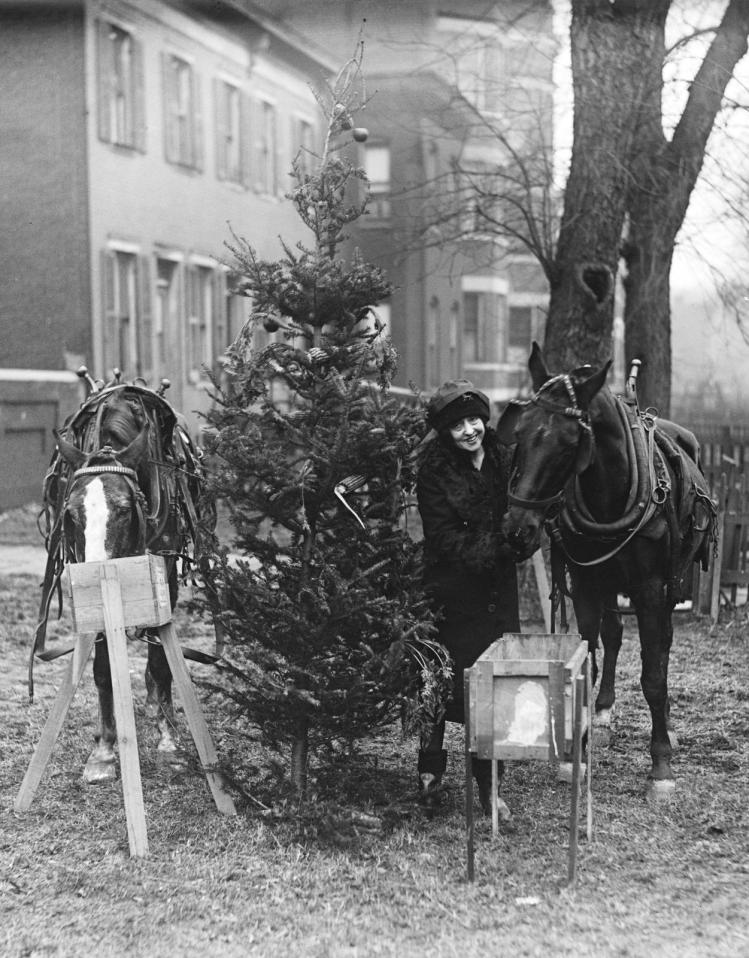
The change Stowe experienced was mirrored in the rest of the nation, as several factors worked to clear away scruples over Christmas. One was the rise of popular national publications, which presented the joy of holiday celebrations to those who had been denied them. A German immigrant named Thomas Nast did a great deal to make the case for celebrating Christmas. He emigrated to New York with his mother and sister in 1846 when he was six years old. At nineteen, he went to work as an illustrator for Harper’s Weekly, one of the most popular periodicals of the day. Nast was a critic of Irish immigrants and the growing power of the Catholic Church, but he remembered with appreciation the Christmas celebrations and indoor trees of his Bavarian childhood. His drawings for Harper’s established the image of Santa Claus as a jolly, rotund old man.
Historian Stephen Nissenbaum argues in his classic book The Battle for Christmas that it was Santa Claus, the delight of children and the creation of the Germans, who ultimately eclipsed the power of the Protestant elders to fight against Christmas celebrations. He writes:
In New England, as elsewhere, religion failed to transform Christmas from a season of misrule into an occasion of quieter pleasure. That transformation would…take place—but not at the hands of Christianity. The “house of ale” would not be vanquished by the house of God, but by a new faith that was just beginning to sweep over American society. It was the religion of domesticity, which would be represented at Christmas-time not by Jesus of Nazareth but by a newer and more worldly deity—Santa Claus.
As celebrations got more popular and children grew more excited about Christmas each year, Protestant denominations felt obliged to bring out the religious aspects of December 25. Christmas worship services were already popular with Catholics, Episcopalians, and Lutherans, and those of other faiths began to take part in the sacred pageantry. Even when it fell on a weekday, Christmas Day was often a church’s largest, or one of its largest, congregations of the entire year.
But the essential trimmings, the accoutrements of Christmas, consisted of what the Germans had brought to America—the decorated Christmas tree and other indoor greenery, the fellowship, and the tiny nativity scenes that even crept into Protestant churches. It was all too much fun, and too popular, to be ignored. Finally in 1870, when the United States was stitching itself back together after the Civil War, President Ulysses S. Grant declared Christmas a federal holiday, along with Thanksgiving, New Year’s, and the Fourth of July. And given the amount of things to buy to celebrate—trees, ornaments, wreaths, and an assortment of gifts—retailers loved Christmas for boosting business. The United States has German immigrants to thank for all this festivity and joyful tradition.
Still, one wonders if the Puritans had a point. Since the Germans introduced their traditions to the United States, we’ve tended to get caught up in the holiday’s celebratory and commercial aspects, which have drastically increased since the arrival of German immigrants a century and a half ago. In the hectic weeks leading up to Christmas, how much do we hear about Mary, Joseph, the Magi, and the sacred baby rather than, as Nissenbaum puts it, that “newer and more worldly deity,” Santa Claus? The Nativity story tells of the joy and glory of Jesus Christ, but so easily gets lost amid the hubbub of parties, preparations, and shopping. As grateful as we can be for the beautiful traditions we’ve inherited, maybe we could all use a touch of Puritanism this year—even if that’s just a moment of quiet to attend to Matthew’s and Luke’s stories of a child given in love to all the world.