The culture scene of the 1980s passed me by. Between raising young children and working all hours to cover breaking news in New York City, there wasn’t time for more than watching Dallas on Friday nights. It was always my feeling that I didn’t miss much. I don’t even remember who shot J. R.
Paul Elie, on the other hand, dived into New York’s downtown arts scene as a student of literature and theology and as an up-and-coming writer in those same years. He saw two great passions—the arts and the Catholic faith—collide in the AIDS pandemic as the virus scythed through the city’s arts community. “If I look closely, I can locate myself in the moment: riding the D train with The Village Voice and Pascal’s Pensées in a black messenger bag…going to Mass at Corpus Christi Church near Columbia University…brooding in the medieval rooms of the Metropolitan Museum—a Catholic dangling man, caught in the disjunct between belief as it was taught and written about and belief as it was enacted in the city,” he writes.
Elie’s new book, The Last Supper, brings to life the story of artists and entertainers whose struggles with their own religious beliefs during that emotional time took form in often-controversial works of art. The photographer Andres Serrano’s Piss Christ, depicting a crucifix soaking in urine, is one example. The backlash could be ferocious against artists like Sinéad O’Connor, who famously tore up a photo of Pope John Paul II on Saturday Night Live in 1992, declaring, “Fight the real enemy.”
The focus of Elie’s book is what he calls the “crypto-religious” in pop music, visual arts, and literature. He defines this as “work that incorporates religious words and images and motifs but expresses something other than conventional belief.” Back in the eighties, I was inclined to see some of the work Elie examines as attention-getting gimmickry; Madonna, for example, seemed all about being in the spotlight. But Elie sees her song “Papa Don’t Preach” as a rebuke to male clerics who were telling people how to live their sex lives. The AIDS crisis had in effect turned the “Material Girl” into a culture warrior, he writes.
Elie aims to tell the artists’ side of the story. “The press coverage of the culture wars at the time typically foregrounded the evangelists and politicians rather than the artists,” he writes in the prologue. “Not so in the telling of this story. Here the artists are the protagonists.”
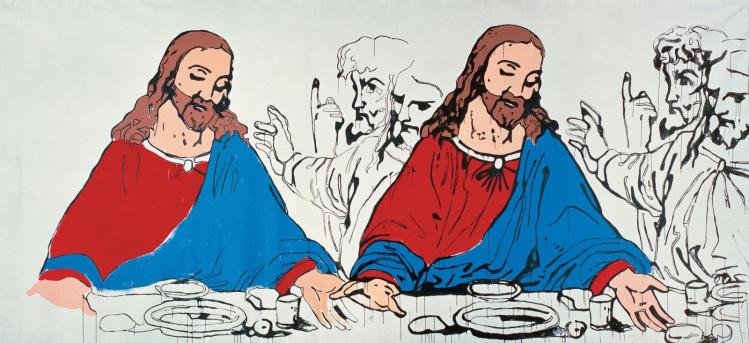
This introduces us to a large and, in this telling, wonderful cast of characters. The creators include Andy Warhol, with his work based on Leonardo Da Vinci’s Last Supper; Bob Dylan, with the Christian bent of his 1979 album Slow Train Coming (“Gotta Serve Somebody”); Patti Smith “addressing the spirit world” in her music; Robert Mapplethorpe stamped by the strict “outer-borough Catholicism” from his youth in Queens; Bruce Springsteen imbued with “down-the-shore Catholicism”; Martin Scorsese and the shellacking he got from the “offended brethren” who claimed that his deeply religious film The Last Temptation of Christ was anti-Christian.
There are deft portraits of many other artists, always with an emphasis on how their complicated religious beliefs entwined with their work: Bono and U2; Leonard Cohen; Tom Waits; The Smiths; Keith Haring; Aaron Neville; Seamus Heaney; Czesław Miłosz; Salman Rushdie. I did a bit of reporting at the New York State Capitol in Albany in the eighties, but had no idea that William Kennedy and Toni Morrison shared a small office in the English Department at the local university, each penning a Pulitzer Prize–winning novel inflected with their Catholic faith.
Many of the artists Elie explores are shaped by a Catholic upbringing. He sees them as descendants of James Joyce, who breaks with Catholicism but “cleaves to Catholic ideas.” The novel Ulysses is infused “with the Catholic sacramental practice of consecrating ordinary things for sacred purposes,” Elie writes.
Joyce’s interest in the life of the body—the “scenes of ordinary desire”—comes through, yes, in Molly Bloom’s sensuality in Ulysses. “In this, too, Joyce is an exemplar,” Elie writes. “In the crypto-religious work of the next generations sex would be the site for the convergence of religion and the ordinary.”
In 1980s New York, this convergence took on a special meaning. A mysterious disease contracted through bodily fluids seemed to flank artists on all sides. As cherished friends withered and died, the survivors explored these mysteries of body and blood in their art.
For Warhol, whose former lover Jon Gould died of AIDS in 1986 at the age of thirty-three, the crisis inspired “a religious intensity” as he completed his masterwork The Last Supper (Be a Somebody with a Body). Warhol’s devout Catholicism was little known to the public during his lifetime; when he died in 1987, it was mostly unmentioned in newspaper obituaries. It took a while for art critics to catch up to the significance of religion in his work.
With his expertise on Catholicism, Elie brings an added dimension to what’s already been published on this. By instituting the Eucharist at the Last Supper, Jesus “makes the human body central to the religion that will be taken to the ends of the earth in his name,” Elie writes. Warhol grasped this as affirmation:
He stressed the connection between the human body and the body of Christ. As he did so, he pointed his work toward a church apprehensive about homosexuality. He brought Leonardo’s most famous work into the postsecular age, recharging its significance in terms of Christianity’s dealings with the body. And he marked out the arts as the realm where the controversies of religion and the body can be dealt with frankly and figuratively, artists going where religious leaders are loath to go.
As Elie portrays it, the celebrated trendsetter “saw art, religion, sex and controversy converging; with the Last Supper series, he announced, in his way, that a crypto-religious moment was at hand.”
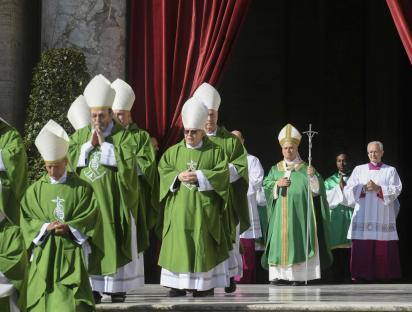
In New York, that “moment” clashed with the “Catholic moment” that Rev. Richard John Neuhaus declared in an influential 1987 book urging the Catholic Church in the United States to speak up in the public square in favor of a religiously informed culture. Neuhaus, a Lutheran who became a Catholic priest in the Archdiocese of New York, was close to Cardinal John J. O’Connor. And the crypto-religion coming from that other sort of Catholic moment in the downtown arts scene was not what they had in mind. O’Connor opposed a gay-rights ordinance, to the point that he told the New York Post he’d rather shut orphanages than hire a single gay person to work in one. He opposed the distribution of condoms, which were necessary to prevent the spread of AIDS. And he was very outspoken in the public square, with tabloid-ready comments for reporters after he celebrated Mass on Sunday, a slow news day.
That made for a mighty clash. I may have a soft spot in my heart for O’Connor after covering him on the religion beat in the early 1990s. There was plenty I didn’t like as a Catholic; I’m recalling my reaction to a homily in which he remarked, basically, that he was surprised so many people came to Communion, because the use of birth control put so many Catholics in a state of mortal sin. But he was complex, and the more I saw, the more difficult it was to categorize him.
As I read The Last Supper, I thought back to a three-hour Good Friday meditation O’Connor preached in 1991. In my brief report on it in New York Newsday, I touched on one of his familiar themes: that Catholics will be maligned in the media for trying to uphold traditional teachings—Pontius Pilate’s great sin was compromise, “the sin of wanting to be popular,” I’d quoted him as saying. O’Connor also spoke of the importance of compassion for people with AIDS, saying, “This cross will lead them to their resurrection.”
What I didn’t include is the part I actually remember: “The body of Christ has AIDS,” he said simply, letting the thought linger. Imagining the headlines that might come from that—“Jesus Had AIDS, O’C Says”—I left it out, rather than try to explain Catholic teaching on the Mystical Body of Christ in a three-hundred-word story. But in retrospect, I think he had experienced some of the same realities that artists like Warhol were trying to express, perhaps because he, too, had been touched by the suffering of AIDS patients he visited in Catholic hospitals.
I don’t take Elie’s book as a political analysis, since, as he writes, it focuses on one side of the story (although it does well in showing the battle lines forming for today’s culture war). The book’s strength is the insightful analysis of the work that these 1980s artists produced, filling in the religious influence that is so often left out in reportage on the arts and pop culture. I hope it turns out to be groundbreaking: Elie’s astute and imaginative examination of the intersection between religion, art, and a politicized culture is badly needed, both historically and today.
You can read an excerpt of Paul Elie’s The Last Supper in the May 2025 issue of Commonweal.
The Last Supper
Art, Faith, Sex, and Controversy in the 1980s
Paul Elie
Farrar, Straus and Giroux
$33 | 496 pp.
Listen to a conversation with Paul Elie on the book on The Commonweal Podcast: