In the past few years, I’ve rediscovered the Christianity of my roots in the Armenian Apostolic Church and its rich liturgical tradition. I was inspired to reconsider the Church of my birthright after learning that one of the major characteristics of the Eastern Church, of which the Armenian Church is a part, is its embrace of mystery, transcendence, and theosis. Before my return to Christianity, I had been immersed in the spiritual traditions of East Asia and India, attracted to their emphasis on experience over belief. But when I discovered Christian mysticism through modern contemplative teachers, I was struck by its similarities to the traditions I already knew. As I studied the history of mysticism, I realized there was a wealth of insight waiting to reveal itself in a Church that was so familiar to me but that I had yet to truly encounter.
Although the Armenian Church was woven into my childhood as a center of both faith and community, I had experienced its rituals without much awareness, as is often the case for children. Recently, in the light of my newfound awareness, I delved into the history and theology of the Armenian Church and the distinctive elements of its Divine Liturgy, seeking to understand its deeper meanings and significance. And, of course, I began visiting my local Armenian Apostolic Church. It wasn’t long before a quiet certainty settled over me: this is where I belong.
One of the things I discovered is the richness of the Armenian Church calendar, on which the liturgy is based. The calendar offers a sacred orientation to time that feels both ancient and deeply personal. Now, I find myself wanting to integrate its rhythm into my daily life—not just as a cultural inheritance, but as a spiritual practice that grounds me in the eternal.
The Church has provided this grounding for Armenians throughout history. It has played a crucial role in sustaining Armenian traditions during periods of foreign rule, genocide, and forced displacement (Azerbaijan’s seizure of Artsakh in 2023 is the most recent). The Church’s calendar, infused with uniquely Armenian commemorations—such as the Feast of St. Gregory the Illuminator, Vardanants Day, and the remembrance of the genocide—roots theology in the nation’s lived experience, making the Church both a reflection of divine eternity and steward of the nation’s collective memory. Embodied in the rituals and calendar of the Church, this liturgical time fosters a continuity that transcends individual participation, linking Armenians to centuries of tradition and embedding values of endurance and stability in Armenian communities around the world. These characteristics foster belonging across generations and throughout the diaspora.
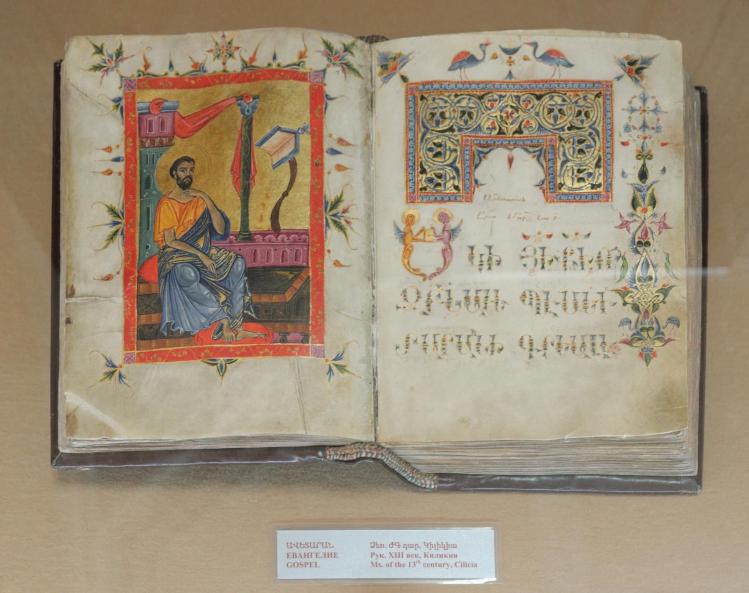
In considering the sacred nature of Armenian liturgical time, I have been drawn to illuminated liturgical manuscripts, which for centuries have preserved the cycles of feasts, fasts, and prayers. They translate the abstract concept of divine time into a tangible, organized sequence of practices. Their contents—chants, prayers, readings, and rubrics—have carried the Church steadily from one era to the next and ensured its centrality to Armenian culture, even in the face of social and political crises that threatened its survival. These liturgical books have preserved not only religious practices, but also Armenian language and art. The handmade medieval volumes of the Lectionary (Jashots Kirk), Liturgical Directory (Donatsuyts), and Liturgical Calendar (Oratsuyts) are especially noteworthy for their exquisite beauty.
Illuminated manuscripts, with their artistry and spiritual depth, are cultural treasures. Many of these priceless works are housed in the Matenadaran, officially named the Mesrop Mashtots Institute of Ancient Manuscripts—a research institute in Yerevan that holds the world’s largest collection of Armenian manuscripts. It is a treasure house of history and faith. I’ve spent many hours in the Matenadaran’s galleries, where illuminated liturgical manuscripts glow under soft lights, their intricate patterns, rich colors, and gold leaf recording centuries of lasting devotion.
The beauty of Armenian letter forms, at times interwoven with floral and geometric motifs, connects the written word to both divine inspiration and artistic craftsmanship. The reader commonly encounters fantastical creatures, brightly colored and unusual birds, and architectural structures in the abundant variety of religious books used for both communal and individual worship. One can find many richly illustrated Bibles as well. Each handmade detail speaks of a life steeped in liturgical time. For over a thousand years, the illuminated manuscript, particularly the illustrated Gospel Book, was the foremost expression of Armenian culture. These stunning objects often featured enameled, gilt-silver repoussé covers decorated with jewels. Gospel books have become a major source of knowledge about Armenian art, religion, language, and history.
Despite centuries of upheaval, war, and displacement, these books are testaments to an unbroken spiritual and cultural tradition. I marvel at how they have endured—carried in exile, hidden in churches, sometimes recovered in the diaspora. Their handmade nature resists the instantaneity of today’s digital culture, inviting a different kind of attention. Now, when I gaze at these medieval and premodern books in reproduction, I recognize the same cycles of feasts and prayers that structure worship in my local Armenian church today. With each encounter, I’m brought back to the material dimension that helps ground my Christian identity.