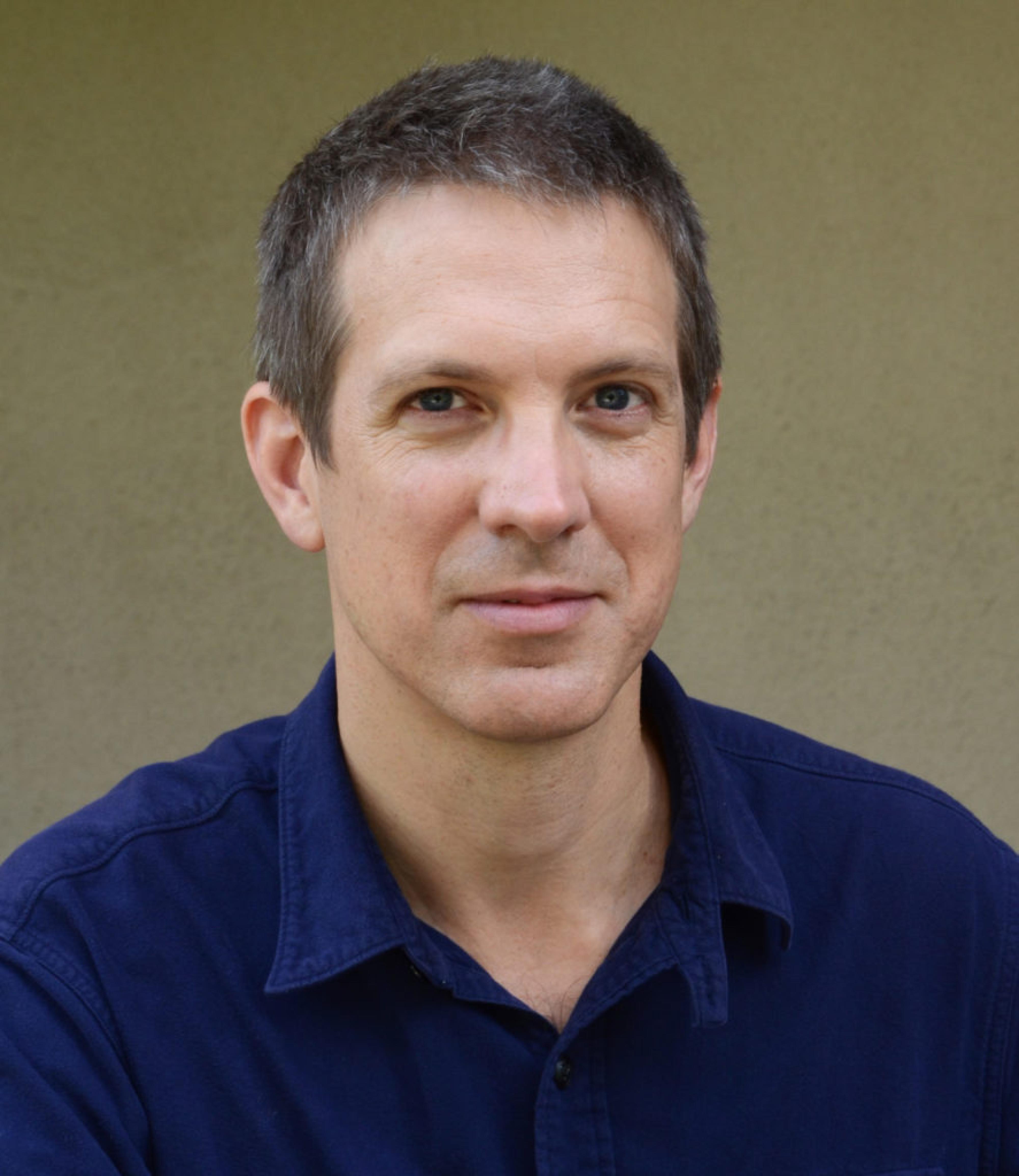
For the past quarter-century, Jonathan Meiburg has been pushing at the edges of American indie rock. With his bands Shearwater and Loma, he has written songs about forever wars, global extinction events, and the atomic legacies of the American century with a musical style mixing post-punk fuzz and symphonic grandeur. As an ornithologist and nature writer, he has traveled to all seven continents, and in 2021 he published A Most Remarkable Creature, a globe-trotting study of the strange and intelligent birds known as caracaras and the many people who have obsessed over them.
As both musician and writer, Meiburg has a uniquely expansive sense of his own work. With 2008’s Rook, he composed a suite of thunderous, heartbreaking songs that addressed both the sorrow and rage of living through a time of climate change and ecological derangement. For Shearwater’s latest album, The New World, he recorded for more than four years at studios in Texas, Brooklyn, and Berlin, and drew on contributions from artists as diverse as veteran studio woodwind player Doug Wieselman, outsider pop legend Laurie Anderson, and the percussive Malian trio Ngoni ba. The results are lush, fluid, and wonderfully rhythmic, drawing in sounds never before recorded by any of Meiburg’s many groups: soaring saxophone solos, jazzy ethiopique grooves, Anderson’s haunting spoken-word coda on closing track “You and Your Dog.”
Meiburg spoke with me from a hotel in Oslo, where he was attending SCAR Open Science Conference and doing research for an upcoming book on “the once and future life of Antarctica.” Among other things, he is learning about a geologic link between Antarctica and West Texas and a geyser of blood-red hypersaline water which may contain the last surviving remnant of a forty-million-year-old preglacial ecosystem. “It’s fun to go spelunking,” he told me. “To get in over your head.”
This interview has been edited for concision and clarity.
Robert Rubsam: There are so many new collaborators on your latest album, The New World. Has your songwriting process changed to accommodate them?
Jonathan Meiburg: Probably so. I feel like almost every big creative project, whatever the medium, goes through phases of woolgathering where you’re just looking for whatever interests you. And you start refining and then you refine the refinements and gradually the thing comes into focus. I love that feeling of discovery, it’s really precious. The way to preserve it, I’ve found, is to work very intensively for short periods of time. Say you really, really work on the thing for ten days, then you go away for a month or two and you don’t listen to anything, then when you come back to it certain virtues and flaws are suddenly very apparent. It lets you make bigger decisions with less fretting about them or obsessing over the sound of the hi-hat in that one song. It’s very easy to get very tweaky when you’re in the middle.
RR: How do you know when you’ve got something, or when it’s going to be something?
JM: When it just keeps coming back to you, and it holds your interest. There’s something about it that moves you. The ultimate question even after we’ve worked on a song forever is, does this make me feel anything? And the most durable songs are the ones that seem to mean the most. That was part of why I didn’t want to let go of the music for “You and Your Dog.” I always felt right from the top of that track that there was something about it that pulled me right in, and it still does that now. The thing that’s nice about digital recording is, if you want, you can basically make a demo of a recording and build on top of the demo and just keep on going until the demo is mostly gone and you’ve built this other structure on top of it. It allows you to preserve what you loved about the original.
RR: Do you go into a record with a sense of what you’d like it to be?
JM: No. That emerges. It really does seem to come from within itself, which I know can’t possibly be true, but that’s what the experience is like. After a while, we were working on and off for about four years, and we had this big pile of songs. Fairly late in the process, we separated them into two different piles—these ones stick together, these other ones also seem to stick together. And I thought we would finish the pile that seemed the most complete.
RR: You’ve traveled. Have those experiences influenced you artistically?
JM: I’ve been really lucky in what I’ve been able to do in life, the places I’ve been able to go, the different ways of living that I’ve been able to see or be part of. In both writing and music, I have a desire to know where we really are, what the world we live in really is. It’s not what the internet tells us it is, but it’s hard to remember that. I like to go places and have experiences that remind me of that. In some ways, the experience of wonder is just a glimpse of the depths of your own ignorance. Music is really good at expressing things where words fail. Songs are a funny form of music: they’re more like lichens, where a lichen is an alliance between a fungi and an algae that thrives in ways that they can’t apart. Music and words are like that. Often with songs, the words don’t hold up as prose on their own, and the music itself might not mean the same thing without the words.
RR: Your lyrics have become more fragmented or abstracted over time. Why take that approach?
JM: I’m more interested in exploring an emotional state than I am trying to give you a narrative. I’d like you to supply some of the narrative. My favorite records are ones where there’s room for you, you’re not just being yelled at by someone. Although it can be wonderful to be in the presence of a talented storyteller in a linear sense, that’s not the kind of writer I am. I like for a song to be a collaboration not just between the words and the music but between the performers and the listener.
RR: I interviewed you back in 2016, just after Donald Trump was first elected, and we talked about the relationship between politics and art. How do you think about that question today? How does the art you make respond or relate to the state of the world around you?
JM: The song “Daydream Unbeliever” is as close to a manifesto as I’ve ever written. I think our job now, at a time when we’re being asked to believe or forced to declare our allegiance to various fantasies, the most powerful thing you can do is maintain the freedom of your own mind. Remember that the truth of the world is not that human beings are the most important thing that there ever was, or that violence and courage are the same thing. You can run around in the woods freaking out, but, in the end, you’re just running around freaking out. You can acknowledge the chaos that we’re living through but not become an embodiment of it yourself, or you can try. You want to occupy a place on a continuum between ignorance and despair. It’s important to try to remain present and to look at where and who you really are in relation to other people and other living things.
RR: Speaking of other beings: I really enjoyed A Most Remarkable Creature. It was full of a kind of imaginative wonder, it makes the reader encounter those particular birds and what they are capable of.
JM: One of my favorite characters in that book was Bernabé Cobo, the Jesuit priest in South America who was writing a history of the Incas but got really preoccupied with the distribution of different species of animals and how it didn’t square with his theology. He was running up against the limits of the world he was allowed to inhabit, and we’re surely no different. There are things we’re just as wrong about, we just don’t know what they are yet.
RR: That’s often what I want out of a work of art, that running up against my sense of what can be.
JM: You’d like for it to move you. You’d like for it not just to elicit an emotion but to actually move you from where you are to another version of yourself that understands things more or differently or is just bothered for a while. [This year] I went to Antarctica with a group of German scientists for a couple of months. Before I got on the plane, I thought: this experience is going to change me, I’m going to come back different from this, I will be different from who I am now. On the one hand, there’s a part of you that wants to run away from that, but then there’s another part that wonders who you will be. Every time I’ve followed that voice, I’ve ended up deeply grateful. Even though sometimes it wasn’t very easy or pleasant.
RR: Is that true of your artistic work as well? You pursue an idea or sound, and the experience changes you?
JM: I’ve made a lot of errors—in any project you make mistakes—and some of them make it into the final project, but if you learn from them at least you won’t make those mistakes again. My hope is to make some new mistakes: if we’re going to do something wrong, let’s make it something we didn’t do wrong before. That feeling of making an album is like a chase, and I love that experience and to share it with other people. It’s very different from writing a book, which is more like a battle with yourself, and no matter how hard you fight you’re never going to win it. But when you’re working on a record, there’s a moment when you feel like you’ve got it.
RR: In both your music and your nonfiction, you’re dealing with the linkages between things.
JM: Linkages in space, linkages in time. I’ve been trying to find ways of thinking about Antarctica that are true but that don’t have to do with penguins, melting ice sheets, or polar explorers. People think of Antarctica as distant, cold, and dead, but it’s really not that far away. In some ways it’s present in every breath that you take. It’s been driving the climate of our planet for more than sixty million years. It’s never been dead, and it wasn’t cold for most of its existence. At the end of the Cretaceous period, Antarctica was warm—it had palm trees, dinosaurs, swamps, and wetlands, but it still also had three months of night. As it froze over after South America and Antarctica split, things that were nurtured in that world continued to live in other parts of the world. For instance, there’s a little wingless fly, a midge, that lives in Antarctica, and genetic analysis shows that its nearest relative lives on the island of South Georgia. It’s only a couple of hundred miles from the Antarctic peninsula, but their last common ancestor was more than forty million years earlier. So it is the last Antarctic insect; all the rest of them died.
RR: It’s a world that feels very different from our own.
JM: And it will be again. As the ice melts, we’re going to get warm Antarctica. It’s going to take some time and it’s going to change the whole world, but it’s done that before. The history of life on earth is a history of intermittent cataclysms and reconstructions. That’s it, that’s all there is. A lot of them we’re not responsible for, but this one we are. We just happen to be the meteor this time. But really, I think we’re just so lucky that we get to see any of this at all. It’s a marvelous world, awesome and terrifying and beautiful. That we get to spend time in it and on it is worth being grateful for, even when it hurts.
We welcome your comments about this article. Please send your response to [email protected].