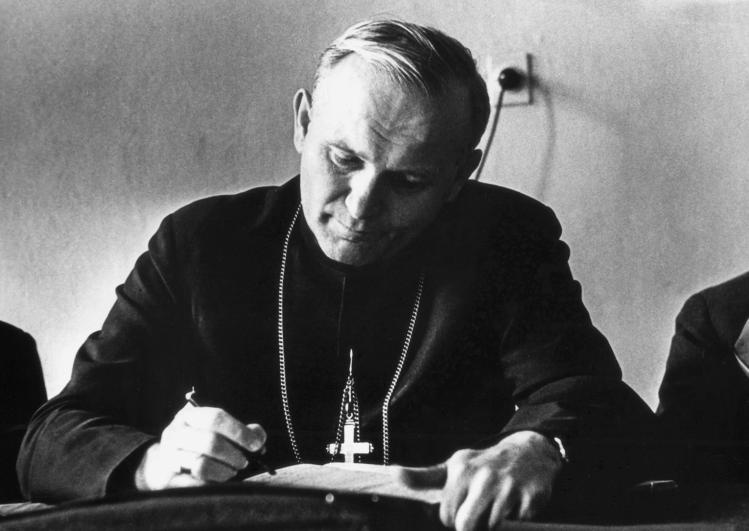
THE ELECTION of John Paul II and his early actions as pope, the unforeseen popularity he had continued to enjoy even after people’s surprise wore off, the difficulty of categorizing the new Pontiff, and the confusion thus created within the tribes and factions of Catholicism—all these go to prove that we are facing one of those events marking a change in our vision of the world. Examining such events can even cause us to give up a few prejudices.
As we observe or try to predict shifts in public opinion, as we see how the warm-hearted, theatrical style of the new Pope touches the crowds, we get a sense that he is filling a role, the need for which must have been both urgent and poorly perceived before his arrival revealed its latent strength: the need for a world spiritual leader. “Expert in humanity”—such was the title that we know Paul VI claimed when addressing the United Nations. But we know, too, that Montini was never able to win recognition for himself in that role; his voice was always heard as one of futile good will, or as speaking from a past that refused to die. Karol Wojtyla, on the other hand, even in the eyes of people who formally dispute some of his positions (notably, in the matters of contraception and abortion), seems to enjoy what was beginning to be dangerously lacking in the papacy: moral authority.
An authoritative voice does not necessarily elicit agreement—indeed, perhaps the opposite, since nothing is more eroding to legitimate authority than weary repetition of the obvious. An authoritative voice speaks to a need, however; it makes us see that a given point of view is important, that a whole area of thought and reflection—now that we have been reminded of it—is indispensable, is a contribution to truth. The papal voice has recovered a little of this impact, at least for the moment; it reaps the benefit from our disappointment with doctrines of efficacy and with ideas that, relying on science and politics, promise to make this a better world. Unlike those secular religions, science and politics, the papal voice at least reminds us that there are questions for which there are no answers—we all encounter them daily—and that we cannot live without taking a stand on certain issues, without making commitments as risky as they are unavoidable. In a word, it reminds us of the importance of the ethical and the spiritual, dimensions that yesterday’s ideologies sought to diminish.
I
FOR A LONG TIME,the Catholic church has been the object of mixed feelings. It has been, by turns, something people have wished to be identified with and something they have wished to be emancipated from; we have seen opinions about the church undergo sharp changes. But the credit generally accorded the present pope cannot be dismissed as merely a burst of traditionalism. When a public personality laying claim to a universal role enjoys a renewal of moral authority that is recognized the world over, it cannot be a matter of chance. Indeed, now that our planet has become one great society of peoples, an immense contrast has developed between the currents of public opinion and the conventions and interests that determine the policies of governments. Since the Cold War and the period of decolonization have ended and international ideals associated with the labor movement have grown feeble, official institutions throughout the world seem to be governed by pure cynicism. As we saw when the question arose of giving support to Soviet dissidents, it has been press campaigns, the actions, of private organizations like the jury for the Nobel Prize in Literature, scientific bodies, and Amnesty International that compensate for the paralysis of governments. Insofar as the United Nations is a system of states, it also has failed totally to supply even the concept of an international order transcending the play of national interest. The spread of dictatorial and totalitarian forms of government, the countless muddled conferences on development, the fiasco that ensued when UNESCO decided to meddle in the international exchange of news—all these things demonstrate that a vast zone of outstanding problems and values exists for which no authority takes responsibility.
Internationally, many obvious political issues, in the absence of statutory authority or juridical justification, have been simply suppressed and denied. Consider: what kind of a world of international relations is it in which the U.N. is unable to acknowledge the great massacre of Armenians in 1895 and 1916 as facts, or in which the Turkish government finds it possible to prevent these massacres’ being commemorated in France? The peoples of the world share in a psychological unity—but not the diplomats.
The peoples of Eastern Europe have become a symbol of the immense segment of humanity whose existence is denied for reasons of state; their governments have largely succeeded in making these peoples invisible, as if they had no reality other than as objects of a purportedly socialist policy. The story of their dissidence, which has taken various forms and been expressed in many actions since 1956, is precisely the story of how they have achieved visibility, an achievement owed in measure to non-governmental internationalism, of which the success of Solzhenitsyn’s books, say, or the election of John Paul II have been successive examples.
From the political point of view, the Pope’s election underlined a paradox. The peoples of Eastern Europe are almost nonexistent in terms of power; within the foreseeable future, they have no chance of regaining their sovereignty; they confront a world order that is based on the denial of their freedom of self-determination (and all the world finds this very natural: we call it détente). Yet it is from these peoples who have been crushed by history that Western Europeans have learned some political lessons. Their experience, their resistance, has guided us; thanks to them, we know that the collective appropriation of the means of production can be a cruel joke, that problems of governmental organization have not disappeared, nor will they ever. The peoples of Eastern Europe have shown us what culture can be when it is conscious of its nobility, what the courage of a believer can be, and what the demand for human rights signifies. When repression receives its full recognition through a non-political institution like the papacy, it makes one pause and think about the inadequacies of international structures, their inability to speak up for the most elementary moral needs, and their enslavement to the cynical game of national states.
It is perhaps in Eastern Europe that we see the most striking contrast between what public opinion feels and what governments do. There is to be found the material for internationalism, for a structure that may assume responsibility for human interests that the dialectic of governments ignores. Whether by human genius or divine inspiration, the conclave sensed this opening. By electing a friend of Polish dissidents, international Catholicism put in its rightful place a movement that neither the state nor the labor internationals had been able to recognize. In an unforeseen victory of the old over what believed itself to be the new, the Catholic church made up for the defaults of international organizations that are corrupt or entangled in the trappings of lay officialdom.
If one considers the election of John Paul II from within the church, what is significant is not that a non-Italian has been installed in the Vatican but that this man was elected because of what the church in Poland has recently been able to do against totalitarianism. For a thousand years, the church has confused institutional unity with the cult of its center, with its Romanita, with uniformity. Amid obvious difficulties, it was able to recover credibility only by acknowledging the importance of a peripheral religious experience. In the normal functioning of a centralized apparatus, it is held that the more closely an individual is integrated with the central bureaucracy, the fewer special bonds that person will have and the more qualified he is, therefore, to represent the institution. The choice of Cardinal Wojtyla constitutes an important departure from this way of thinking. The election of a man from the periphery suggests a different concept of unity. Unity is seen not as being ensured by the disciplinary integration the Curia provides but as being achieved through the exchange and confrontation of differing experiences. It may be no exaggeration to see here an early indication of the liquidation in the church of a centralized apparatus that was established in the time of Gregory VII.
In sum, the Wojtyla election makes one reflect on the idea, indeed on the possibility, of something like a spiritual authority both within the Catholic community and beyond. To those of us who welcome this possibility with hope, it seems that what characterizes this spiritual authority is twofold: it represents what the dominant system of governments ignores; and it is rooted in the particular, the individual. The fact that this authority expresses itself via a logic so opposed to that of state apparatuses, which wish only to perpetuate themselves and to accommodate each other, explains why only periods of crisis give such authority an opportunity.
II
THE POPE seems convinced that the present situation offers Catholicism fresh opportunities, and even the possibility of new relationships with the modern world. He has suggested as much in his first encyclical: “A large part of the human family, in different milieus, has become in my opinion more aware of absolutely needing the church of Christ, its mission, and its service.” And a bit further on: “Jesus Christ becomes in a way, newly present, despite all His seeming absences.” One can read here allusions to the recent experience of the Polish church, and to the fact that in the struggle shared by some Polish revisionists with Christians, the former have come to recognize the church as a protection for the people. As a Polish writer noted two years ago, these revisionists have repudiated as potentially totalitarian “the self-sufficing certainty that the supernatural order does not exist.”
The struggles of the Polish church have left deep marks on the Pope. Much of what he has said and done since his election is a natural expression of that experience. But one must not be deceived by the nature of Catholic resistance in Poland. If in the last few years the Polish church has supported and sometimes sparked the fight for human rights and freedoms, historically its strategy has been based on the prior defense of its own domain; on the preservation, through religious rites and education, of a strong and coherent Catholicism. This strategy was personified in Cardinal Wyszynski, and for a long time was criticized by the Polish opposition and even by Catholic intellectuals. One of them wrote ten years ago: “in all that concerns essential political and social problems the Church remains passive…. It is powerful, but except in secondary matters, its power is not used.”
For a long time, the opposition was haunted by the danger in Poland of a”historic compromise”— well before the term was invented—in which the church would retain governance of souls while the government would have complete freedom in its domain. The fact that things have not turned out this way is obviously due in part to the nature of the Communist government, but also in part to the fact that spiritual action concerns man in his wholeness and necessarily has social repercussions.
Those who chide John Paul II for not inveighing against Pinochet the way they think he castigated Gierek are merely displaying their ignorance. They are ascribing to the Polish church a strategy that is not its strategy. There has been no political defiance on the part of the church in Poland but rather the defense and consolidation of its strong points: religious life, family life and, at the most, organizational life. The government was forced to retreat after a slow change in the balance of forces that occurred as Polish society moved progressively toward autonomy. Rather than insist that the Pope pass from this method to that of Camilo Torres, critics would do better to ask themselves whether even politically the Polish method might not in the long run prove to be more efficacious.
The fact that in Poland the struggle for simple existence preceded the struggle for human rights accounts for the Pope’s insistence, both in his encyclical and in the statements he made in Mexico, on the primary necessity of first defending the Catholic identity. To him this means the maintenance of ecclesiastical discipline: “The church today needs Christians prepared to bear clear witness to their Catholic identity…” (this from his sermon in the Cathedral in Mexico City); she needs also priests who are not ashamed to wear the cassock, religious who obey their bishops rather than surrender to the temptation to wield a “parallel ministry,” and theologians who do not abandon themselves to their fantasies:” No one can discuss theology as if that meant no more than offering an expose of his personal ideas.” The same priority accounts for the Pope’s insistence on respect for traditional rules regarding sexual morality, Christian education within the family, as well as his praise for pilgrimages and popular piety.
Such statements have aroused indignant protests on the left: people enduring hunger and torture are being invited to trust in the Holy Virgin… ! The objections are overhasty. The Pope does not deny that one must fight for freedom and justice. It is simply that he squarely poses the question avoided by those who require a “prophetic” word that is at once both fully Christian and fully political. Against the refusal of these partisans to allow any distinction of levels, the Pope maintains that it is necessary to “safeguard the uniqueness of Christian liberation and the energies it is capable of releasing” (Puebla address) and that an action claiming Christianity as its authority must conform to certain special criteria; among them, “the sense of communion first with the bishops, then with the other sectors of the People of God.” In other words, for John Paul II it is a matter of knowing whether the action undertaken has as its point of reference the church or a political ideology. It is a pertinent question. For despite all the speeches about Liberation (unqualified and, with a capital “L”) in actuality people disagree about the meaning of the word, and the desire to unify the religions and the political in a single word eventually blurs the inevitable divergence between practical choices and the values by which one judges them. The result is to absolutize one’s choices or one’s political sentiments. Thus many have liquidated their religious referents while dedicating themselves to a totalitarian form of political conviction.
III
JOHN PAUL II raises questions about liberation theology.(At the same time he takes care not to condemn it and avails himself of the term “liberation” as he construes it.) His questions appear justified. But it also seems to me that he too falls into an undue confidence. He aims to put spiritual authority not only at a certain remove from the political realm but also above and beyond it.
Here the Pope’s thinking seems to me limited by a measure of traditionalism; while at the same time it reflects the special nature of the Polish situation. In Poland in fact, the Catholic church has the dual advantage of being both powerful and separate from power—simultaneously strong and innocent. It expresses, it irrigates, it sustains all that part of Polish life that belongs to what is private, modest, poor. Life, death, love: that which constitutes the whole of existence for the powerless, whose trust the church enjoys—that is its domain, that is its anchorage. In Poland, the church is bound to people’s daily life; at the same time it represents the national identity while remaining free of the preoccupations that accompany the holding of power, and with regard to politics it finds itself in that position of superior legitimacy—the titular patron of what is essential and most profound—of which John Paul II’s encyclical elaborates the theory. To extrapolate and apply this to Latin America is not easy. If there, as in Poland, Catholicism signifies the celebration of life and both protest and consolation in the face of suffering and injustice, it is also and at the same time the official religion and the guarantor of social order. John Paul II seems impervious to political criticism of the church (in what was socially the most militant speech has made in Mexico, in Oaxaca, the Pope offered a purely idyllic version of the evangelizing of the Indians in Latin America); and yet this criticism cannot be avoided in Latin America. Certainly, Christian devotion can be linked to the the struggle for justice there, but that justice cannot be achieved without conflicts and ruptures within the body of the Christian community itself.
The experience of social Christianity and then of Catholic Action in Europe illustrates very well the difficulties that a committed Christianity produces in Christian lands. Either much of what it tries to achieve rests upon Politico-religious amalgams that cover social compromise within the Christian milieu, or the commitment leads on an open road to disillusionment, factionalism and naive hyperpoliticization when divisions among Christians finally explode. Phenomena like the wild plunge into Marxism by certain activists are then the counterpart of the earlier claim of clergy and Christians to be self-sufficient, the possessors of a perfect language, of an unalterable truth.
If the Christians in Poland were to find themselves faced with the prospect of exercising power, the church would lose its innocence, it would be fragmented, and the language of John Paul II would be less serene.
IV
FINALLY, the spirituality in which John Paul II strongly believes has, in his view, no mode of existence other than the communal: it is manifest in the revealed truths that are handed down by the hierarchy and that govern the life of Christians. It reflects a situation such as peasants in Western Europe knew not so long ago, in which government is extraneous to life. The film of [Ermano] Olmi—The Tree of Wooden Clogs—has recalled for us this world, in which life was like a ritual. Secularization shattered this once unchanging order; it introduced not only change but especially the possibility of choice, with all its attendant anxieties. The pact with immutable poverty was broken.
The spirituality that some Westerners are rediscovering, now that the religions of science, progress, and revolution have failed, is almost at the opposite pole of that traditional spirituality: it is allied to personal self-questioning, a sense of responsibility, the courage to risk, to venture. Memory of the past and communal membership can no longer serve as more than points of reference and interrogation, not as a rule defined unambiguously.
The West—and till now only the West—is experiencing the phenomenon of a secularized society. (The “socialist” systems function with an ideology that merely equals religion minus transcendance.) The secularized society implies democracy, in that it leaves to each man the choice of his reasons for living and calls values constantly into question. In a secularized society, the bond is not an inventory of recognized principles, a consensus, nor is it custom or ideology; ultimately, the social bond is found in the debate itself—in the fact that things are discussed—and in the institutions that allow this to be so. In such conditions, a faith that rests on repetition, a faith that always knows in advance, can only become marginal. What Western man feels most deeply is the gravity and uncertain nature of choice. He will go to the merchants dealing in absolutes in order to be delivered of this burden of choice, but in the end the spiritual experiment he is conducting is to be engaged beyond what he knows, to live with the unknown and to love it. In these circumstances, religious traditions are not solemn, definitive answers but rather lines of experience, intercommunicating choices, fraternities of freedoms.
The modern West does not readily tolerate ecclesiastical interventionism; it thinks that every man should be able to devise his own laws. According to the Gospel, however, beyond the law that has been laid down there is more than a cynical relativism: a presence, an exigency, a utopia may resound; a God can accompany our freedom, can make us understand that it is not pointless. Perhaps what is expected of a spiritual authority on our side of the world is that it accompany us, break our solitude—keep us company and make us communicate. Such a spiritual authority would not speak in the name of a truth that we want to be both immutable and incorporated in an organization; assuming that it is both contingent and relative, among us it would be the commemoration of the saints and the prophets.
THE POPE’S task seems impossible. How is he to be an authority for those who demand firm guideposts because they are engaged in a mass spiritual resistance, or (in Latin America) because they are undertaking a work of popular consciousness-raising, and also be an authority for Westerners who reject any authoritarian form of control? Yet one has the feeling that John Paul II has squared this circle by spontaneously assuming the ambiguity of his position, by reaffirming in classical fashion his authority in matters of dogma and morality, but couching his statements in an altogether new and relatively undogmatic form, by speaking in the first person singular, by repudiating a tone of timorous caution, by trying to center his discourse on convictions that for him have both force and radiance, by taking off quite simply from what he believes and what he has experienced rather than from what he thinks he should say. This appealing and perhaps fecund ambiguity (notably in the encyclical) repeats the ambiguity of his election itself, in which the conclave was able to regenerate Roman centrality only by choosing a pope from the outside. This is a passionately interesting story, and one that is not to be written in advance. It involves not only the future of Catholicism but also the spiritual meeting between East and West that Solzhenitsyn, since being expelled from Russia, works unceasingly to demonstrate is impossible.