The real ones could not be displayed: tiny
muscles would contort out of all likeness
just as alcohol would ruin the colours.
But there was a demand
for the miraculous things of the deep,
when, for a generation,
aquariums did the work of ikons and crucifixes.
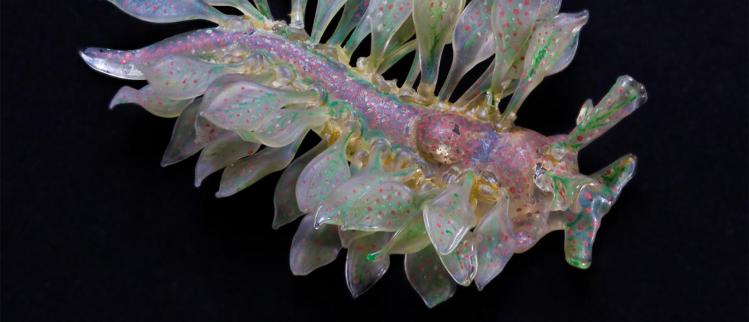
Father and son, artisans in Dresden,
fashioned out of glass, wire,
glue, powders, pigment,
what could not last in the air:
radiolaria, sea-slugs, anemones,
octopi, siphonophores, squid;
they stand as stalks or polyps,
thin tentacles akimbo, orifices open
in perpetual and innocent predation.
*
Among the triumphs of taxidermy,
a pike with the fish that choked it still in its gullet.
I am twenty-five or six,
and this is the Pitt Rivers
on an afternoon that is all misgivings
and the encroachments of doubt,
a sense that believing may be a child’s game.
I am surrounded by the loot of empire:
war canoes and wooden masks,
cabinets of toiletries and hair,
shrunken human heads on strings.
My daughter in her stroller wakes,
so I steer away from what she might remember,
and we come upon the invertebrates.
At first, I think them made of flesh,
learning afterwards they are artifice
indistinguishable from what lives.
I can hardly believe the world turns up
such beauty, so commonly.
It is enough.
*
Overtaken mid-Atlantic by a gnawing past,
I am sleep-deprived
and defenseless as I drill down into a poem
that leads where I do not want to go.
There she is at table in the nursing home,
her old disorder muted
and her misremembering grown entire.
I mean it to be compassionate,
to enact the customary kindness,
but in the spaces between lines
and at nerve endings the time zones have exposed
I see the long trick—
my own life drawing from affect’s empty well,
learning to bear cruelty or indifference
while telling the story of love.
And for all this I arraign God.
*
Stone falling away in sheets
from a coastline eaten by tides and winds—
something of the mind falls and something is exposed.
It is like that through three hours of rail to Manchester,
and then the night of churn and half sleep
in a hotel bed in Princess Street.
I cling in closing waters to what I was,
then wake with only a shred of heart restored
in a city where I am supposed to read my poems.
That grey morning, I step into Holy Name,
where, under terracotta and limestone,
Hopkins once said his masses,
and, in later years, my friends
Levi and Hebblethwaite said theirs.
I’m hoping for reassurance of the shape of things,
a glimpse of my old allegiances,
but find at best an outline here
such as my finger might draw in dust.
*
Perseus, while he washed,
laid Medusa’s head on seaweed,
which her dripping blood turned to coral—
the story is Ovid’s, among his Metamorphoses,
those changes I read of long ago and forgot,
only to see them now recounted on a red banner
at the Manchester Museum.
Tired as I am, I am here as a courtesy
to a friend whose wife curated the show
and called it “Something Rich and Strange.”
Some pieces seem shaped as naked shrubs,
some as cones or horns or mushrooms,
some with the convolutions of a brain,
and beside them the products of art,
the coral beads and hairpins,
a household shrine from Sicily,
a brooch worn by Gertrude Stein,
and, after thirty years, the eye falls
with a start of recognition on the Dresden glass,
wires, pigments, arrested transformations,
the plumose or frilled white anemone,
the sea cucumber, the nudibranch,
the octopus and cuttlefish,
tiny figures horizontal or upright,
like vases, like discs, like nothing else in the world.