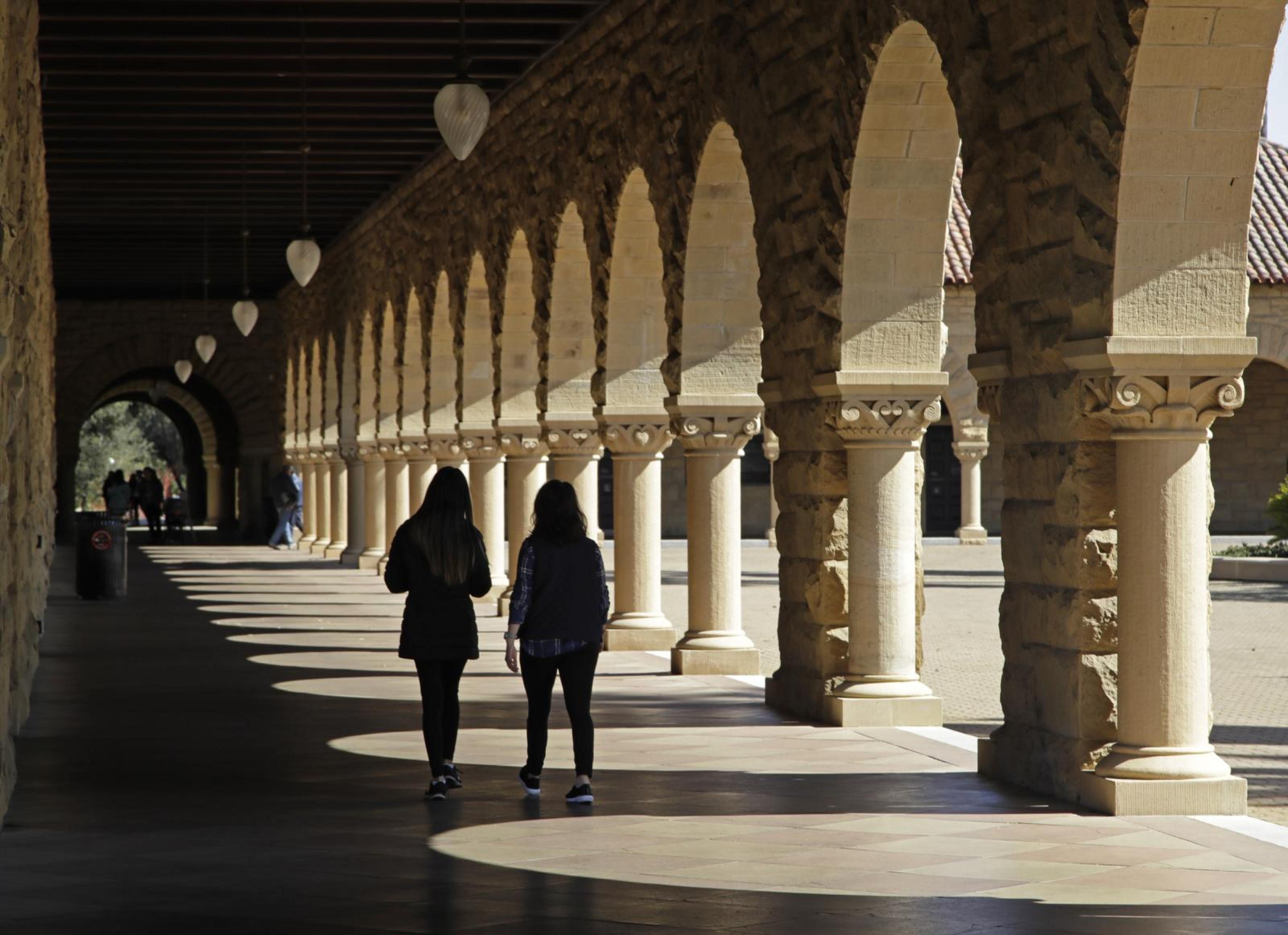
How to Rule the World tells three stories—one about youth, one about scientific deceit, and one about the seductions of Mammon. The stories rub up against each other, the result being a constant sense of commotion, energy, and youthful ambition set loose. The setting of the three stories, Stanford University, is now, as everyone knows, the epicenter of a world of money, power, and prestige. With its ever-expanding endowment, its immense campus, its research labs, and its intimate connection with the leading companies of Silicon Valley, it has become both the creator of wealth for others and a radiant symbol of such wealth.
This was the heady and frenetic world into which Theo Baker plunged in 2022. He was not ready for college; no first-year student ever is. He did what all first-year students do: he met his roommate, encountered “brilliant” fellow students from all over the world, bought a bicycle, worried that he was an imposter who had been mistakenly admitted to one of the most exclusive colleges in the country, broke off his relationship with his high-school sweetheart, got drunk, lost his virginity, and slept through a good number of his classes. This is the least interesting of the book’s three stories because it is the most familiar. Every first-year student believes his or her travails to be unique and uniquely embarrassing. But Baker behaved as first-year students have been behaving for generations.
What was unique to him was not that he slept through his classes, but the reason he was so tired in the first place. Baker had come upon a story, or fragments of a story, and had written it up for the student newspaper, The Stanford Daily. It had to do with a tip from a Stanford alumnus about the university’s president, Marc Tessier-Lavigne. There were, it seemed, disturbing “irregularities” in some of Tessier-Lavigne’s published academic research—for instance, two identical images in one of his scientific papers had been presented as if they were distinctly different.
The story changed Baker’s life. For the next seven months, that scientific paper and others with more “irregularities” became an obsession for Baker. He slept through classes because most of his waking hours were spent in pursuit of MTL (as Tessier-Lavigne was known on campus). A detailed account of Baker’s investigative reporting takes up the bulk of this book, in which the author presents himself as a kind of collegiate version of the relentless Jules Maigret of Georges Simenon’s mystery novels.
After Stanford’s previous president, John Hennessy, announced his retirement in 2016, no candidate for the position could have had credentials that appeared stronger than Tessier-Lavigne’s: a Rhodes Scholar from Canada, a successful president of Rockefeller University for five years, a distinguished professor of neuroscience, and the chief scientific officer at Genentech. His modest, very Canadian manner only seemed to underscore his superiority. Steadily correct in appearance, cautious and exact in speech, Tessier-Lavigne endeared himself to few but won the admiration of many.
As Baker tried to find out as much as he could about MTL, he was taken aside by a senior Stanford official who warned him to be “extremely careful”; another official cautioned him that “they’re likely to pursue you aggressively.” As Baker proceeded with his reporting, that aggressive response took two forms: silence and threats. Despite repeated requests, he was never allowed to interview the president. Nor would any of the university’s trustees (all wealthy people from the business world) agree to speak with Baker. Only the university’s lawyers reached out to him—to threaten him with litigation.
Such pressure only intensified Baker’s zeal to amass the kind of evidence needed to persuade even those who were most protective of Tessier-Lavigne’s reputation. When Baker’s story eventually gained national attention, the trustees conducted their own investigation and concluded that while Tessier-Lavigne “did not personally engage in research misconduct” or “have actual knowledge of any manipulation of research data,” he had “failed to decisively and forthrightly correct mistakes in the scientific record.” Tessier-Lavigne resigned.
Baker’s account of the whole episode is entertaining and dramatic, but it is not the most disturbing of the three stories that make up this book. It is his third story—about the tech industry preying on Stanford students—that will prove more difficult for the university to explain and defend than the conduct of its former president. Baker learned that some of his brightest classmates were being pursued and entertained by a world of power, prestige, and money that operated freely within the precincts of Stanford but beyond its control. Talent scouts from this world were in constant search of the most gifted young men and women among a very gifted student body. Who among those top students would develop the next profitable tech startup? Who among them would become “rulers of the world”? Finding and courting—not to say capturing—such students was a top priority for some people with very deep pockets. As Baker describes the seduction, “Whole firms have been started with the aim of recruiting and funding Stanford students—the younger the better. Some firms explicitly ask only for freshmen and sophomores. ‘Our bread and butter is young students,’ a VC explained to me once while promising a small group of Stanford freshmen and sophomores that if we ever had ideas, their firm would help us out.”
What undergraduate student could easily spurn the heady excitement offered by such agents of Silicon Valley? What could the university itself offer that would be more alluring? Stanford had already become, in the minds of thousands of high-school students, the most desirable college precisely because of its strength in computer science and related fields. They rightly regarded it as a gateway to lucrative careers in Big Tech. But apart from credentials and networking opportunities, what kind of education is Stanford still offering its undergraduates? And what is it still demanding of them? At the end of his book, Baker points to the conflict over the university’s mission: “Is this a place to learn or a place to get rich?” So long as it is not just a business school, what degree of cultural literacy, historical knowledge, ethical reflection, and familiarity with the natural sciences should a student of Stanford possess upon graduation? Those are questions that Baker (who apparently found little of interest in the ordinary Stanford curriculum) cannot answer. Only Stanford can.
If it cannot put forward and defend a compelling mission beyond helping its students become tech billionaires, it will leave itself open to those who would treat its students only as potential assets, as talent to be monetized as quickly as possible. That pressing danger is revealed in the most interesting pages of this most remarkable and telling book.
How to Rule the World
An Education in Power at Stanford University
Theo Baker
Penguin Press
$32 | 336 pp.
Editor’s Note: Since this review was first published, it has been lightly revised to underscore the fact that, while an independent review commissioned by Stanford’s board of trustees found serious flaws in several studies Marc Tessier-Lavigne supervised, it found no evidence that he had committed any fraud or malfeasance.
We welcome your comments about this article. Please send your response to [email protected].