It wouldn’t be right, by Armida’s logic, to drive through Tucson without playing Canciones de Mi Padre, Linda Ronstadt’s best-selling Spanish-language album. Driving strictly five miles below the speed limit through colorfully painted, half-dilapidated, half-gentrified barrios of Ronstadt’s hometown, my grandmother is imparting some exaggerated small-town gossip. Admittedly, I’m eating it up.
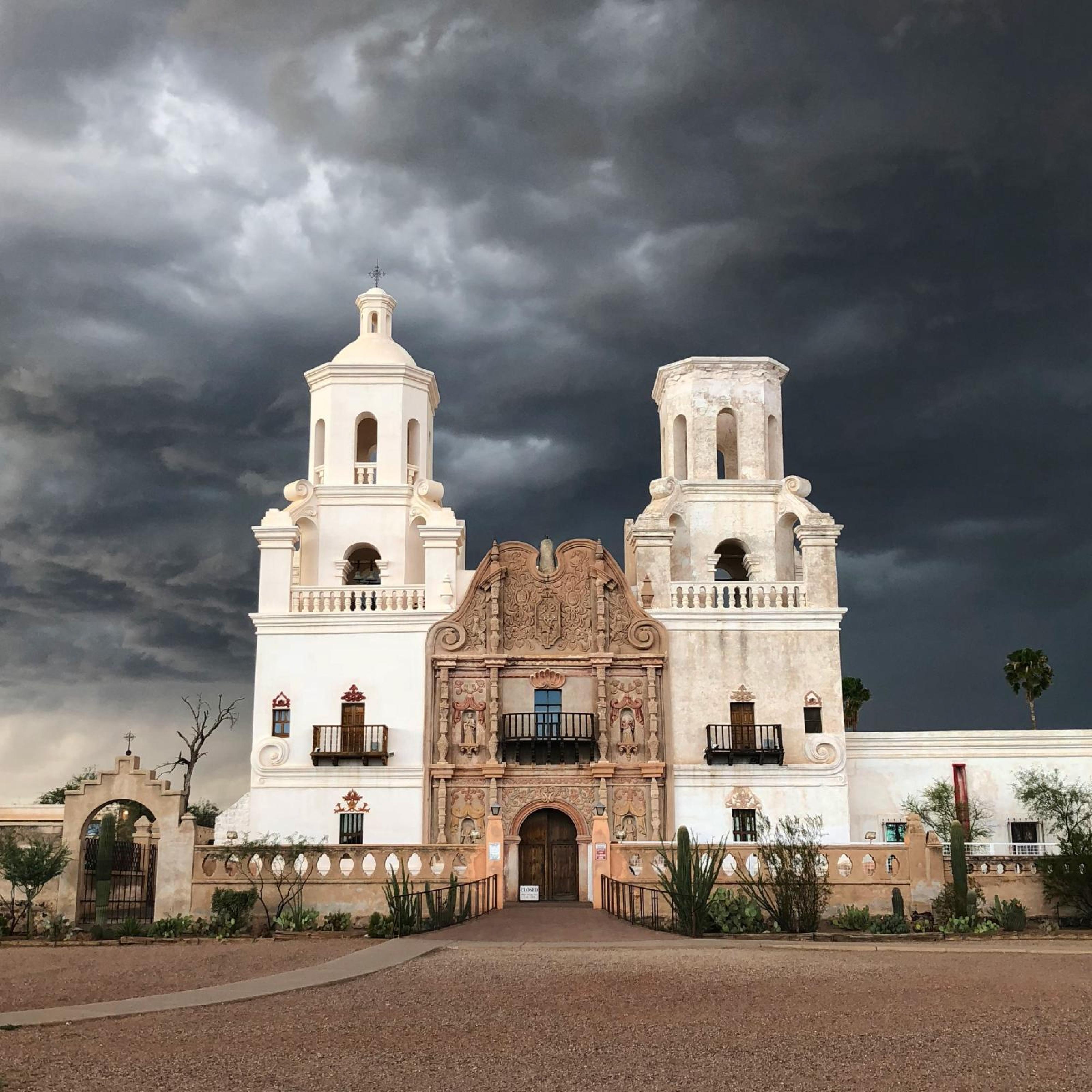
We make this pilgrimage every few years, driving two hours south to Tucson from where we live. (Other drivers only need an hour.) Armida, just four-foot-ten, lifts herself to squint over the wheel at our destination, San Xavier del Bac Mission. She can strike fear in some hearts, but she’s softly crooning in her childhood language as Ronstadt’s last track fades out: “al amo a hacer lo mismo que tú.” It’s a Mexican migrant laborer’s lament, describing the experience of Armida’s husband—my grandfather. “Sun that you so evenly distribute your light, you should teach my master to do the same as you.”
That lethal Sonoran sun beats down on the white adobe church: classically mission, yet Old World for our Wild West, with imposing bell towers and stucco arches. The 1797 edifice dwarfs the hut that Padre Kino, the famed Jesuit missionary, first erected in 1692 at this O’odham (pronounced awe-awe-thumb) village, Wa:k. Hispanicizing it ‘Bac’ and honoring St. Francis Xavier, Jesuit missionary to Japan, Kino christened the hut’s mission “San Xavier del Bac.”
Time magazine’s “Is God Dead?” cover story scandalized readers when published during Holy Week sixty years ago. I doubt a copy reached this mission. But to the crowd shuffling into this year’s Holy Thursday Mass—a mix of O’odham for whom San Xavier is their parish church, miscellaneous desert people, Armida and me—it wouldn’t have come as a surprise. God had of course been dead. The O’odham God died when O’odham became “Papago.” That Creator was replaced by the Jesuits’ God. The cultural disruption that Time’s John Elson described in “Toward a Hidden God” has long been known here.
Elson investigated God’s disappearance amid the social upheavals of atheism, the Tonkin Resolution, sex, drugs, and rock-and-roll. But those are dwarfed by the colonialist trials endured by tribes populating countless missions like this. Now, not even Rome attempts to downplay the tragedy of colonial violence against natives that forced many of them to the faith.
Yet it is O’odham women, even older than septuagenarian Armida, at this Mass, suffering with hunched backs as they stand for the entirety of the Passion Gospel. “Augusto,” Armida whispers, describing the wrinkled, sun-worn faces visible behind sheer black veils.
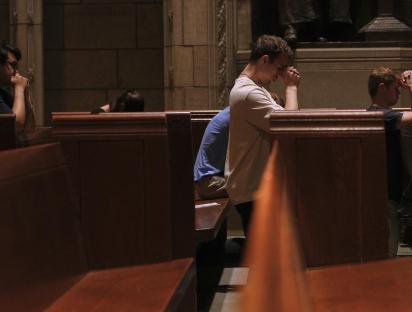
Water rushes over the feet of a dozen locals as the priest reenacts Jesus’s show of humility at the Last Supper. The washing seems particularly apt this Holy Week—sixty years after “Is God Dead?”—as The New York Times, The Washington Post, and The Atlantic are all reporting a flood of Catholic converts among my fellow Gen Z-ers.
Commanding the church is the altarpieces’ paramount Catholic flair. We’re often deprived of these relics of Old World Catholicism. My generation has come up with Amazon, Temu, and mass-produced cheap extravagance. In the same way that antique stores and thrift shops appeal to us with authenticity and beauty meant to last, we’re drawn to a religion that for millennia has used earthly beauty to order senses to the divine.
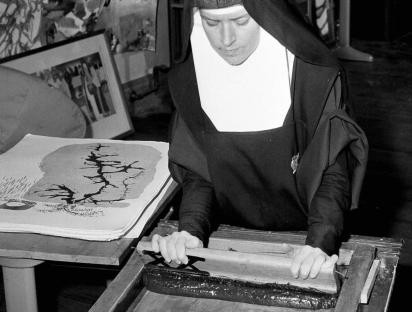
After Mass, I wander the adobe cloisters, peering into classrooms used for centuries of catechism. Priests from far away teaching fire and brimstone to children who lived in the crucible of Sonoran fire. It’s hard not to wonder what else those children might have been subjected to, the kinds of crimes that every Catholic, in one way or another, has been forced to reckon with.
In every defiled rectory and every Catholic turned away by scorning catechists, God has died. America’s favorite monk, Thomas Merton, regarded God as dying “again and again in the individuals who were made to share the joy and freedom of His grace, and who deny him.” The Franciscan friar leading San Xavier del Bac reminded his congregants of Good Friday observances: tomorrow God will die, only to be crucified every day in the interior of hearts.
It’s true that my generation grew up with a dying God, navigating post-9/11 political polarization and the disembodiedness of the digital ether. We saw a decline in the kind of religious fervor seen at this mission, but that wasn’t the crucifixion sounding the loudest death knell on the mission bell. Above all, my generation has borne witness to a decline of the most important faith: faith in one another. Though Pew recently noted that Christianity is no longer on the decline in the United States, it also reported that the United States is the only country among twenty-five surveyed where most citizens don’t think their fellow countrymen are “good people.”
Perhaps with the apparent rise of the religious faithful among my generation there will also come an increase in our faith in one another, as our God preached at the Last Supper. Sixty years after Elson surveyed a world with a dying God, I surveyed a Church populated not just by rheumatic elders, but by twenty-somethings like me. Our God works in cycles, as we desert people know from our suffering. Unrelenting as our sun is, it brings growth while evenly distributing its light, as Linda Ronstadt crooned.
Genuflecting to the bloodied crucifix before I leave the mission, I note how morbidly it represents the strange Catholic comfort that could explain O’odham piety: finding peace despite suffering. Perhaps my generation is on mission to find that peace: God not dead, but resurrected in our hearts.
To read all the contributions to the symposium, click here.
We welcome your comments about this article. Please send your response to [email protected].